
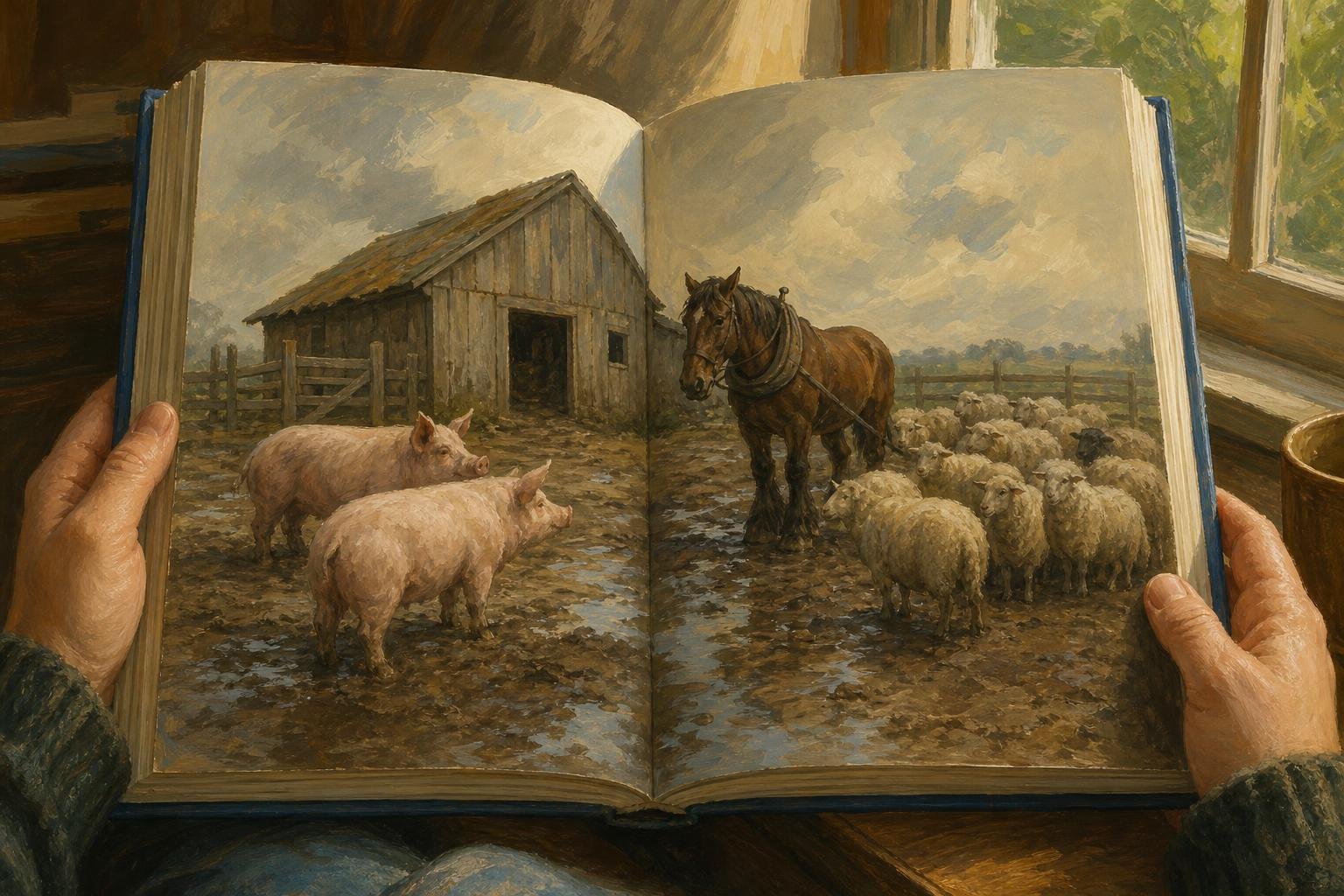

Animal Farm is George Orwell's 1945 fable about the animals of an English farm who drive out their drunken owner, then watch the pigs become masters as cruel as he was. It satirizes the Russian Revolution and Stalin's Soviet Union.
What the Book Is About (No Spoilers)
The book opens at night. Mr. Jones of Manor Farm has gone to bed too drunk to shut the pop-holes, and the animals gather in the big barn. Old Major, a twelve-year-old prize boar, waits on a raised platform under a lantern hanging from a beam.
Major tells them their lives are "miserable, laborious, and short." Man, he says, "is the only creature that consumes without producing." He teaches them a song he half-remembers from his youth, "Beasts of England," and the barn sings it five times over until Jones fires his gun into the dark.
Three nights later Major dies. Months pass. On Midsummer's Eve, a Saturday, Jones gets drunk in town. He returns on Sunday, but the animals remain unfed. That evening they break into the store-shed for food. When Jones and his men whip them, they fight back and drive the humans out. They rename their home Animal Farm.
Orwell published the tale in Britain in August 1945. Its chapters follow Soviet history from the 1917 revolution through the Second World War, and the rest of the story asks what happens to a promise once somebody has to run it.
The Full Plot, Start to Finish
Spoilers follow.
The pigs turn Major's ideas into Animalism and paint seven commandments on the barn wall. That first summer the animals farm the land better than Jones ever did, and the harvest is the biggest the farm has known. When Jones comes back with armed men, Snowball leads the defense at the Battle of the Cowshed.
Snowball wants to build a windmill. Napoleon opposes it, and the argument ends when nine huge dogs burst into the barn and chase Snowball off the farm. Napoleon abolishes the Sunday debates. A few weeks later he announces that the windmill will be built. That evening Squealer claims that Napoleon originated the plans and Snowball stole them.
The pigs move into the farmhouse. Later, a storm knocks the windmill down, and Napoleon blames Snowball. Food grows scarce. Ordered to surrender their eggs for sale, the hens rebel by laying them from the rafters so they smash on the floor. Napoleon stops their rations and orders death for any animal who feeds them. The hens hold out for five days before surrendering; nine hens die. Later, the dogs tear out the throats of animals who confess to treason. Frederick's men eventually blow up the rebuilt windmill with explosives.
Then Boxer's lung gives way. He collapses hauling stone, and the pigs promise to send him to a hospital in town. A van comes for him. Benjamin, who almost never hurries, gallops across the yard braying, because he can read the lettering on its side: "Alfred Simmonds, Horse Slaughterer and Glue Boiler." The animals run after it, and Clover screams at Boxer to get out. His hooves drum against the inside of the van, but the sound grows fainter. He is too weak to kick his way free. Squealer later reports that Boxer died peacefully in hospital, and soon after, a crate of whisky arrives at the farmhouse.
A one-line summary of Animal Farm says the pigs betray the revolution. The chapters show how slowly they do it, and how many of the animals help. By the end the pigs walk on two legs and host human farmers. Napoleon restores the name Manor Farm. A quarrel erupts over their card game, and the animals watching through the window can no longer tell pig from man.
The Characters and Who They Represent
Spoilers continue.
These are allegorical correspondences, not exact biographies: Old Major combines elements of Karl Marx and Vladimir Lenin, while Napoleon represents Joseph Stalin. Napoleon rarely speaks in the early chapters. He takes nine puppies from the farm dogs Jessie and Bluebell after they have been weaned and raises them in a loft, out of sight, until he needs them. Those dogs become his secret police. Snowball talks constantly and is wounded fighting at the Cowshed. Snowball represents Leon Trotsky: after his exile he turns into the farm's all-purpose villain, which is how Trotsky was treated in Stalin's Russia.
Squealer does Napoleon's talking. The other animals say he could turn black into white. Every cut in the rations comes to them as a statistic proving they are better fed than under Jones.
Moses the raven does no work. He tells the animals about Sugarcandy Mountain, an afterlife where clover grows all year, and the pigs let him stay because a promised heaven keeps tired animals quiet. Organized religion has the same use in the book.
Boxer represents the exploited working class, answering every setback with "I will work harder." Clover suspects something is wrong but cannot read well enough to prove it. Benjamin reads perfectly well and says only that donkeys live a long time. Out past the hedges, Frederick and Pilkington, broadly Nazi Germany and the Western powers, deal with Napoleon whenever it pays.
The Seven Commandments and How They Change
Animalism starts with these rules:
- Whatever goes upon two legs is an enemy.
- Whatever goes upon four legs, or has wings, is a friend.
- No animal shall wear clothes.
- No animal shall sleep in a bed.
- No animal shall drink alcohol.
- No animal shall kill any other animal.
- All animals are equal.
The pigs first add qualifications to the rules, then replace all seven with a single commandment. Beds are forbidden only "with sheets," drinking only "to excess," killing only "without cause." After the executions, Clover asks Muriel the goat to read her the Sixth Commandment, and the extra words are there. One night the animals find Squealer lying beside a broken ladder, with a pot of white paint spilled next to him. Only Benjamin understands what he was doing up there, and he says nothing.
Quotes and Symbols Worth Knowing
By the final chapter the barn wall carries a single line: "All animals are equal, but some animals are more equal than others." This single commandment has replaced all seven.
"Beasts of England" is banned before the commandments are replaced. After the executions, Squealer announces Napoleon's decree banning it and explains that the rebellion is complete; in its place the animals get "Animal Farm, Animal Farm, / Never through me shalt thou come to harm."
The windmill was supposed to give every stall electric light and hot water. When it is finally finished, it mills corn for sale.
Then the sheep get their new slogan. All through the book they have drowned out debate with "Four legs good, two legs bad." Squealer takes them away for a week. When they come back, the pigs walk out of the farmhouse on their hind legs, Napoleon carrying a whip in his trotter, and before anyone can object the sheep start bleating: "Four legs good, two legs better!"
The Main Themes
The milk goes first. In Chapter II, after the rebellion, five buckets of fresh milk stand in the yard while the animals go out to the harvest, and when they come back the milk is gone. Later the windfall apples are ordered taken to the harness-room for the pigs.
Squealer's explanation shows how the pigs hold on to every privilege after that. The pigs are brainworkers, he says, and science proves milk and apples are necessary to their health. Then comes the real argument: if the pigs fail, Jones will come back. "Surely there is no one among you who wants to see Jones come back?" Nobody does, so nobody objects.
Once fear settles the milk, it can settle the past. Snowball's wound from the Cowshed becomes evidence that he was secretly fighting for Jones. The animals half-remember otherwise, but Squealer's claims undermine their confidence in their own memories.
Literacy is unequal, not restricted to the pigs. Snowball organizes reading classes; Muriel, Benjamin and the dogs can read, while Boxer struggles to get beyond D. Among the themes of Animal Farm, unequal education matters because it leaves many animals dependent on others to check the rules. The pigs exploit that dependence by changing the commandments, while readers such as Benjamin fail to challenge them.
Who Should Read It, and Which Edition
Animal Farm is short and its language plain, so it suits readers who want a political classic they can finish in an evening, including readers who already know Nineteen Eighty-Four. Anyone expecting a gentle animal story should know about the executions and the knacker's van first.
Getting the book printed was its own fight. Jonathan Cape turned it down after an official at the Ministry of Information advised against it, and Secker & Warburg finally published it. Orwell wrote a preface, "The Freedom of the Press," attacking the way the British press censored itself rather than criticize the Soviet ally. It did not appear in the first edition. It stayed out of print until 1972, when The Times Literary Supplement published it. The preface carries one of Orwell's most quoted lines: "If liberty means anything at all, it means the right to tell people what they do not want to hear."
For an edition containing that preface, look for Harcourt Brace's 1995 illustrated Animal Farm, with artwork by Ralph Steadman (ISBN 9780151002177). It also includes Orwell's preface to the 1947 Ukrainian edition. Ask your library to locate or request this edition by publisher, illustrator and ISBN.
Key Takeaways
- Hunger brings the animals into the store-shed, where food is available. The rebellion erupts when Jones and his men try to drive them out with whips.
- The hens are the first to rebel against Napoleon. Ordered to give up their eggs for sale, they lay them from the rafters so the eggs smash, and nine hens die after he cuts off their rations.
- The commandments change one phrase at a time before being replaced by a single commandment. Animals who cannot read must ask others to check the rules against their memories.
Frequently Asked Questions
Why was Animal Farm a controversial book?
It attacked Stalin while Britain and the Soviet Union were wartime allies. Several publishers rejected it, including Faber and Faber, where T.S. Eliot turned it down. The Soviet Union later kept it out for decades.
Is Animal Farm a hard book to read?
No. Short chapters and plain vocabulary make it easy going for teenage readers. The historical parallels take more work, but the Animal Farm plot is clear without them.
What are the seven rules in Animal Farm?
They are the Seven Commandments of Animalism, listed in full in the section above.
How does Animal Farm end?
Spoiler: Napoleon restores the name Manor Farm while entertaining neighboring farmers. When their card game ends in a quarrel, the animals peering inside find that their pig rulers and human guests look alike.
Is Animal Farm a novel or a novella?
It is a novella of ten chapters and roughly 30,000 words. Orwell's subtitle, "A Fairy Story," points to its fable form.
Read the Fable, Recognize the Power
Animal Farm by George Orwell comes down to one lesson: tyranny rarely arrives in one go. It builds through privileges the animals accept and abuses they fail to stop. Five buckets of milk, two words added to a commandment, a van nobody stops: these losses are not all accepted quietly. The hens rebel, and the animals try to rescue Boxer. Read it to ask why their resistance fails.