
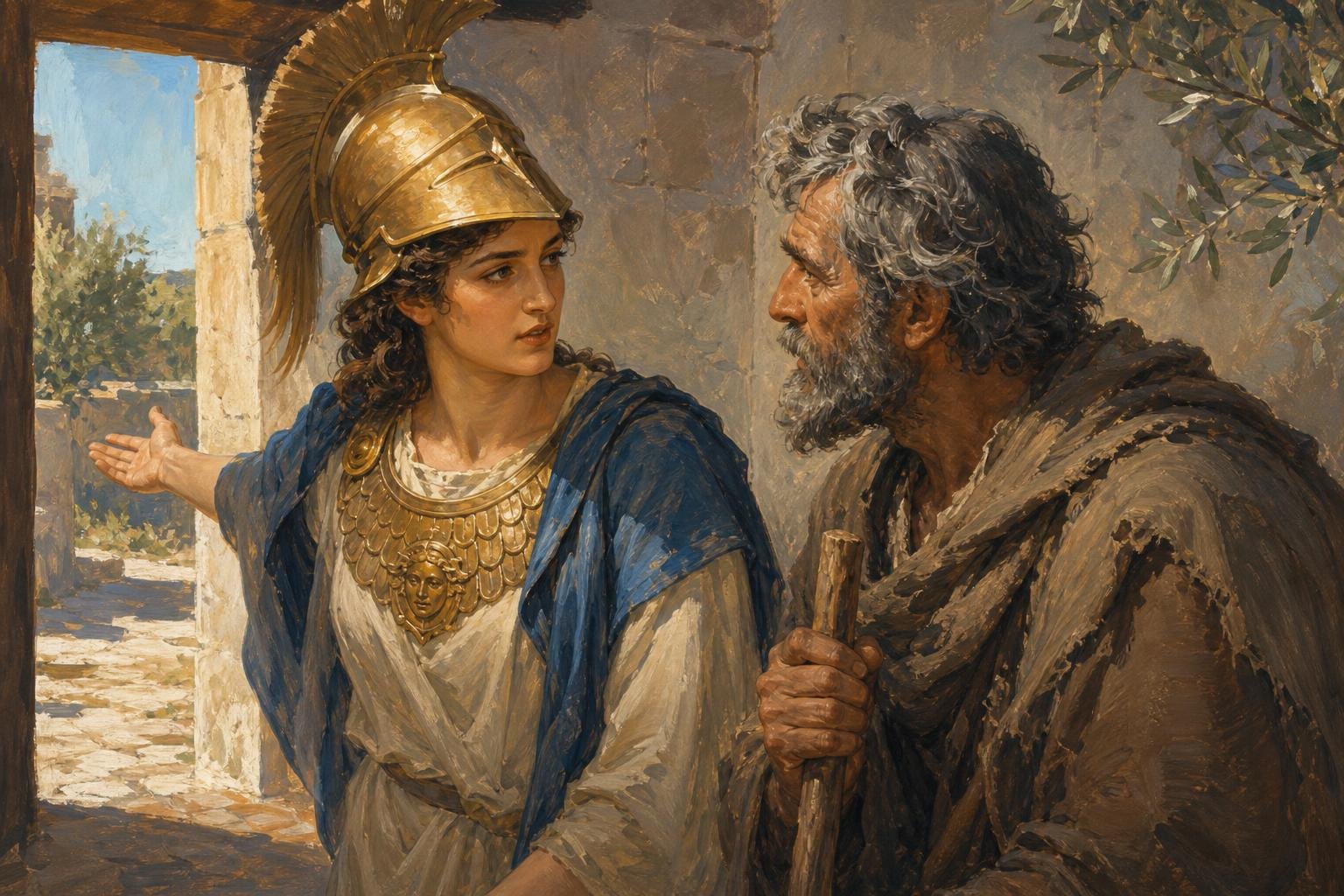

Athena in the Odyssey is Odysseus's divine patron. She argues his case before Zeus, guides his son Telemachus, and gives Odysseus the disguises and timing he needs to retake his home in Ithaca. She directly intervenes against the suitors, making their spear throws ineffective and raising her aegis to panic them, but she will not openly defy Poseidon, the god who keeps him from home.
This article groups her interventions by character and setting: her bond with Odysseus, her advocacy on Olympus, her guidance of Telemachus, her help among the Phaeacians, and her work with Odysseus and Penelope on Ithaca. It closes with the boundaries she keeps. Each section asks two questions. What does Athena do, and what does she leave for the humans to do? That second question is where her character shows.
Why Athena Takes Odysseus's Side
Athena favors Odysseus because they think alike. The clearest statement comes in Book 13. Odysseus wakes on Ithaca and meets Athena disguised as a young shepherd. He initially fails to recognize Ithaca. Even after the disguised Athena tells him where he is, he conceals his identity with a long false story. Athena smiles, takes on her own form, and teases him for his endless schemes. She says that he is the best of mortals in counsel and stories, and she is famous among the gods for the same gifts.
That kinship explains the rest of the poem. Odysseus and Athena share a preference for planning, patience, and well-timed deception. She rewards those qualities in him, and she expects him to use them.
This is patronage between a god and a favored mortal. Nothing in Homer's text makes it a romance.
Pleading His Case on Olympus
Her patronage starts in Book 1, before Odysseus appears at all. He has been away for twenty years: ten fighting at Troy and nearly ten more trying to get home. Calypso holds him on her island. Poseidon, his enemy, is away feasting among the Ethiopians. Athena uses that absence to ask Zeus why Odysseus, who honored the gods with sacrifices, should suffer so long.
Zeus agrees that Odysseus should return home. In Book 5, Athena raises the case again at a second council. Zeus then sends Hermes to tell Calypso to release Odysseus.
Even here Athena acts through persuasion. She does not free Odysseus herself. She gets the ruler of the gods to authorize his release, and Odysseus still has to build his own raft and sail it.
Mentes and Mentor: How She Guides Telemachus
Athena's work with Telemachus begins in Book 1, also while Poseidon is absent. She arrives at the palace on Ithaca disguised as Mentes, a Taphian chief and old guest-friend of Odysseus. The suitors are eating Telemachus's inheritance, and he sits among them daydreaming about his father's return. Mentes tells him to call an assembly, confront the suitors, and sail to Pylos and Sparta for news.
The two disguises do different jobs. Mentes is a visitor from outside who can jolt Telemachus into action. Mentor is an old Ithacan friend whom Odysseus left to watch over his household, and he can travel with Telemachus. In Book 2, Athena takes Mentor's form to arrange the voyage and sail beside him.
Book 3 at Pylos shows Athena encouraging Telemachus to speak for himself. He is too shy to question old Nestor, and Athena, as Mentor, tells him that some words will come from his own judgment and others from a god. He then questions Nestor before Athena leaves in the shape of a bird, revealing her divine identity. His growing responsibility does not end her guidance; she gives him further instructions in Book 15.
Getting Odysseus to the Phaeacians
Odysseus's route from Calypso's island runs through Scheria, home of the Phaeacians. Athena prepares each step. In Book 5, Poseidon wrecks Odysseus's raft. Athena calms the winds and helps him survive two days in the sea until he reaches land, exhausted.
In Book 6 she visits the princess Nausicaa in a dream, in the shape of a girl her own age. She urges Nausicaa to take the family's clothes to the river for washing. That errand puts the princess near the spot where Odysseus lies sleeping.
Book 7 finishes the job. Athena wraps Odysseus in mist so that no Phaeacian challenges him. Disguised as a young girl carrying a water jar, she guides him to King Alcinous's palace and advises him to approach Queen Arete first.
The speeches belong to Odysseus. Athena brings him to the right door, and his words earn the Phaeacians' help.
Disguise and the Return to Ithaca
The Phaeacians carry Odysseus home, and Athena's role then turns to strategy. In Book 13, right after the shepherd scene, she helps him hide the Phaeacian gifts. She plans the suitors' destruction with him and transforms him into a ragged old beggar. The disguise lets him test servants, suitors, and family without warning anyone.
In Book 15 she visits Telemachus in Sparta, urges him home, and warns him about the suitors' ambush. In Book 16 she briefly restores Odysseus's true appearance so father and son can recognize each other and plan together.
In Book 22 she appears as Mentor in the hall during the fight. Her work continues in Book 24, when the suitors' relatives seek revenge. She strengthens Laertes for the clash, then commands an end to the fighting. With Zeus's backing, she restrains Odysseus and establishes peace between the opposing sides. Restoring his household requires not only defeating the suitors but also stopping the cycle of retaliation.
Athena's Help for Penelope
Penelope also receives Athena's care, though Athena never plots with her the way she plots with Odysseus. In Book 4, Penelope learns that Telemachus has sailed secretly and that the suitors plan to kill him. That night Athena sends a dream figure shaped like Penelope's sister Iphthime. The figure tells her that her son has a divine guardian. Penelope wakes comforted.
Athena's influence goes beyond reassurance. In Book 21, she inspires Penelope to set the contest of the bow. Penelope still tests her husband with her own cleverness: in Book 23, Odysseus proves his identity by describing the secret of their bed. Athena then prolongs the night for their reunion. Divine prompting and Penelope's own judgment both shape the outcome.
What Athena Will Not Do
The clearest limit is Poseidon. He remains Odysseus's divine opponent for most of the poem, and Athena does not oppose him face to face. Book 6 says so directly. Odysseus prays to her in her grove on Scheria, and she hears him but does not appear openly. She still respects her father's brother, who stays furious until Odysseus reaches home.
That restraint separates her strategic support from unlimited rescue. She works around Poseidon, in the gaps his absence leaves and in the moments after his storms.
She also limits her help to the humans she favors. In Book 22, as Mentor, she taunts Odysseus to fight harder. Then she holds back full victory to test the strength of Odysseus and Telemachus, and she watches from the rafters in the form of a swallow. Only later does she raise her aegis and break the suitors' nerve. The poem wants the victory to be theirs.
Key Takeaways
- Athena protects Odysseus through advocacy, disguise, and strategic guidance.
- She favors the intelligence and resourcefulness that Odysseus shares with her.
- Her relationship with Odysseus is divine patronage, not an established romance.
- Her mentorship encourages Telemachus to become more independent.
- Her influence links wisdom in conflict with the restoration of order.
Frequently Asked Questions
Who is Athena in the Odyssey?
Athena is the goddess of wisdom and Odysseus's patron in Homer's poem. She persuades Zeus to let Odysseus go home, mentors Telemachus, and helps Odysseus plan his revenge on the suitors. She is the god most active in the story.
Who plays Athena in Nolan's Odyssey?
Zendaya plays Athena in Christopher Nolan's The Odyssey, which opened in U.S. theaters on July 17, 2026.
Was Athena in love with Odysseus?
No. Homer presents her as Odysseus's patron and ally, and she says in Book 13 that she favors him because his cunning matches hers. Nothing in the text suggests a romance.
Was Athena in love with Telemachus?
No. With Telemachus she acts as a mentor, and she usually appears as an older man, either Mentes or Mentor. Her aim is to help him grow into an adult who can act on his own.
How does Athena help Odysseus?
She argues for his release on Olympus, guides him to the Phaeacian palace, and disguises him as a beggar on Ithaca. She also plans the suitors' defeat with him and intervenes in the fighting.
Does Athena always appear in her divine form?
Rarely. She appears as Mentes, Mentor, a young shepherd, a young girl, Nausicaa's friend, and birds. She drops the disguise at chosen moments, such as with Odysseus in Book 13.
Divine Guidance Meets Human Resourcefulness
The importance of Athena in the Odyssey lies less in the size of her power than in the way she uses it. She advocates for Odysseus before Zeus, helps him hide his identity, and shapes the plan behind his return to power. With Telemachus, her guidance pushes a young man to act instead of waiting. On Scheria she leads Odysseus to the palace door, and in Book 22 she holds back victory until father and son have fought for it. Read together, her interventions show a consistent pattern. She is a protector and a mentor whose direct help works alongside human courage and judgment. In the Odyssey, wisdom wins through planning, recognition, and restraint, and strength alone is never enough.