
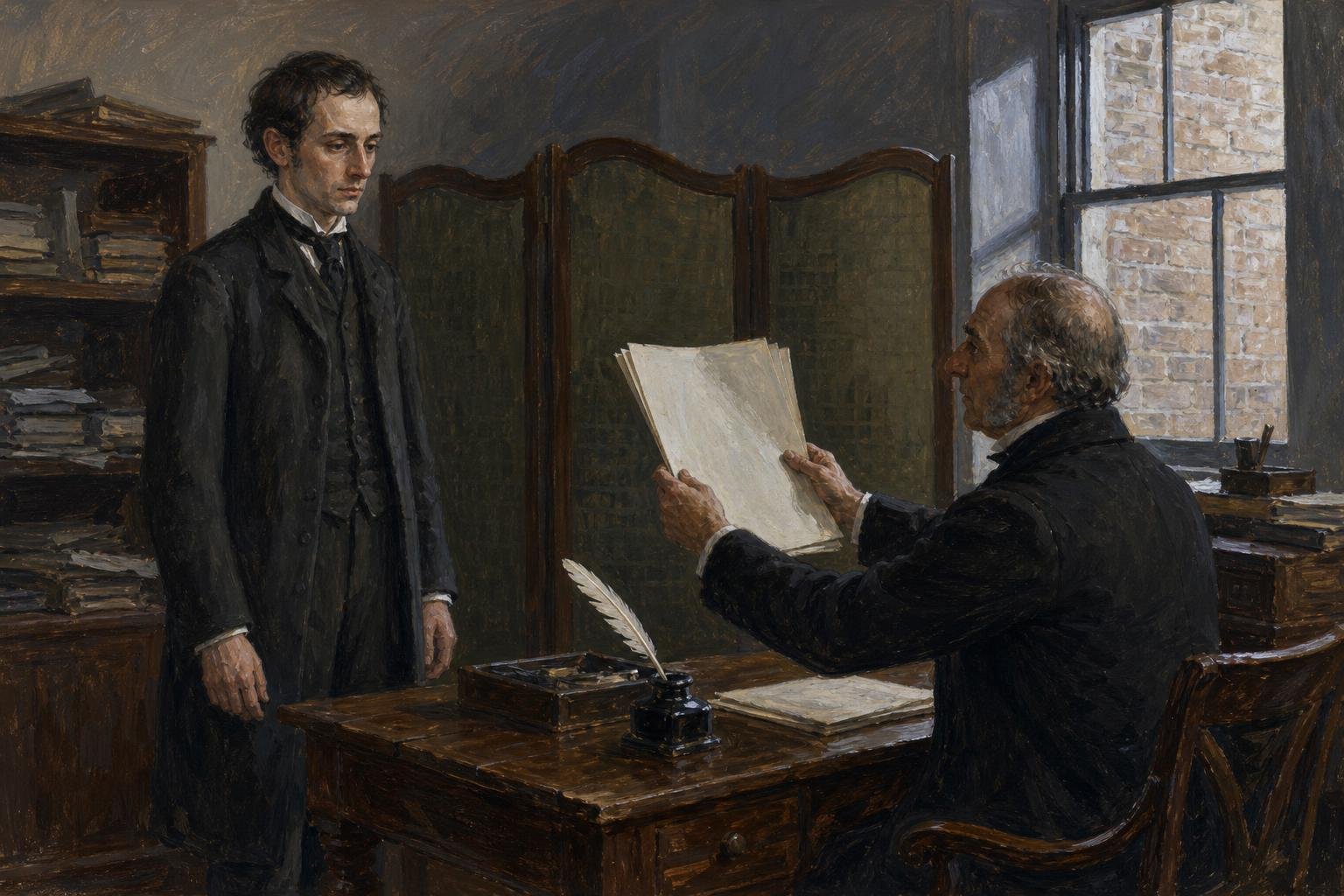

Bartleby the scrivener starts as a tireless legal copyist, then calmly refuses to copy anything at all. In Herman Melville’s story, his employer cannot make him work or leave, and Bartleby eventually dies in prison after refusing food. The unsettling part is how little noise he makes while bringing the lawyer’s orderly life to a halt.
The Lawyer Hires a Copyist
Turkey works best before lunch; Nippers becomes useful afterward. Between their alternating bouts of irritability, the unnamed Wall Street lawyer manages his copying business with help from Ginger Nut, a young errand boy. He likes safety and predictable routines. Bartleby looks like a welcome addition: quiet, industrious, apparently undemanding.
The lawyer puts his new clerk behind a screen near his own desk. Bartleby can hear his employer without remaining in view; his window looks toward a nearby wall. He produces an extraordinary amount of writing. For an employer already juggling two difficult copyists, the arrangement looks almost ideal.
Bartleby Begins to Refuse
Then the lawyer calls Bartleby over to compare a copy with its original. “I would prefer not to,” Bartleby says. The lawyer repeats the request, expecting that his employee has misunderstood. Bartleby gives the same answer.
The lawyer appeals to the other clerks, who readily agree that Bartleby should obey. Their agreement changes nothing. Bartleby stays behind his screen, and the employer who issued the instruction finds himself arguing for something he thought needed no argument.
Soon Bartleby declines errands, too.
The Office Becomes Bartleby’s Home
On a Sunday visit, the lawyer puts his key into the office lock and finds it resisted from within. Bartleby appears in his shirt sleeves and tattered clothes. He prefers not to admit his employer just yet. Perhaps the lawyer could walk around the block until he has finished his affairs?
The lawyer obeys. The reversal is quietly ridiculous: the man who pays for the office waits outside while his clerk controls admission. But discovering that Bartleby lives there changes the joke. This is where he spends his Sundays as well as his working days.
The lawyer feels a sudden fellowship with this solitary man, then recoils from the prospect of an attachment he cannot manage.
After the Sunday discovery, the lawyer questions Bartleby about his past, but he will not explain. The phrase “prefer not to” even begins creeping into his coworkers’ speech. Eventually he stops copying, too. The lawyer suspects that working in the poor light has injured his eyesight; Bartleby offers no account of what has happened.
Business and reputation press back into the lawyer’s thoughts. He dismisses Bartleby with money beyond his wages. Bartleby stays.
The Lawyer Moves and Offers Further Help
Since he cannot remove the clerk, the lawyer removes himself. He packs up his practice and moves to another office, leaving Bartleby behind. An employer has effectively fled his own employee.
The escape does not hold. The new occupants complain, and the lawyer returns to bargain. Would Bartleby work in a store? Travel as someone’s companion? Finally, the lawyer offers his own home as a temporary refuge while they decide what comes next. Each proposal meets another refusal. The lawyer can change the address and invent a different occupation; he cannot get Bartleby to choose one.
Bartleby Dies in Prison
Removed as a vagrant, Bartleby is confined in the Tombs, a New York prison. Its massive masonry encloses a yard where grass grows underfoot. The lawyer visits and pays a man connected with the prison’s food service to give Bartleby meals. Bartleby will not eat.
On a later visit, the lawyer finds him curled against the wall, his head touching the cold stones. He is dead.
Months after Bartleby’s death, the lawyer hears an unverified rumor that he once worked in the Dead Letter Office in Washington, losing his position after a change in administration. The narrator imagines the contents of undeliverable letters: a ring whose intended wearer may already be dead, money arriving too late to relieve someone’s need. Messages meant to sustain life reach no one.
What Bartleby’s Refusal Might Mean
Copying legal documents means reproducing someone else’s words by hand, then checking that reproduction against an original. Behind his screen, facing a wall, Bartleby begins as the perfect worker for this enclosed world. His refusal breaks its governing assumption: that an employee will keep making himself useful. Read as passive resistance, his mild answer is powerful precisely because the lawyer cannot turn it into an ordinary quarrel.
Yet refusal also strips Bartleby of the means to survive. His isolation suggests profound distress, although no diagnosis emerges from the story. The lawyer’s predicament is different: he wants to help without letting another person’s need consume his life. His personal invitation costs more than an extra payment, but even that offer cannot create a connection Bartleby will accept.
Key Takeaways
- The story turns on a central reversal: the employer keeps changing his plans while the clerk stays put.
- The lawyer supplies the account, so Bartleby’s interior life remains inaccessible.
- Polite language gives the refusals their peculiar force and deadpan humor.
- Help can be sincere and still fail to reach its recipient.
Frequently Asked Questions
What Is the Main Point of Bartleby, the Scrivener?
The story asks what people owe someone whose suffering they cannot understand or remedy. Its discomfort comes from making compassion feel necessary without making it effective.
What Is Bartleby’s Famous Line?
Bartleby’s famous line is “I would prefer not to.” He expresses refusal as a preference, leaving his employer struggling to treat it as open defiance.
What Is Bartleby the Scrivener About?
It is about a copyist whose refusals overturn his employer’s orderly office life. As Bartleby stops working but refuses to leave the office, the lawyer struggles to balance compassion with his own needs. The story explores isolation, responsibility, and the limits of helping someone whose motives remain unknown.
What Does a Scrivener Do?
A scrivener copies documents by hand. Checking those copies for errors is part of the office’s shared work, which explains why Bartleby’s first refusal disrupts his coworkers too.
Is Bartleby’s Previous Employment Confirmed or Only Rumored?
His employment at the Dead Letter Office is only rumored. The lawyer hears the report after Bartleby’s death, not from Bartleby himself.
Does the Lawyer Ever Learn Why Bartleby Refuses?
No, the lawyer never learns why Bartleby refuses. His explanations reveal his efforts to understand, not access to Bartleby’s thoughts.
Refusal Leaves the Lawyer Without Answers
His final cry, “Ah, Bartleby! Ah, humanity!” extends his grief beyond one former employee. It does not erase his evasions or make his compassion worthless. Melville leaves both in place. The cost of refusal falls most brutally on Bartleby, while the survivor must live with a responsibility he can neither discharge nor fully explain.