
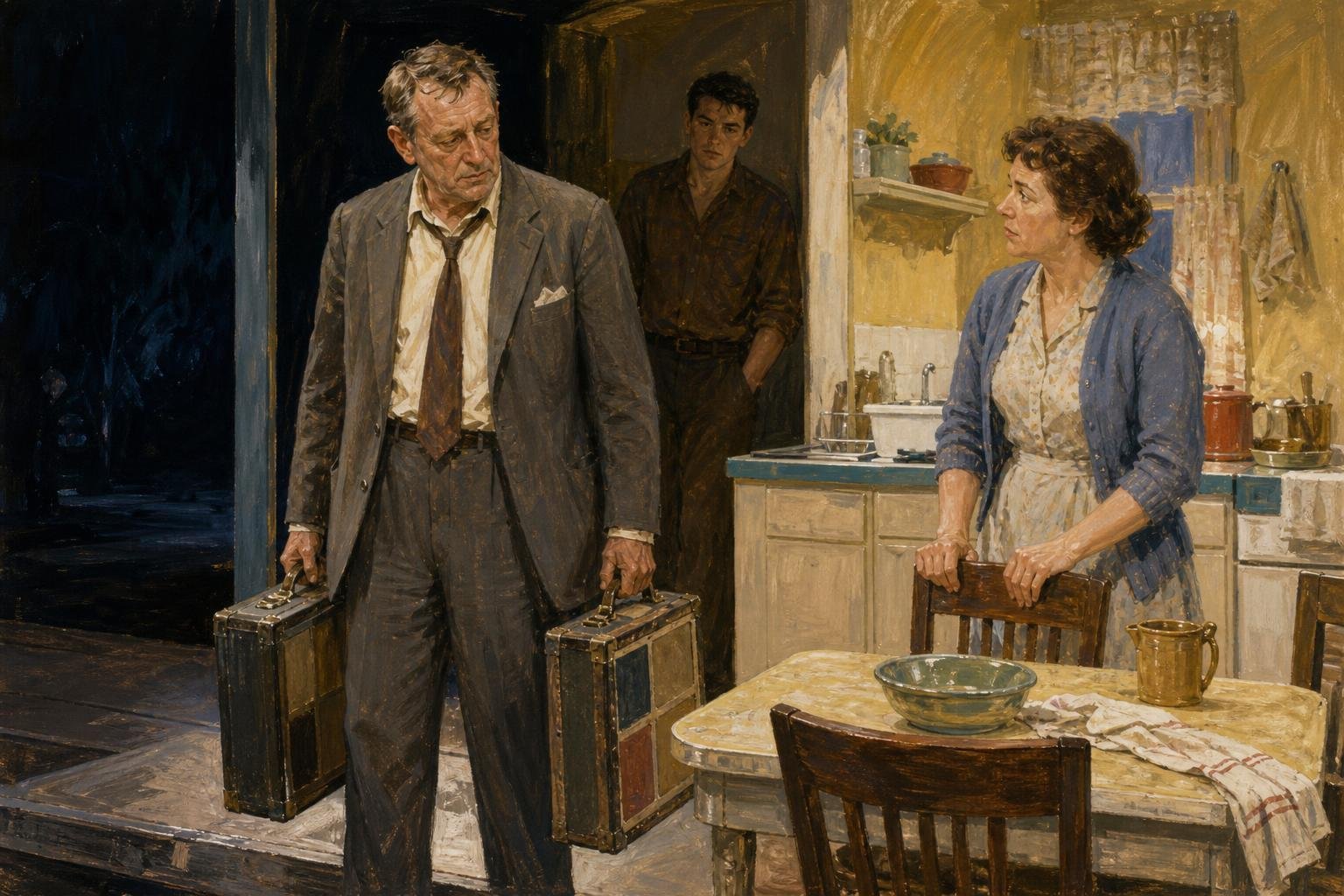

Death of a Salesman follows Willy Loman, an aging Brooklyn salesman, through his final day. Losing his job and confronting his son Biff, he kills himself, hoping insurance money will secure Biff's future. Arthur Miller's play premiered on Broadway in 1949 and won the Pulitzer Prize for Drama.
This summary follows the plot in order, connecting events to Willy's dream, then examines the structure and central questions.
Characters
- Willy Loman: An aging salesman who equates popularity and financial success with personal worth.
- Linda Loman: Willy's protective wife, who recognizes his distress and asks their sons to support him.
- Biff Loman: Their older son, whose discovery of Willy's affair shattered his admiration for his father.
- Happy Loman: Their younger son, who exaggerates his prospects and continues pursuing Willy's ambitions.
- Charley: Willy's practical neighbor, who lends him money and offers him work.
- Bernard: Charley's studious son, who becomes a successful lawyer.
- Ben: Willy's dead brother, an imagined model of wealth and boldness.
- Howard Wagner: Willy's employer, who refuses his request for local work and fires him.
- The Woman: Willy's unnamed partner in the Boston affair that teenage Biff discovers.
Act One: Willy Comes Home Early
Willy returns early from a sales trip after drifting off the road. Linda suggests requesting work in New York. Biff's return home sparks arguments and memories of his youth, when Willy prized personality over Bernard's academic effort.
Linda reveals Willy's commission-only income, borrowing, and suicide attempts. Biff proposes asking former employer Bill Oliver to finance a sporting goods business. Willy's hope revives.
Act Two: Howard and Charley
Howard Wagner refuses Willy's request for local work, saying there are no openings. Willy invokes Dave Singleman, whose popularity and crowded funeral shaped his ambition. Howard then fires him.
At Charley's office, Willy encounters Bernard, now a successful lawyer. Bernard recalls Biff's disturbing return from Boston. Willy refuses Charley's job offer but accepts money for insurance, suggesting he might be worth more dead than alive.
Biff's Failed Meeting and the Boston Secret
Oliver does not recognize Biff, who realizes he exaggerated his former importance. Biff steals Oliver's fountain pen and flees.
At dinner, Willy cannot accept Biff's account. Boston memories intrude, and he retreats to the washroom. The sons leave him at the restaurant before the full Boston hotel scene unfolds: teenage Biff discovered Willy's affair after seeking help over failed math. Disillusioned, Biff abandoned summer school.
Later, finding Willy planting seeds, Biff rejects their shared pretensions and sobs. Willy recognizes his love but misunderstands its meaning.
Willy's Death and the Requiem
Urged on by an imagined Ben, Willy believes insurance money will make Biff successful. He deliberately crashes his car offstage. Whether the policy pays remains unresolved.
Few attend the funeral. Linda has paid off the mortgage; Charley defends Willy's need to dream. Biff rejects his father's ambitions, while Happy commits to pursuing them.
Symbols
- Seeds: Willy's late-night planting suggests his desire to leave something lasting behind when his career and hopes for Biff seem barren.
- Stockings: Linda mends stockings while Willy gives stockings to The Woman. They connect household hardship with his betrayal and guilt.
- The rubber hose: Linda discovers it and recognizes evidence of Willy's suicidal intentions. It makes the danger beneath the family's hopeful plans tangible.
- The fountain pen: Biff's theft exposes the gap between his imagined business importance and reality. Looking at the pen helps him question the future he is pursuing.
Why the Play Moves Between Past and Present
Miller's working title, The Inside of His Head, describes the structure. Memories interrupt the present; lighting, music, and actors crossing wall boundaries mark shifts.
These shifts expose Willy's confusion while delaying the Boston revelation until Act Two. The audience discovers the cause of Biff's estrangement as Willy loses his ability to suppress it.
Themes
- The American Dream: Willy's version promises success through popularity and personality. His career and sparse funeral expose the limits of that belief.
- Self-deception: Willy exaggerates his importance and Biff's prospects. Biff begins to reject their shared illusions after the failed meeting with Oliver.
- Father–son relationships: Biff's love survives his disillusionment, but Willy mistakes that love for proof that Biff will become successful. Happy instead commits to continuing his father's ambitions.
- Memory: The past repeatedly interrupts the present, revealing how Willy's hopes and guilt shape his understanding of his family.
Key Takeaways
- Popularity cannot give Willy lasting security.
- Biff's disillusionment begins with the affair.
- Professional failure deepens an existing crisis.
- Insurance becomes Willy's imagined final sale.
- The brothers leave the grave with opposing ambitions.
Frequently Asked Questions
What is the most famous line from Death of a Salesman?
Linda's "attention must be paid" is among its best-known lines. Her Act One appeal insists that an ordinary man's suffering deserves recognition, regardless of his achievements.
What happens in Act 1 of Death of a Salesman, and what does it show?
Willy returns home, revisits Biff's youth, and embraces the business proposal after Linda reveals his crisis. His contradictory descriptions of Biff as lazy and hardworking expose judgments driven by pride.
What is the main point of Death of a Salesman?
The play challenges measuring human worth through earnings and popularity. Willy cannot accept his family's love as sufficient evidence that his life matters.
Who is the tragic figure in Death of a Salesman?
Willy is the tragic figure, though his family shares the suffering. Miller's 1949 essay "Tragedy and the Common Man" argues that ordinary people can be subjects of tragedy.
Why can't Linda cry at Willy's funeral?
Linda initially cannot cry because Willy's death feels unreal: she imagines him away on another sales trip and keeps expecting his return. She then breaks into sobs as she speaks of the paid-off house. Her repeated "We're free" contrasts financial freedom with his absence.
What is Death of a Salesman about, in short?
An aging salesman destroys himself because he mistakes financial success for personal worth. His final day exposes the distance between his ambitions and his family's needs.
Key Quotes
- Willy, Act One: “Be liked and you will never want.” Willy presents popularity as a guarantee of security.
- Linda, Act One: “attention must be paid” This excerpt from Linda's appeal insists on Willy's dignity regardless of his achievements.
- Willy, Act Two: “I am not a dime a dozen!” Willy resists Biff's attempt to abandon their claims to exceptional importance.
- Biff, Act Two: “Pop, I’m nothing!” Biff rejects inflated expectations, then breaks down in tears; Willy recognizes his love but misreads its meaning.
Willy's Dream and Its Cost
Biff's tears offer Willy something his career never secured: love without a demand for achievement. Willy interprets that moment through his old assumptions, turning affection into another reason to provide money. The tragedy lies in that misreading. He dies trying to earn a place in a family that already loves him.