
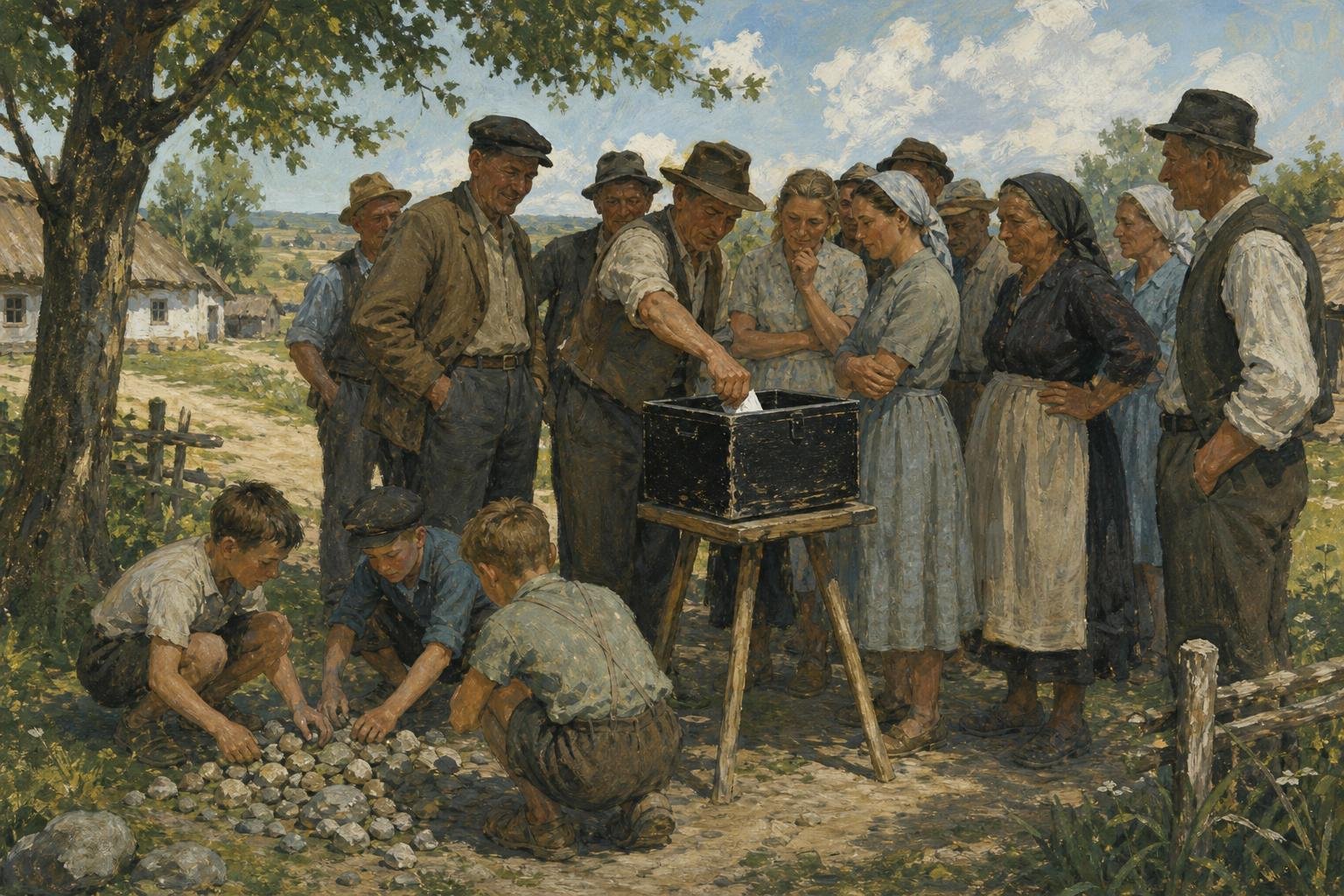

On June 27, the residents of a small village gather for an annual lottery while boys pile up stones nearby. The drawing selects Tessie Hutchinson to be stoned by her neighbors, turning an ordinary summer morning into a public killing. The story follows that gathering through two drawings and Tessie’s final protest; its horror lies in how readily familiar people carry out the result.
How the Village Gathering Begins
The village is unnamed. It should take little enough time for everyone to get home for noon dinner. Children arrive first, newly released from school. Some boys fill their pockets with stones, choosing smooth, round ones; others help build a pile in a corner of the square and guard it against raids.
The adults gather around this preparation without alarm. Men talk about planting and rain, tractors and taxes. Women exchange gossip before joining their husbands. Parents call their children over, sometimes more than once. Attendance belongs to the same ordinary world as farm work and household chores.
That familiarity makes the stones easy to overlook. The men stand away from the pile, and their jokes bring smiles instead of laughter. There is uneasiness here, but nobody explains it. Jackson’s detached third-person narrator stays close to what people say and do, leaving the boys’ careful preparations beside the adults’ small talk.
How the Two Drawings Work
Tessie has arrived late, having forgotten the date while occupied with household work. She jokes with her neighbors and makes her way to her family. Nothing in her entrance suggests that she has come to challenge the lottery. She expects to take her place like everyone else.
Mr. Summers runs the lottery with help from the postmaster, Mr. Graves. His lists distinguish family heads, the households within each family, and each household’s members. Before anyone draws, he checks who will represent the families. Clyde Dunbar has a broken leg, so his wife will draw for him. The Watson boy represents his family. Absence does not remove a family from the drawing.
Then the family representatives come forward for folded slips. They must keep the papers closed until everyone has drawn. Bill Hutchinson gets the marked one. Tessie immediately calls out that Summers did not give her husband enough time to choose. The gathering’s easy conversation gives way to a family’s sudden danger.
She demands that her married daughter Eva and Eva’s husband Don join the family drawing. Summers refuses: married daughters draw with their husbands’ families. Tessie tries to widen the group facing the second draw, but the rules hold her own household in place.
Summers confirms that Bill also represents the family’s only household, so no separate drawing among households is needed. The second drawing is smaller and faster: Bill, Tessie, and their three children, Bill Jr., Nancy, and little Davy. There is a slip for each, with help for Davy because he is too young to manage alone. The papers are opened. Tessie has the black spot. There is no further drawing and no appeal; everyone else now knows they are safe for another year.
What Happens to Tessie Hutchinson
Those rules give way to movement as soon as her marked slip is exposed. Mrs. Delacroix, who chatted with Tessie earlier, picks up a stone so large that she needs both hands. Someone gives little Davy pebbles. Tessie stands with her hands stretched out as the villagers move toward her.
A stone hits the side of her head. She screams, “It isn’t fair, it isn’t right,” and the villagers are upon her. Jackson ends with the attack, not an account of Tessie’s body afterward. The killing is the purpose of the selection, and even her youngest child has been equipped to take part.
Who Keeps the Ritual Going
Old Man Warner gives the lottery its loudest defense. When Mr. Adams says that another village is discussing giving it up, Warner dismisses the idea and repeats the saying, “Lottery in June, corn be heavy soon.” He has participated seventy-seven times. For him, longevity is an argument: the ceremony has lasted through his life, so abandoning it sounds like folly.
Mrs. Adams goes further: some places have already stopped holding lotteries. Abandonment is an existing alternative, not merely a proposal; this village need not keep doing what it has always done. Warner dismisses those examples as trouble rather than explaining why someone must die.
His contempt works alongside quieter forms of pressure. Summers keeps the business moving. Bill tells Tessie to shut up when she protests his selection. No single person has to force the whole village into obedience. The official can follow the schedule because relatives and neighbors help silence the person who interrupts it.
What the Box, Paper, and Stones Show
The black box is shabby and splintered, its black finish faded or worn enough to expose the wood beneath. Yet the villagers resist replacing it. They tolerate its decay more readily than the suggestion of a new box, although other parts of the ceremony have already changed or disappeared. Their loyalty is to selected remnants of the past, not an untouched ritual.
The slips of paper are one such change. Wooden chips once served the purpose, but the growing population made paper more practical because it fit into the box. An inconvenience can be corrected. The killing stays.
The stones need no special maker or keeper. Children can collect them before the ceremony, and adults can take them up afterward. Jackson places the story’s most destructive objects in the least remarkable setting: underfoot, within everyone’s reach. Mrs. Delacroix’s two-handed grip makes their weight harder to dismiss than any general statement about the village’s cruelty.
What the Story Suggests About Fairness
Tessie’s first complaint concerns the time Bill had to choose his slip. By her final scream, she calls the result both unfair and wrong. Between those objections, no neighbor steps forward to stop the punishment. They answer her fear by continuing the process that produced it.
A longer pause at the box would not save Tessie from the possibility of being killed. Nor would including Eva and Don make the punishment defensible. Her proposed changes might give her another chance to escape, but someone would still receive the black spot. That is the limit of arguing only about the draw.
Tessie’s earlier willingness to participate makes her resistance uncomfortable, not worthless. She has accepted a danger that becomes intolerable when it reaches her. That contradiction matters: a person can recognize an injustice late, for selfish reasons, and still be right that it must stop. Her inconsistency does not excuse the people throwing stones.
Key Takeaways
- The village’s relaxed gathering conceals preparations for a killing.
- Family and household membership determine who faces each stage of the draw.
- Tessie’s neighbors become her attackers without ceasing to act like ordinary villagers.
- Warner defends continuity; Summers supplies the organization that keeps it going.
- Changes to the equipment leave the violence untouched.
- A correctly followed rule can still produce an indefensible act.
Frequently Asked Questions
What is the lottery by Shirley Jackson about?
“The Lottery” is about a community that accepts an annual ritual killing as a normal obligation. Before the drawing begins, boys gather the stones that the villagers will use against the selected person.
What happens at the end of The Lottery?
Tessie receives the slip with the black spot in the second drawing. Her neighbors attack her with stones as she protests. Someone even gives her youngest child, Davy, pebbles to join in.
What is the main message in The Lottery?
A central message is that tradition does not make a cruel practice right. Old Man Warner defends the lottery’s long history even after Mrs. Adams says that some places have stopped holding it.
What is the plot twist in The Lottery?
The lottery awards death instead of a desirable prize. The stones the boys collect at the beginning become the weapons the villagers use against Tessie at the end.
Why did Bill tell Tessie to shut up in The Lottery?
Bill tells Tessie to shut up to stop her objection to the first drawing. Tessie has just complained that Summers did not give Bill enough time to choose his paper. Jackson gives no private explanation for his response, so embarrassment or obedience remain possible motives rather than established facts.
Why was The Lottery so controversial?
“The Lottery” provoked angry letters and subscription cancellations after appearing in The New Yorker’s June 26, 1948, issue. Ruth Franklin’s account of the letters notes that most writers were confused rather than angry, with some mistaking the story for a factual report. The story pairs ordinary village conversation about farming and taxes with preparations to stone a neighbor.
A Familiar Ritual Reveals Collective Cruelty
The expectation of getting home for noon dinner gives the ending its terrible normality: the villagers have allowed time for violence within an ordinary day. Jackson’s ending suggests how collective cruelty can become part of ordinary life without prompting a community to question it.