
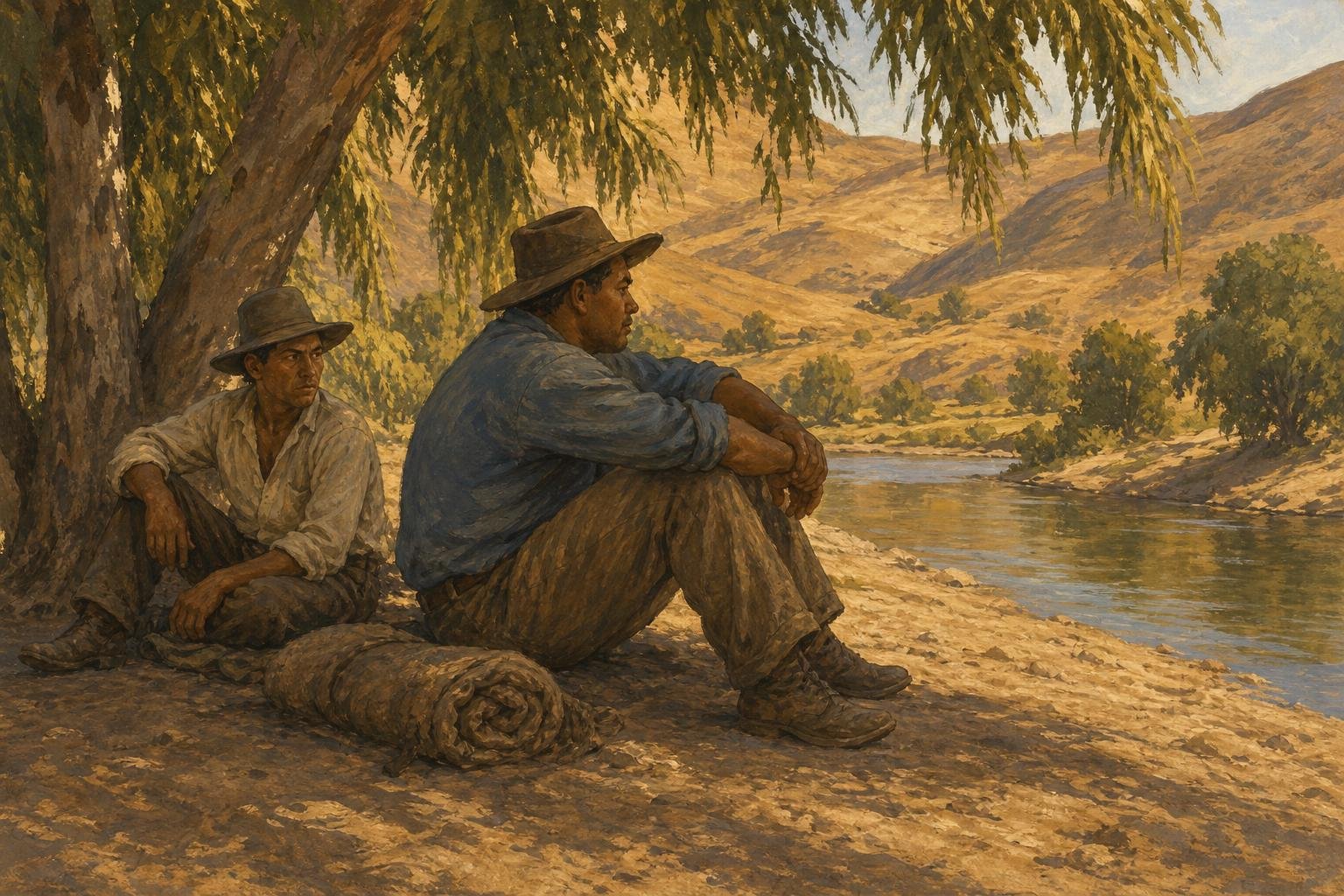

Of Mice and Men is John Steinbeck's 1937 novella about two migrant workers, George Milton and Lennie Small, who travel to a California ranch during the Great Depression and share a dream of owning a small farm. The dream nearly comes within reach. Then Lennie, a strong man who cannot control his strength, accidentally kills the wife of the boss's son, and George shoots Lennie by the river to spare him from a lynch mob.
The whole story takes four days. It begins with two men on the run from their last job, sleeping by a river and hoping the next ranch will be different. This Of Mice and Men summary follows those four days chapter by chapter, then explains what the title and the ending mean.
When and Where the Story Takes Place
Of Mice and Men is set in the Salinas Valley near Soledad, California, on a ranch about a quarter mile from George and Lennie's riverside campsite. The action runs from a Thursday evening to a Sunday evening. The book has six chapters, and each stays in a single place, much like a scene in a play. Steinbeck wrote it partly with the stage in mind.
Each stage of the plot below follows one pattern. Something happens on the ranch, and that event moves George and Lennie's farm closer or pushes it farther away.
Of Mice and Men: publication facts and Depression-era setting
| Book fact | Publication or setting detail | Connection to the story |
|---|---|---|
| Author | John Steinbeck | California-born writer depicting migrant ranch workers |
| First publication | 1937 | Published during the Great Depression it portrays |
| Original publisher | Covici Friede; New York | Issued the first American edition |
| Geographic setting | Near Soledad, in California’s Salinas Valley | George and Lennie seek work on a ranch |
| Historical setting | 1930s; Great Depression | Scarce jobs and insecure wages shape the dream of owning land |
| Working environment | Ranch employing itinerant laborers | Shared bunkhouse; manual work; movement between jobs |
The working conditions in that last row shape everyone in the book. Ranch hands move from job to job, carry everything they own in a bundle, and spend their wages in town. Few have a family or a home. Almost none travel with a friend. That is why the bond between George and Lennie puzzles everyone they meet.
George and Lennie Arrive at the Ranch
Chapter 1 opens with George and Lennie camped by a pool on the Salinas River, the night before they report for work. George is small, quick and sharp-tempered. Lennie is huge and usually gentle, struggles to remember instructions and understand consequences, and loves to pet soft things. George takes away a dead mouse Lennie has been stroking in his pocket. Lennie kills mice by accident, because he pets them too hard.
That same strength cost them their last job in Weed, California. Lennie grabbed a girl's dress because he wanted to feel the fabric, and when she screamed he held on in panic. She said he had attacked her. The two men hid in an irrigation ditch until dark and then fled. Before they sleep, George tells Lennie that if he ever gets in trouble again, he must come back to this spot and hide in the brush.
Remember that instruction. Remember, too, the story Lennie begs to hear. In Lennie's words, they will one day "live off the fatta the lan'," on a few acres with a cow, some pigs, and rabbits that Lennie will tend. The dream is a ritual between them, and George tells it the same way every time.
Chapter 2 brings them to the bunkhouse. The boss is suspicious that George does all the talking. Curley, the boss's son, is a former boxer who picks fights with bigger men, and George sees at once that Curley will go after Lennie. Curley's wife appears in the doorway, and George warns Lennie to stay away from her. They also meet Candy, an old swamper who lost a hand in a ranch accident, and Slim, a skilled mule driver the other men respect.
Two days in, the farm already looks farther away. Curley and his wife are exactly the kind of trouble that ended things in Weed.
Candy Joins the Dream
Chapter 3 is where the dream first looks real. It opens with George thanking Slim for giving Lennie one of his dog's newborn puppies. Talking to Slim, George admits for the first time how much Lennie depends on him, and how much he has come to depend on Lennie's company.
Candy's old dog comes next. It is blind, stiff and smells bad, and Carlson, another ranch hand, presses Candy to let him shoot it. Slim agrees it would be a kindness, so Candy gives in. Carlson takes the dog outside and shoots it in the back of the head with his Luger pistol. Candy lies on his bunk afterward.
Candy's fear of the same fate drives what comes next. He overhears George describing the farm and asks to join. He has compensation from the loss of his hand, plus some savings. He is old, expects to be let go soon, and dreads being put out of the way like his dog. A share in the farm means a home nobody can throw him out of. With his money, George realizes, they could buy a place he knows of within weeks. For a moment all three men believe it. After they agree on the plan, Candy tells George he should have shot the dog himself rather than let a stranger do it. That regret foreshadows George's final decision.
The moment does not last. Earlier, Curley came looking for his wife, then left for the barn. Now he returns with Slim, Carlson and Whit. Slim rebukes him, and Carlson and Candy mock him. Seeing Lennie still smiling at the thought of the farm, Curley mistakes his smile for mockery and starts punching him. Lennie does not fight back until George shouts at him to. Then he catches Curley's fist and crushes his hand. Slim persuades Curley to say his hand got caught in a machine, so George and Lennie keep their jobs.
The farm has never been closer. Lennie's hands have just shown how quickly it could be lost.
Crooks and a Lonely Saturday Night
Chapter 4 takes place on Saturday night, when most of the men have gone into town. Lennie wanders into the room of Crooks, the Black stable hand. Crooks lives alone in a shed attached to the barn because the white workers do not allow him in the bunkhouse. He is proud and bitter, he reads constantly, and at first he tells Lennie to leave.
As they talk, that isolation turns cruel. Crooks torments Lennie by suggesting George might never come back, then explains why he did it: a man with nobody to talk to gets sick, and Crooks has nobody. When Candy arrives and mentions the farm, Crooks scoffs. He has seen hundreds of men with the same dream, and none of them ever got land. Yet the money makes him hesitate, and he asks whether he could come and work for them.
Curley's wife ends that hope. She comes in looking for company, mocks the three men left behind as the weak ones, and hints that she knows how Curley's hand was really hurt. When Crooks tells her to leave, she reminds him that she could have him lynched with a word. Crooks shrinks back. After she goes, he takes back his offer.
Four people sat in that room, and each was shut out for a different reason. Crooks was set apart by race, Candy by age, Lennie by his disability, and Curley's wife because she was a woman. The tentative solidarity among Lennie, Candy and Crooks collapses under Curley's wife's threat.
Lennie and Curley's Wife in the Barn
Chapter 5 opens on Sunday afternoon. Lennie sits in the barn beside his puppy, which he has killed by striking it during play when it seemed about to bite him. He is frightened that George will no longer let him tend the rabbits. Curley's wife comes in and sits with him while the men play horseshoes outside.
She talks to Lennie because no one else will. She once could have gone into the movies, she says, and a man promised to write to her and never did. She married Curley only to get away from home, and she does not like him. Steinbeck never gives her a name, and readers often take that as a sign of how little the men around her see her as a person.
When Lennie says he likes soft things, she invites him to feel her hair. He strokes it too hard. She tries to pull away and starts to scream, exactly as the girl in Weed did, and Lennie panics. He covers her mouth and shakes her, and he breaks her neck. Knowing he has done "a bad thing," he partly covers her body with hay, puts the dead puppy under his coat to throw away, and leaves for the hiding place George gave him.
Candy finds the body and brings George. George knows at once that the farm is gone. Candy asks if the two of them could still buy the place, and George answers that he thinks he knew all along they would never do it. Curley gathers the men to hunt Lennie, swearing to shoot him in the gut. Carlson finds his Luger missing. George has taken it, and he joins the search.
The farm is no longer far away. It is gone.
Back at the River
Chapter 6 returns to the same pool on the Salinas River where the book began. Lennie is hiding in the brush, just as George told him to on the first night. A heron catches and swallows a water snake, a small killing in a peaceful place.
Alone, Lennie imagines his Aunt Clara scolding him and a giant rabbit telling him George will leave him. George arrives and sits stiffly beside him. At Lennie's request he repeats the old speech: lonely ranch hands have no one, but the two of them have each other. Then he tells Lennie to look across the river and describes the farm one last time. As Lennie pictures the rabbits, George raises the gun, but his hand shakes and he lowers it. He raises it again, steadies his shaking hand and shoots Lennie in the back of the head, the same way Carlson killed Candy's dog.
When the search party arrives, George lets them believe he took the gun from Lennie and fired in a struggle. Only Slim understands. He tells George he had to do it and leads him away for a drink. Carlson watches them go and asks what is eating those two, and that question is the novella's last line. Carlson cannot see that George has just lost the only person he had.
What the Title and the Ending Mean
The title comes from Robert Burns's 1785 poem "To a Mouse." The speaker has turned up a mouse's nest with his plow, wrecking a shelter the mouse built for winter. He tells the mouse that it is not alone, because the plans of men and mice fail alike. The poem treats the schemes of men and mice as equally fragile. The farmer's plans can be overturned as easily as the nest.
Steinbeck's men are the mice. George plans carefully. He keeps Lennie quiet in front of the boss, tells him where to hide, and adds up Candy's money. None of it holds against Curley's temper, the ranch's hierarchy and Lennie's hands. Readers still argue over whether the last shot is mercy, betrayal or both. George spares Lennie a lynching and lets him die thinking of rabbits, but he also chooses not to run with him. Slim calls the killing necessary, but his judgment does not settle whether George was right.
Key Takeaways
- George and Lennie seek ranch work in Depression-era California after fleeing Weed.
- Their shared dream of owning land offers hope against poverty and isolation.
- Candy's savings briefly make the farm seem attainable.
- Lennie accidentally kills Curley's wife, bringing the dream to an end.
- George kills Lennie at the riverbank, leaving their friendship's final act morally troubling.
Frequently Asked Questions
Does Of Mice and Men have LGBTQ themes?
The novella does not present an LGBTQ relationship or character. Steinbeck portrays George and Lennie's bond as a close friendship, and the other men find it odd mainly because ranch hands so rarely travel together. Some modern readers offer queer readings of male closeness in the book, but the text does not state them.
What does George say to Lennie before he kills him?
George tells Lennie he is not mad at him and never has been. He asks Lennie to look across the river and describes the farm, the animals and the rabbits Lennie will tend. When Lennie asks to go there now, George says, "Sure, right now," and fires.
What is the deeper meaning of Of Mice and Men?
The story suggests that ordinary people's hopes are fragile when they have no money, no power and no one to protect them. Its title, taken from Burns, says that careful plans often fail. Many readers also see it as a study of loneliness and of the hard choices that come with caring for someone vulnerable.
Why did George kill Lennie?
George killed Lennie to spare him from Curley, who was hunting him after the death of Curley's wife and meant to make him suffer. By doing it himself, quickly and while Lennie was calm and happy, George avoided the regret Candy felt over letting someone else shoot his dog. Whether it was right is the question the book leaves open.
What is Lennie's mental disability?
Lennie is portrayed as having an intellectual disability, but Steinbeck does not specify a diagnosis or establish its cause. Lennie struggles with memory and judgment and relies heavily on George's guidance. George tells the boss that a horse kicked Lennie in the head as a child, but when Lennie questions the story just after the boss leaves in Chapter 2, George's reply implies it is false.
What happens in Of Mice and Men?
George and Lennie's dream of owning a farm collapses when Lennie accidentally kills Curley's wife. George then kills Lennie before Curley's armed search party reaches him.
The Dream Ends at the Riverbank
The final return to the river changes the meaning of the opening refuge. George's instruction first offers Lennie somewhere safe to wait; in the last chapter, it brings them together for the killing. George uses their familiar farm story to comfort Lennie in what he believes is the only way left to protect him. That mixture of care and violence leaves the ending unresolved.