

“Some are born great” sounds like encouragement; among Shakespeare quotes, it is bait in a forged letter. Shakespeare quotes on life and love can offer devotion or comfort, but they can also expose vanity and despair. These 18 quotes from Shakespeare give you the words, their sources, and the moment that makes each one bite.
Quotations follow the Folger Shakespeare Library’s online editions. Internal punctuation is retained; only initial capitals and terminal punctuation are adapted for standalone excerpts. Folger’s editorial brackets are omitted. Play references give act and scene; sonnet references give poem and line numbers.
1. “To Be, or Not to Be”
Hamlet, Hamlet 3.1: “To be or not to be.”
Hamlet is weighing suicide, not choosing between two ordinary courses of action. Death might end suffering, as sleep ends a day. Then the comparison turns terrifying: sleep brings dreams. What dreams might come when we are dead?
2. “All the World’s a Stage”
Jaques, As You Like It 2.7: “All the world’s a stage, / And all the men and women merely players.”
At a banquet in the forest, Jaques turns human life into seven successive roles, from infancy to helpless old age. The theatrical comparison makes identity temporary and patterned. Around him, people offer food and companionship; he savors a speech that reduces everyone to a part, with decline waiting at the end.
3. “To Thine Own Self Be True”
Polonius, Hamlet 1.3: “This above all: to thine own self be true.”
Polonius sends his son Laertes away with advice about sound personal conduct. His own conduct supplies the sting: addicted to spying and indirect schemes, he later hides behind a hanging to overhear Hamlet with his mother. Hamlet stabs him through it. The man recommending integrity cannot stop snooping.
4. “Brevity Is the Soul of Wit”
Polonius, Hamlet 2.2: “Brevity is the soul of wit.”
Polonius announces this principle during his rambling explanation of Hamlet’s behavior. Gertrude supplies the review: “More matter with less art.” Short Shakespeare quotes rarely come with a sharper demonstration of their speaker’s failure to take his own advice.
5. “Some Are Born Great”
The letter Malvolio reads, Twelfth Night 2.5: “Some are born great, some achieve greatness, and some have greatness thrust upon ’em.”
Maria forges Olivia’s handwriting to make Malvolio believe his mistress loves him. The letter flatters his ambition, then prescribes a costume: yellow stockings, cross-gartering, and smiles. He obeys, presenting himself in precisely the style Olivia dislikes. The inspirational slogan has dressed its reader for humiliation.
6. “All That Glisters Is Not Gold”
The scroll in the golden casket, The Merchant of Venice 2.7: “All that glisters is not gold.”
The Prince of Morocco chooses the most impressive-looking casket and opens it expecting a reward. Inside sits a skull, with a scroll in its empty eye socket. That scroll delivers the warning. “Glisters” is Shakespeare’s word; “glitters” is the familiar modern variant. The gold exterior has concealed a death’s-head.
7. “If Music Be the Food of Love, Play On”
Orsino, Twelfth Night 1.1: “If music be the food of love, play on.”
Among Shakespeare quotes about love, this sounds ready-made for a romantic playlist. Orsino immediately asks for so much music that his appetite for love will sicken and die. He wants a cure by excess. Before the speech ends, he has already tired of the music.
8. “The Course of True Love Never Did Run Smooth”
Lysander, A Midsummer Night’s Dream 1.1: “The course of true love never did run smooth.”
Hermia’s father opposes their marriage, and Lysander consoles her with the history of thwarted lovers. Then consolation becomes a plan: meet outside Athens and escape to his aunt’s house, beyond Athenian law. Their route takes them into the woods, where magical interference will make parental opposition look almost straightforward.
9. “Shall I Compare Thee to a Summer’s Day?”
Sonnet 18, line 1: “Shall I compare thee to a summer’s day?”
Summer is too short and changeable to match the beloved: even the sun can be too hot or dimmed. This sonnet, unlike the dramatic speeches here, puts its faith in the poem itself. Its closing boast is brazen: while people breathe and read, these words will keep the beloved alive.
10. “Let Me Not to the Marriage of True Minds”
Sonnet 116, lines 1–2: “Let me not to the marriage of true minds / Admit impediments.”
For readers choosing Shakespeare love quotes for a vow, this offers absolute constancy. Marriage supplies the language for a union of minds that circumstances cannot alter. The speaker allows no exceptions: if his definition proves false, he declares that he never wrote and no one ever loved. Everything rests on that claim.
11. “My Mistress’ Eyes Are Nothing Like the Sun”
Sonnet 130, line 1: “My mistress’ eyes are nothing like the sun.”
The compliments seem to go badly: her hair is like black wires, and her breath “reeks.” Shakespeare takes apart the inflated comparisons of conventional love poetry, leaving an ordinary human woman in their place. The ending affirms that his love is rare. She needs no counterfeit sun for eyes to deserve it.
12. “Parting Is Such Sweet Sorrow”
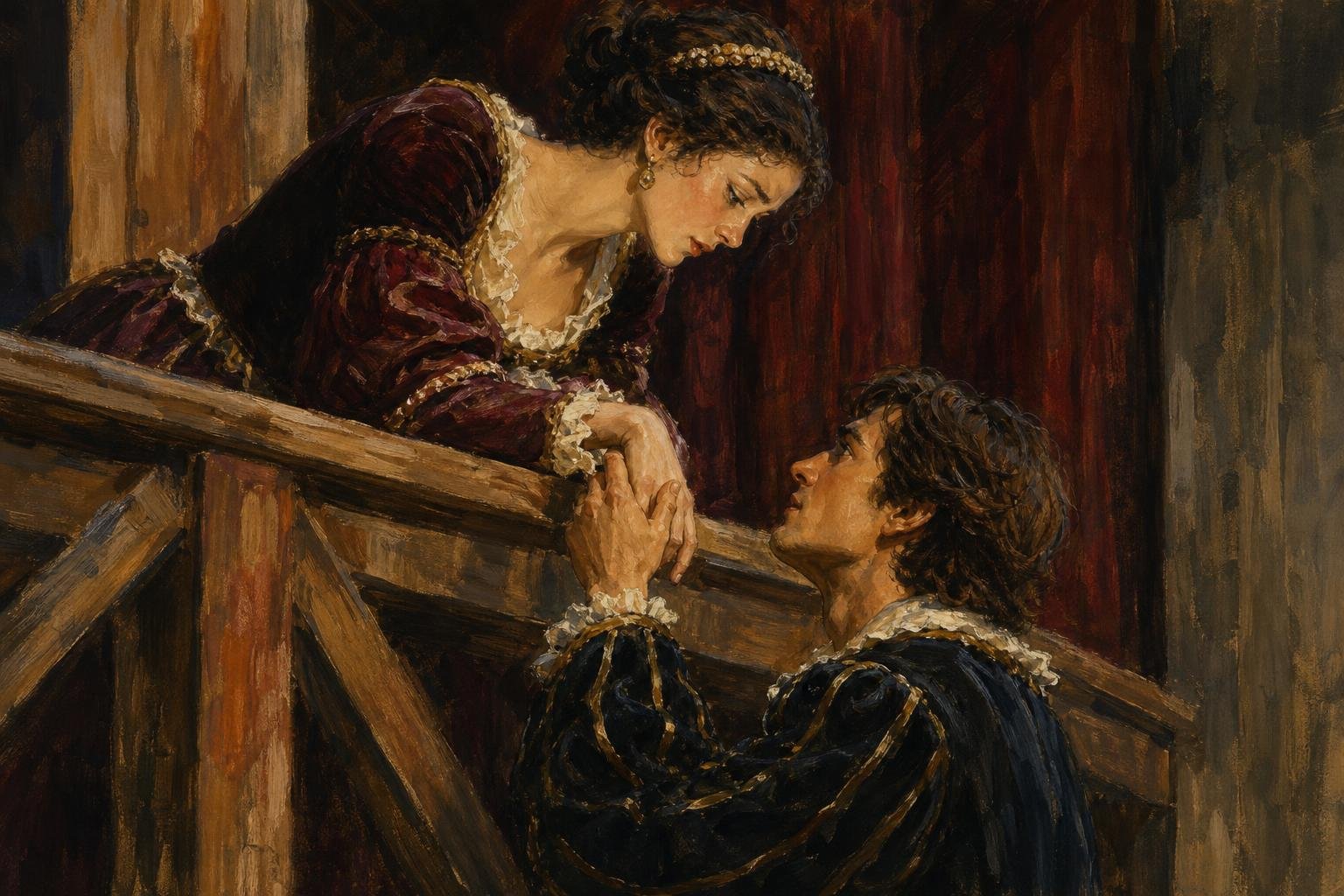
Juliet, Romeo and Juliet 2.2: “Parting is such sweet sorrow.”
Juliet keeps trying to end the lovers’ nighttime conversation. Separation hurts because being together is sweet, and another meeting beckons. She wants to say goodnight and keep saying it.
13. “Love All, Trust a Few”
The Countess, All’s Well That Ends Well 1.1: “Love all, trust a few, / Do wrong to none.”
The Countess gives her son Bertram this counsel before he leaves for court: extend goodwill without giving everyone your confidence. His later behavior answers the advice harshly. Ordered to marry Helena, he abandons his new wife and heads for war.
14. “Our Doubts Are Traitors”
Lucio, Measure for Measure 1.4: “Our doubts are traitors / And makes us lose the good we oft might win / By fearing to attempt.”
Lucio urges Isabella, a novice preparing for religious life, to appeal to Angelo for her brother’s life. Hesitation could cost her the chance to save him. Lucio’s opportunism makes him an awkward motivational speaker, and the assignment is dangerous: Angelo will turn her appeal into an opportunity for sexual coercion.
15. “Cowards Die Many Times Before Their Deaths”
Caesar, Julius Caesar 2.2: “Cowards die many times before their deaths; / The valiant never taste of death but once.”
Caesar counts repeated fear as repeated dying. His confidence has force, but assassination is approaching: the conspirators will stab him in Act 3, Scene 1. The speech dares you to admire a man whose contempt for fear helps leave him exposed to the knives.
16. “Out, Out, Brief Candle!”
Macbeth, Macbeth 5.5: “Out, out, brief candle! / Life’s but a walking shadow.”
Lady Macbeth has died, and Macbeth’s pursuit of power has devastated his world. He declares existence brief and meaningless. That despair takes theatrical form: a “poor player” who “struts and frets his hour upon the stage,” then falls silent.
17. “The World’s Mine Oyster”
Pistol, The Merry Wives of Windsor 2.2: “Why then, the world’s mine oyster, which I with sword will open.”
The modern saying promises opportunity. Pistol promises force: the world will yield because he has a weapon. Stop at “oyster” and the threat becomes cheerful encouragement. Keep the sword, and you have a swaggering demand.
18. “Now Is the Winter of Our Discontent”
Richard, Richard III 1.1: “Now is the winter of our discontent / Made glorious summer by this son of York.”
Edward IV’s reign has brought Richard’s family from trouble into triumph. Stop at “discontent” and you reverse that announcement. Yet Richard cannot enjoy the peace: while others turn to dancing and courtship, he announces plots against his brother Clarence. Public celebration gives him cover for private treason.
Key Takeaways
- Match the quotation’s emotional purpose to your occasion before choosing it.
- For an inscription, include enough of the sentence to preserve its meaning.
- When discussing a play, let the speaker’s actions test the apparent wisdom.
- A memorable line can be moving and ridiculous at the same time.
Frequently Asked Questions
Does Punctuation Vary Between Editions of the Same Quotation?
Yes, editions can punctuate the same words differently, changing their pace or emphasis. Retain the edition’s internal punctuation; adapt only initial capitals and terminal punctuation for standalone excerpts.
How Should I Mark a Line Break When Quoting Shakespeare in Running Text?
Use a spaced slash to mark a verse line break within running text: “Let me not to the marriage of true minds / Admit impediments” (Sonnet 116, lines 1–2). Follow the edition’s verse divisions, not the way text wraps on your screen.
Should a Shakespeare Quotation Citation Include the Speaker’s Name?
Identify the speaker somewhere in your sentence or attribution when quoting a play. Naming Polonius lets readers recognize the joke in the brevity quotation; act and scene alone locate it without explaining that joke.
How Can I Check Whether a Shortened Quotation Changes Its Meaning?
Read through the end of the sentence and the surrounding exchange. With Orsino, the request following “play on” supplies a motive that the opening alone conceals.
Can a Character’s Statement Be Treated as Shakespeare’s Personal Belief?
No, a character’s statement alone cannot establish Shakespeare’s personal belief. Caesar’s confidence and Macbeth’s despair belong to different people under different pressures, not to a single consistent adviser.
How Should I Cite a Quotation From a Sonnet Rather Than a Play?
Give the sonnet number and any relevant line numbers, such as Sonnet 130, line 1. Sonnets have no acts or scenes, and their lyric speakers should not be assigned a dramatic character’s name.
Let Context Guide Your Choice
Choose your purpose first: a vow needs different language from a farewell, and a joke can tolerate a speaker whose judgment you distrust.
You can use a familiar phrase in its modern sense, provided you understand what you are changing. Pistol’s oyster is a useful test: does your audience need the optimism, or would the sword make your point sharper? Above all, know whose voice you are borrowing. Otherwise, you may quote a villain and mistake him for your adviser.