

William Shakespeare's wife was Anne Hathaway, a woman from Shottery, near Stratford-upon-Avon, whom he married in 1582. They had three children and remained married until Shakespeare died in 1616, but the surviving records cannot establish whether their marriage was happy or unhappy.
Anne Hathaway's marriage is often described through stories about a hurried wedding, years apart, and an unusual inheritance. The account below separates documented events from interpretations, including research that challenges the familiar picture of Anne remaining permanently in Stratford while her husband worked in London.
Where Anne Hathaway Grew Up
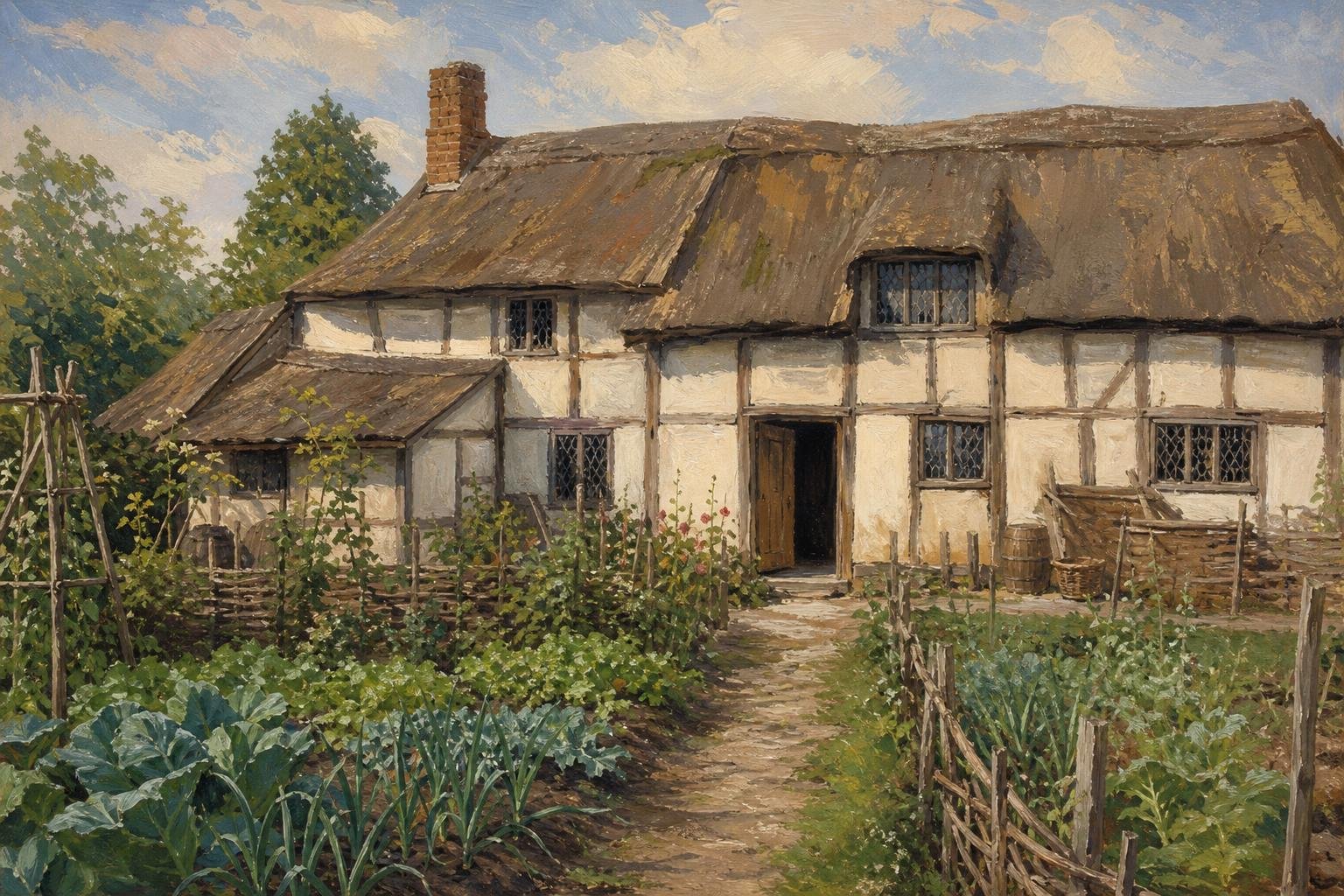
Anne was born around 1556 and grew up in Shottery, a village near Stratford-upon-Avon. Her father, Richard Hathaway, was a farmer. The family home survives as Anne Hathaway's Cottage, although the word “cottage” can give a misleading impression of the substantial farmhouse associated with her family.
That farmhouse places Anne within a working rural household, not within the theatrical world her husband later entered. The surviving evidence says much less about her education or daily activities than about her family connections. Claims about her personality, literacy, or ambitions therefore need care. The house provides a tangible connection to her early life, but its survival does not mean that every story told about her courtship is documented.
When Anne and William Married
Anne Hathaway married Shakespeare in 1582, when she was about 26 and he was 18. Folger's Shakespeare Documented reproduces the Diocese of Worcester marriage bond dated November 28, 1582. It supported permission for the marriage to proceed after one reading of the banns, the announcement of an intended wedding, instead of the usual three.
The timing matters because their daughter Susanna was baptized in May 1583. Anne was already pregnant when they married, but pregnancy does not establish that Shakespeare was forced into the wedding or that either partner regretted it. Their age difference is likewise a fact, not an explanation of their feelings.
“When was Shakespeare married?” therefore has a clearer answer than “Why did he marry?” The records establish the year and the circumstances surrounding the wedding. They do not preserve the couple's private decisions or an exact, securely documented wedding date.
Why the Records Use Different Names
The marriage paperwork contains a genuine puzzle. An entry dated November 27, 1582, names William Shakespeare and “Anne Whateley” of Temple Grafton. The following day's bond identifies the intended bride as Anne Hathaway of Stratford. The discrepancy has encouraged stories about another woman or an interrupted romance.
Those stories go beyond what the documents establish. In Shakespeare Documented, archivist Robert Bearman explains that the Hathaway bond is an original document, whereas the Whateley register entry was copied retrospectively. He therefore considers the bond more reliable and a copying error a possible explanation. The discrepancy does not demonstrate that Shakespeare married twice or abandoned one bride for another.
“Agnes” presents a different naming issue. Katherine West Scheil's Anne Shakespeare's Epitaph identifies Richard Hathaway's daughter Agnes in his will as Anne; the Shakespeare Birthplace Trust likewise describes Anne as also known as Agnes. The names could overlap in contemporary usage. Neither naming puzzle establishes an additional wife.
Their Children and Family Life
William and Anne had three children: Susanna, baptized in 1583, and twins Hamnet and Judith, baptized in 1585. Hamnet died in 1596 at age 11. His cause of death is not recorded, so the frequent claim that he died of plague should not be treated as established fact.
Hamnet's death is an important part of the family's history, but it does not give us direct access to either parent's grief. Nor can a fictional death in Shakespeare's plays serve as a record of their response. The Stratford parish register, described by the Shakespeare Birthplace Trust, records Susanna's baptism on May 26, 1583, the twins' baptisms on February 2, 1585, and Hamnet's burial on August 11, 1596; it leaves the household's emotional life unrecorded.
Did Anne Live Apart From Shakespeare?
Shakespeare's career took him to London, while his family's documented connections remained strong in Stratford. In 1597, he bought New Place, a substantial Stratford house. These circumstances helped create the familiar account of an ambitious husband living away from a wife confined to their hometown.
That account is more certain than the evidence allows. In his 2025 paper, “The Shakspaires of Trinity Lane: A Possible Shakespeare Life-Record,” literary scholar Matthew Steggle examines a fragmentary letter addressed to “Mrs Shakspaire.” It concerns her husband's dealings with money held for an apprentice, John Butte or Butts, and mentions a former home in Trinity Lane. Steggle proposes that William and Anne lived together there in London, perhaps around 1599–1603. Hereford Cathedral says the letter survives in a book held in its library on deposit from Lady Hawkins School in Kington.
Identifying the woman as Shakespeare's wife remains an interpretation, not an uncontested fact. Bristol's research record also lists Steggle's follow-up, “Investigating the Shakspaires of Trinity Lane.” It revisits the proposed identification rather than establishing how often Anne traveled or how the couple organized their marriage.
What the Second-Best Bed Means
Shakespeare's will, signed on March 25, 1616, left Anne his “second best bed” with its furnishings, as the Shakespeare Birthplace Trust explains in “The Second-Best Bed.” The phrase has become one of the most familiar pieces of evidence used to describe their marriage as cold or hostile. Read alone, however, it cannot support that conclusion.
The Shakespeare Birthplace Trust explains that beds were valuable possessions and that the best bed could be reserved for guests. It therefore considers Anne's bequest likely to have been the marital bed. That interpretation supplies historical context, but the will itself does not explain why Shakespeare chose this gift.
The alternative claim that the bequest was an insult is equally uncertain. A will records the distribution of property within a legal and family setting. It is not a reliable substitute for a spouse's account of the relationship.
Anne's Later Life and Burial
Anne survived Shakespeare, who died in April 1616, by seven years. She died on August 6, 1623, and was buried beside him in the chancel of Holy Trinity Church in Stratford-upon-Avon. Her memorial records her age as 67, supporting the approximate birth year used in accounts of her life.
For readers wondering where Anne Hathaway is buried, Holy Trinity Church is the specific place, distinct from the Shottery home associated with her childhood. Her grave also supplies evidence of her continuing place within the Shakespeare family after her husband's death. It cannot settle the marriage's emotional character, but neither should it disappear behind the better-known story of his will.
Key Takeaways
- Anne Hathaway was William Shakespeare's wife; conflicting names do not establish another marriage.
- They married in 1582, while Anne was pregnant.
- Their family included Susanna and twins Hamnet and Judith.
- Letter research challenges assumptions about permanent separation between Stratford and London, but its interpretation remains uncertain.
- Neither the second-best bed nor relationships in Shakespeare's works proves that the marriage was unhappy.
Frequently Asked Questions
Who was Shakespeare's wife?
Shakespeare's wife was Anne Hathaway, who came from Shottery, near Stratford-upon-Avon. Her surviving biography rests largely on family documents, marriage records, and memorial evidence, leaving many personal questions unanswered.
Was Shakespeare's wife Anne or Agnes?
She is generally known as Anne Hathaway, while her father's will calls her Agnes. The names could overlap in contemporary usage, so the variation does not establish that they refer to different women.
Did William Shakespeare have two wives?
There is no reliable evidence that Shakespeare had two wives. The Anne Whateley entry creates a documentary puzzle, but it does not establish a separate marriage.
Who was Shakespeare's true love?
The surviving evidence cannot identify Shakespeare's “true love.” Anne was his wife, but neither his poems nor his plays can securely reveal his private romantic attachments.
What happened between Shakespeare and his wife?
Their marriage included parenthood, the loss of their son, and Shakespeare's work away from Stratford. The records do not establish a permanent estrangement, and the London-letter interpretation gives another reason to question that assumption.
Anne Hathaway Beyond the Marriage Myths
Anne's surviving biography reaches beyond the wedding and the will: her Shottery family home, her children and her memorial belong to her history too. The London letter may add another dimension, but neither it nor the older records can supply a private account of the marriage.