
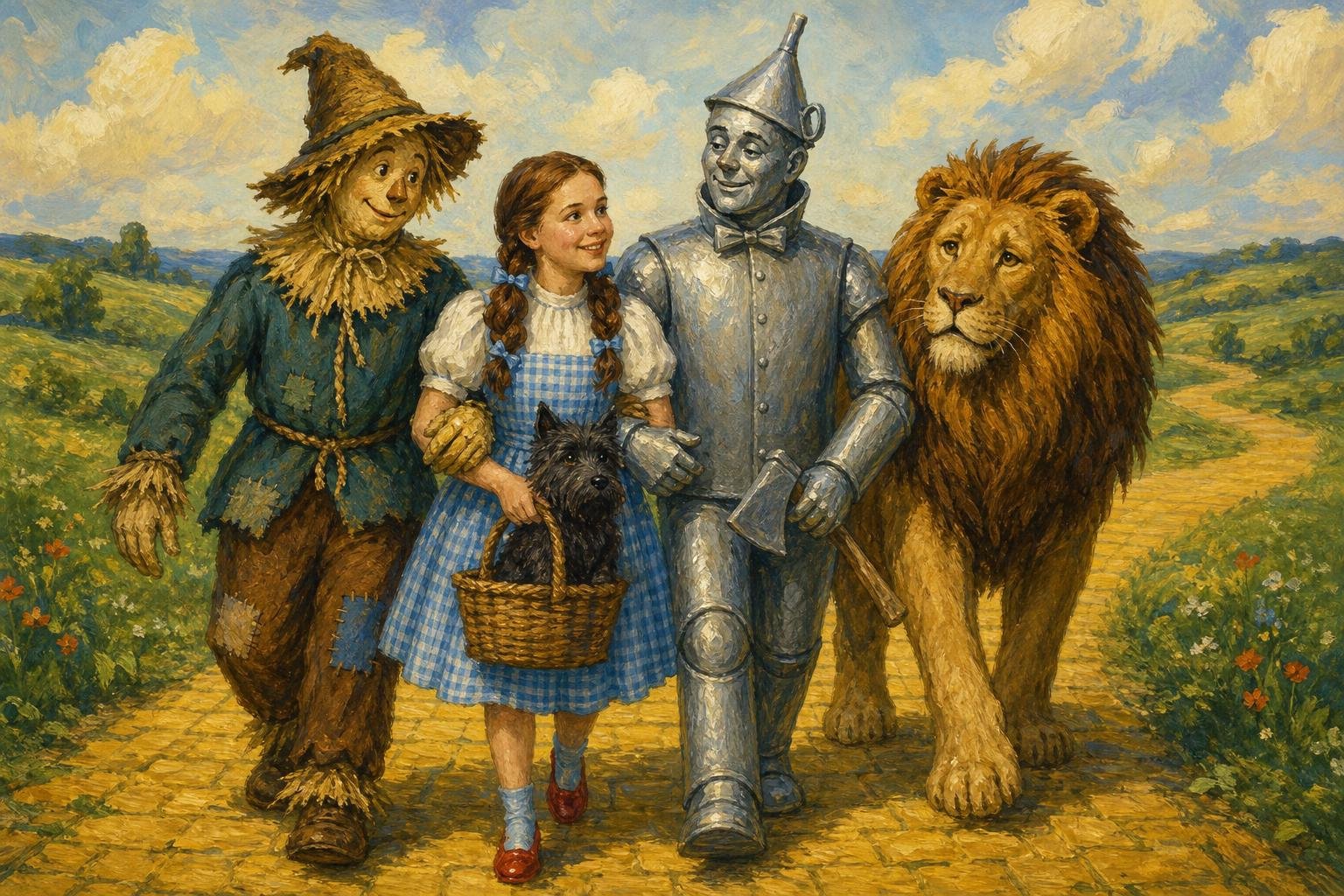

Dorothy Gale and her companions are the central Wizard of Oz characters: a girl desperate for home travels with a Scarecrow who doubts his brains, a heart-hungry Tin Woodman, and a frightened Lion. The Wizard promises help, while the Wicked Witch of the West wants Dorothy’s magical shoes.
These 10 figures turn that collision of wishes into a journey. They originated in L. Frank Baum’s The Wonderful Wizard of Oz (1900), illustrated by W. W. Denslow; MGM’s The Wizard of Oz (1939) gave them their familiar screen faces.
1. Dorothy Gale
Dorothy’s rescue of the Scarecrow is wonderfully practical: she helps him off the pole where he hangs in a cornfield. He joins her on the road, turning a small act of help into a friendship.
That road begins when a cyclone carries her Kansas house to Oz. Judy Garland plays Dorothy in the film, where her adventure becomes a dream populated by counterparts of Kansas acquaintances. Baum’s Dorothy travels through a real Oz. In either version, she seeks the Wizard because she wants to get home.
2. Scarecrow
The Scarecrow wants a brain, but watch him at a ravine in Baum’s novel. He proposes a tree bridge before the Kalidahs appear. The creatures approach as the travelers start crossing; once his companions are safely across, he tells the Tin Woodman to chop the bridge loose while the Kalidahs are on it. His plan saves the party.
Ray Bolger plays him and the Kansas farmhand Hunk in the film. In the book, the supposedly brainless companion ends up ruling the Emerald City after the Wizard leaves: a straw-stuffed figure in the seat of power.
3. Tin Woodman
The Tin Woodman wants a heart; his body’s history makes that wish painful. Once a human woodcutter, he falls victim to an enchanted ax that cuts away his legs, then his arms and head. A tinsmith rebuilds him piece by piece, but his replacement body has no heart.
His tenderness survives. The film leaves out the dismemberment and calls him the Tin Man, played by Jack Haley, who also plays the Kansas farmhand Hickory.
4. Cowardly Lion
In Baum’s novel, the Cowardly Lion carries his companions across a ditch by leaping it with them on his back. The animal who believes he has no courage becomes their way across an otherwise impassable gap.
Bert Lahr plays the Lion and the farmhand Zeke in the film. His bluster keeps collapsing into visible fright, yet he stays with Dorothy’s party.
5. The Wizard
The Wizard of Oz is an ordinary man with an extraordinary publicity machine. He makes his help conditional: in Baum’s novel, Dorothy must kill the Wicked Witch of the West; in the film, the companions must bring him her broomstick. Frank Morgan plays him in the film, hiding behind a projected face and amplified voice until Toto pulls aside the curtain.
Baum gives the exposed humbug some wonderfully dubious remedies: brains made with bran, pins, and needles; a silk heart stuffed with sawdust; and a drink passed off as courage. The companions accept these tokens of qualities their actions already display. For Dorothy, he attempts a more practical solution: departure by balloon.
6. Wicked Witch of the West
Margaret Hamilton’s Wicked Witch wants the shoes Dorothy acquired when her falling house killed the Wicked Witch of the East. They are silver in Baum’s book and ruby in the film. Hamilton also plays Miss Gulch, the Kansas woman who threatens Toto.
In the film, the Witch sets the Scarecrow alight. Dorothy throws water to save him, splashing the Witch, whose body sinks toward the floor as she melts. Dorothy destroys her enemy while trying to rescue a friend; water also defeats the Witch in the novel, under different circumstances.
7. Toto
Toto, played in the film by a female dog named Terry, keeps upsetting human plans. Exposing the Wizard is only one interruption.
As the balloon departure approaches, he chases a cat. Dorothy follows him, and the balloon leaves without her.
8. Glinda
Billie Burke’s Glinda arrives in a floating bubble in the film. At the journey’s end, she reveals that Dorothy’s shoes can carry her home: Dorothy must tap her heels together three times.
Baum’s unnamed Good Witch of the North first meets Dorothy; Glinda, the Good Witch of the South, explains the shoes’ power later. The film makes Glinda the northern witch, changing which of these Oz characters holds the answer from the beginning.
9. Winged Monkeys
The Winged Monkeys, often called Flying Monkeys, do more than swoop overhead. In Baum’s novel, they pull the Scarecrow’s stuffing out and drop the Tin Woodman onto rocks, leaving Dorothy’s companions unable to protect her before carrying her away.
The Golden Cap explains their obedience: its owner can command them three times. Their violence serves an imposed obligation, not an allegiance freely chosen. The film briefly shows the Golden Cap but omits the explanation of its power, chiefly presenting the monkeys as the Witch’s airborne servants.
10. Aunt Em
Baum surrounds Aunt Em with gray Kansas prairie; the harsh life has worn away her own youthful color and laughter. Dorothy’s attachment to her makes home worth returning to despite Oz’s wonders.
Clara Blandick plays Aunt Em in the film. She shares the Kansas household with Dorothy’s Uncle Henry. These Kansas scenes give Dorothy family to miss, even when the people at home have no magic to offer.
Key Takeaways
- Dorothy’s rescues build the friendships that sustain her journey.
- Her companions’ deeds make the Wizard’s promised gifts look unnecessary.
- Toto’s interruptions change both the Wizard’s reputation and Dorothy’s route home.
- Adaptation changes responsibility, especially for Glinda and the Winged Monkeys.
Frequently Asked Questions
How old is Dorothy in The Wizard of Oz?
Baum’s original novel does not state Dorothy’s precise age. Garland’s age during production is not the character’s age; Dorothy is presented as a child.
Why does the Tin Man want a heart?
He thinks a heart will let him love again. In Baum’s novel, he weeps after accidentally killing a beetle: grief that demonstrates the compassion he already has, despite believing he needs a heart to love.
What does each character in The Wizard of Oz want?
Dorothy wants home; Scarecrow wants brains, Tin Woodman a heart, and Lion courage. The Wizard wants his secret kept, the Witch wants the shoes, and Glinda helps Dorothy return. Toto stays close to Dorothy, Aunt Em cares for her, and the Winged Monkeys must serve whoever controls the cap in the book.
What did each character represent in The Wizard of Oz?
The characters have no single, compulsory symbolic meaning. Dorothy can suggest belonging, her companions unrecognized abilities, and the Wizard authority built on appearances; those readings explain their actions without turning everyone into a coded message.
Who are the four witches in The Wizard of Oz?
Baum’s four are the wicked witches of East and West, the unnamed Good Witch of the North, and Glinda of the South. The film’s rearrangement leaves no separate southern witch, so its geography cannot supply the book’s full roster.
Is Tin Woodman the same character as Tin Man?
Yes, Tin Woodman is Baum’s name for the character called Tin Man in the film. Stage adaptations also feature him, though his role varies with the production’s source material.
Dorothy’s Journey Connects the Cast
What connects these characters from The Wizard of Oz is the gap between what they believe and what they do. The Scarecrow needs no certificate to devise his bridge; Dorothy needs no title to save a friend. The Wizard has the title and spectacle, but neither guarantees the power she expects.
Read the novel for the sharper edges behind those familiar faces, especially the Tin Woodman’s lost body and the monkeys’ enforced service. Watch the MGM film for the Kansas doubles and the performances that make those doubts visible. Both versions make companionship more dependable than the promise of an all-powerful rescuer.