
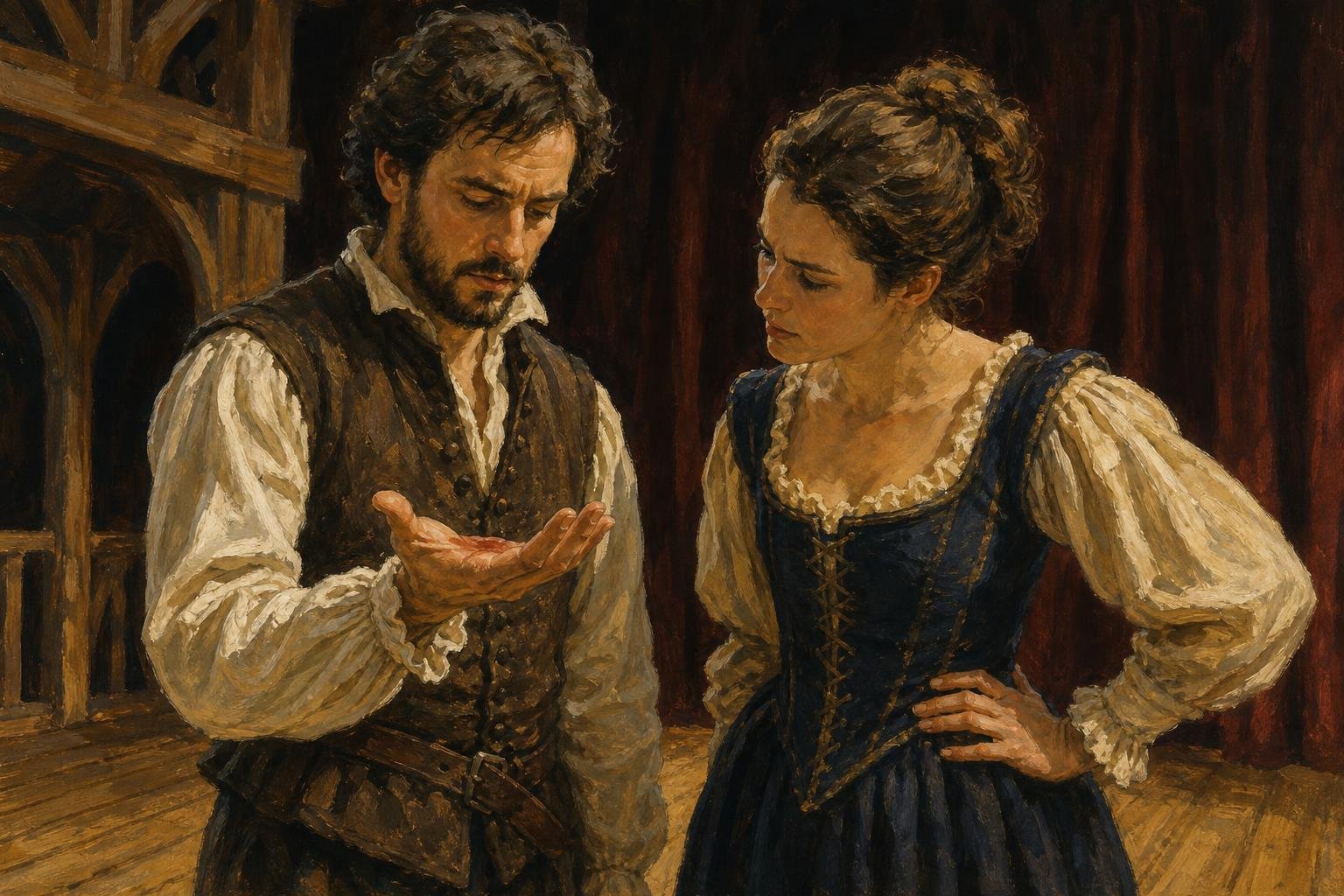

Fashionable, swagger, and lonely regularly appear on lists of words Shakespeare invented. The evidence is more complicated: some candidates have documented earlier uses, while others require distinguishing a new word from a new meaning or grammatical role. Here are familiar examples, their attribution histories, and the dramatic situations that give them force.
What Counts as an Invention?
The Oxford English Dictionary traces words through dated evidence. Its earliest quotation for a word identifies the earliest use its editors have documented, not necessarily the moment someone created it. Everyday speech could circulate long before anyone wrote it down, and much early writing has disappeared.
A playwright might coin a term, borrow it from conversation, or independently form something another person had already used. The examples below separate documented earlier uses from unconfirmed attributions, then examine what Shakespeare does with each word.
Everyday Words and Their Dramatic Uses
Fashionable appears in Troilus and Cressida, where Ulysses compares time to “a fashionable host” whose attention shifts toward new arrivals. The word serves an argument about how quickly public favor changes. In A Midsummer Night’s Dream, Puck describes the amateur actors as “swaggering,” giving their arrival a suggestion of noisy self-importance.
That social judgment becomes an outright insult in King John, when Constance calls Austria a “cold-blooded slave.” These familiar words do dramatic work: they expose behavior or turn anger into accusation.
The following table brings together familiar examples and their contexts.
Words credited to Shakespeare: meanings, play contexts, and attribution status
| Everyday word | Meaning today | Shakespeare play and context | Attribution status and evidence | Everyday example |
|---|---|---|---|---|
| Lonely | Sad from isolation; without company | Coriolanus, 4.1: Coriolanus compares himself to a “lonely dragon.” | Predates this play: David Crystal identifies Mary Sidney’s “lonely ghosts” in 1592. | “Moving away left me feeling lonely.” |
| Eyeball | The rounded organ of sight | The Tempest, 1.2: Prospero orders Ariel to remain “invisible / To every eyeball else.” | Predates Shakespeare: Jonathan Hope identifies William Patten’s 1575 use for the pupil and iris together; the OED he consulted cites Shakespeare first for the whole-eye sense. | “The optician examined my eyeball.” |
| Besmirch | Damage someone’s reputation | Hamlet, 1.3: Laertes discusses whether deceit stains Hamlet’s intentions. | Merriam-Webster gives 1604 as the first known use; the Online Etymology Dictionary dates it to the 1590s and quotes Henry V. | “False accusations besmirch her reputation.” |
| Swagger | Walk or behave with conspicuous confidence | A Midsummer Night’s Dream, 3.1: Puck mocks the amateur actors as “swaggering.” | The Online Etymology Dictionary identifies Shakespeare’s uses as the earliest recorded for the verb. | “He swaggered into the room.” |
| Cold-blooded | Deliberately cruel; without sympathy | King John, 3.1: Constance insults Austria as a “cold-blooded slave.” | Invention by Shakespeare is unconfirmed. | “It was a cold-blooded betrayal.” |
| Fashionable | Popular or consistent with current trends | Troilus and Cressida, 3.3: Ulysses compares time to a “fashionable host.” | Jonathan Hope rejects the invention claim, identifying other writers’ examples earlier than the Shakespeare citation in the OED he consulted. | “Wide-leg trousers are fashionable again.” |
Lonely, Eyeball, and Besmirch in Context
Lonely predates Shakespeare’s use in Coriolanus. In ‘Think on my Words’, David Crystal identifies “lonely ghosts” in Mary Sidney’s translation of The Tragedie of Antonie, published in 1592. In Coriolanus, Act 4, Scene 1, the banished soldier describes himself as “a lonely dragon.” The comparison makes his separation sound fearsome as well as painful: lonely describes a powerful creature living apart, not simply feeling sad.
Eyeball also predates Shakespeare. In his study “Who Invented ‘Gloomy’?”, Jonathan Hope identifies an example in William Patten’s Calendar of Scripture, published in 1575, referring to the pupil and iris. Shakespeare gives the word dramatic force in The Tempest, Act 1, Scene 2: Prospero orders Ariel to remain “invisible / To every eyeball else.” The command makes invisibility bodily and immediate: nobody else must see the spirit.
Besmirch turns physical dirt into moral damage in Hamlet, Act 1, Scene 3. Laertes uses it while discussing Hamlet’s intentions toward Ophelia.
How Macbeth Turns Blood Into Language
A more striking example comes after Duncan’s murder. In Macbeth, Act 2, Scene 2, Macbeth wonders whether an ocean could wash his bloody hand clean. He imagines the opposite:
“The multitudinous seas incarnadine, Making the green one red.”
Multitudinous gives the seas an overwhelming scale. Incarnadine, used here as a verb, means to turn red; Macbeth imagines his hand staining the water instead of the water cleansing him. Editions differ in punctuation, but the action is clear.
The passage’s force comes from the pairing: an immense quantity of water becomes helpless against the blood of one murder.
Why Older Meanings Matter
That attention to context also prevents familiar words from becoming misleading. In Hamlet, Act 4, Scene 4, Hamlet calls the pressures driving him toward revenge “excitements of my reason and my blood.” Here excitement means an incitement or stimulus to action, not simply a feeling of enthusiasm.
Bedroom offers another useful surprise. In A Midsummer Night’s Dream, Act 2, Scene 2, Lysander asks Hermia not to deny him “bed-room” beside her. The expression concerns room in a bed, not clearly a separate room containing one. Modern spelling can hide that difference.
Words in Shakespeare: familiar words with surprising historical meanings
| Word | Meaning in Shakespeare’s passage | Common meaning today | Textual example | Play and location |
|---|---|---|---|---|
| Honest | Sexually faithful or chaste | Truthful; not deceitful | “I think my wife be honest, and think she is not” | Othello, Act 3, Scene 3 |
| Naughty | Wicked or morally bad | Mischievous; mildly disobedient | “So shines a good deed in a naughty world” | The Merchant of Venice, Act 5, Scene 1 |
| Brave | Splendid or admirable | Courageous; ready to face danger | “O brave new world, / That has such people in’t!” | The Tempest, Act 5, Scene 1 |
| Artificial | Skilled in making art; artful | Human-made rather than natural; sometimes insincere | “We, Hermia, like two artificial gods, / Have with our needles created both one flower” | A Midsummer Night’s Dream, Act 3, Scene 2 |
In these Shakespeare passages, honest means sexually faithful, naughty means wicked, brave means splendid, and artificial means artistically skilled.
How to Use These Examples
For notes or classroom writing, attach an example to its speaker and location. “Macbeth uses incarnadine as a verb in Act 2, Scene 2” gives readers something precise to discuss. It also separates the character’s language from an unsupported claim about the author’s intentions.
Key Takeaways
- Familiar examples include fashionable, swagger, and cold-blooded.
- A surviving written example does not prove that its author invented the word.
- Shakespeare expanded expression by changing how existing words functioned.
- Historical meanings can differ: excitement could mean incitement.
- Read original passages before presenting a word’s origin as certain.
Frequently Asked Questions
What did they call kissing before Shakespeare?
People already used kiss and kissing. Kiss descends from Old English, so Shakespeare did not invent either the action’s ordinary name or the idea of describing it in English.
What was a bedroom called before Shakespeare?
Chamber and bedchamber were available before Shakespeare’s lifetime. His use of “bed-room” in A Midsummer Night’s Dream refers to space in a bed, so it should not be treated as straightforward evidence that he named the modern bedroom.
What words did Shakespeare invent?
Swagger, besmirch, and multitudinous are among the words often credited to him. Two other familiar candidates have documented earlier uses: David Crystal identifies lonely in Mary Sidney’s writing from 1592, and Jonathan Hope identifies eyeball in William Patten’s writing from 1575.
What words did Shakespeare make?
Shakespeare made language expressive through compounds, changed meanings, and shifts between grammatical roles. Macbeth’s use of incarnadine as a verb is a clear example of this creative flexibility, distinct from creating an entirely new word.
Can a newly discovered earlier text change a word’s attribution?
Yes. An earlier dated example can replace Shakespeare’s passage as the earliest known written evidence. It changes the documented history without diminishing what Shakespeare accomplished with the word in his own work.
Familiar Words, More Careful Attribution
For a useful vocabulary note, record two things separately: the word’s documented history and its effect in the passage. Name the source of any earlier example, then identify Shakespeare’s speaker and scene. If the attribution remains unconfirmed, say so rather than turning a memorable quotation into an origin story.