
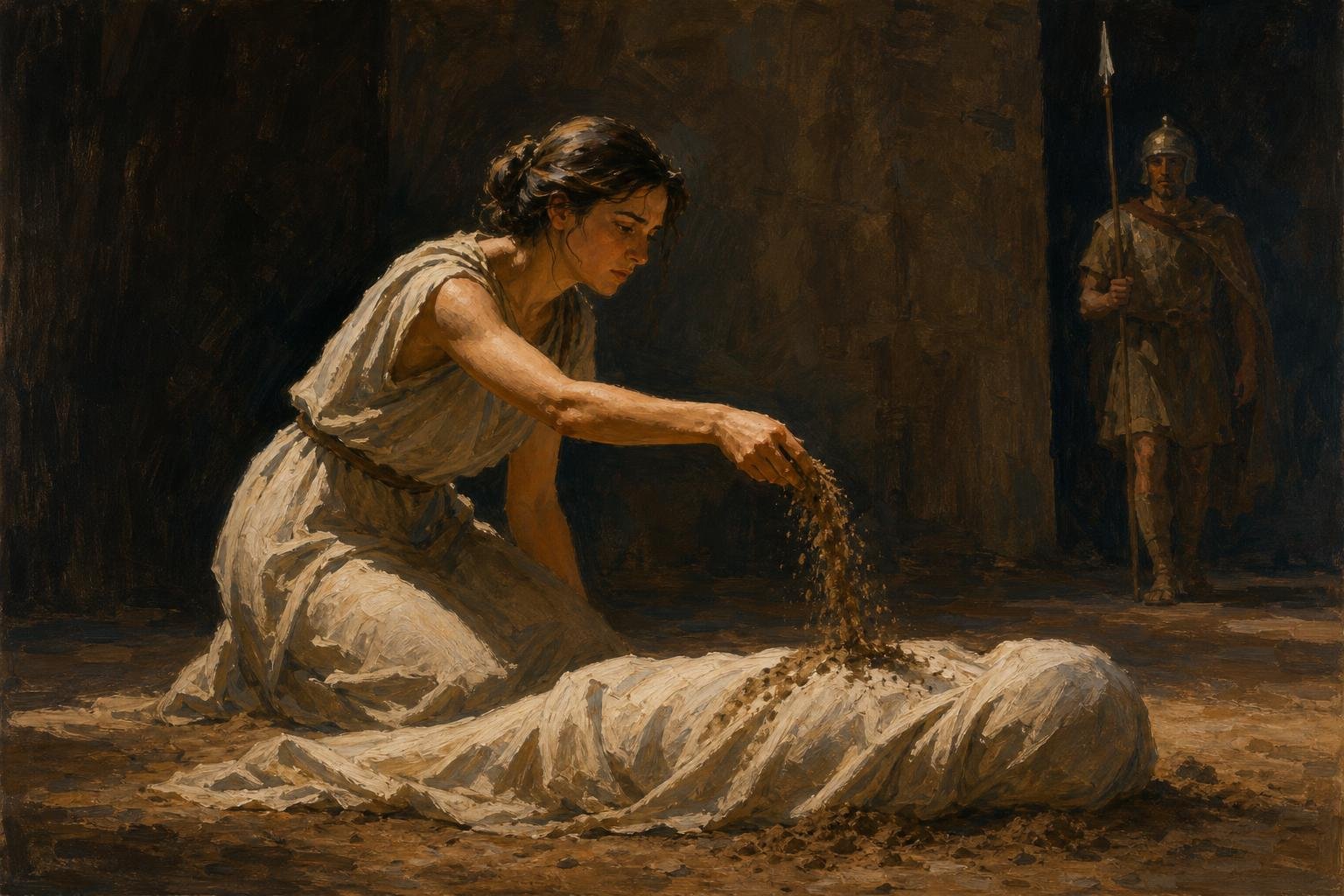

Antigone is Sophocles' tragedy about a princess of Thebes who buries her brother Polynices against King Creon's decree and is condemned to die for it. Creon refuses warning after warning, and his eventual reversal fails to save Antigone, his son Haemon or his wife Eurydice. The Antigone plot starts from a single order: a traitor's corpse will lie outside Thebes, unwept and unburied, for the dogs and birds to eat.
That body rots in the open through most of the play. Ismene, Haemon and the prophet Tiresias each try to stop what follows, and each time Creon digs in harder. This Antigone summary follows the play in order, from the brothers' war to the deaths that come after Creon finally gives way.
Before the Play Begins: Oedipus' Sons and the War for Thebes
The play was first performed around 441 BCE. It concerns the children of Oedipus and Jocasta: Antigone, Ismene, Eteocles and Polynices. After Oedipus falls, his two sons fight over who will rule Thebes.
Polynices comes back at the head of an army from Argos and attacks his own city. The brothers meet in battle and kill each other, and the assault fails. With both brothers dead, Creon, Jocasta's brother, inherits the throne.
When the play opens, Eteocles has already been buried, while Polynices lies unburied outside the walls.
Creon's Decree and Antigone's Decision
The play Antigone opens before dawn, with the Argive army barely gone. Antigone brings Ismene outside the palace, where no one can hear them, and tells her what Creon has proclaimed. Eteocles, who died defending Thebes, has already been buried with full honors. Polynices will stay where he fell, exposed to scavengers, and anyone who buries him will be stoned to death.
Antigone has already decided to bury him. She wants Ismene's help.
Ismene refuses. Antigone calls her a coward, tells her to proclaim the plan to the whole city if she likes, and goes out alone to the body.
Antigone's Arrest and Her Defiance of Creon
A guard arrives, terrified, to report that someone has sprinkled dust over Polynices and performed the burial rites. Nobody saw who did it. Creon assumes the guards took a bribe and threatens them with death unless they produce the culprit.
The guards brush the dust off the corpse and sit upwind of the stench. In the middle of the day a dust storm blows up. When it clears, they see Antigone at the body, crying out over the bare corpse and pouring offerings, and they seize her.
She denies nothing. Zeus did not issue Creon's decree, she says, and no mortal ruler's command outranks the unwritten laws of the gods. To Creon, Antigone is a criminal who boasts of her crime, and he swears that no woman will rule him while he lives.
Ismene is dragged in and now claims a share of the guilt. Antigone won't let her have it. Creon threatens both sisters with death, believing Ismene helped plan the burial.
Haemon Confronts His Father
Haemon, Creon's son, is engaged to Antigone. He comes in calm, saying he will obey his father. Then he tells Creon what nobody else dares to: Thebes is whispering that Antigone deserves praise, not death.
He asks his father to bend. Trees that give way to a winter flood keep their branches, he says, and trees that stand rigid are torn out by the roots.
Creon hears only disloyalty. Should a man his age take lessons from a boy, and should the city tell its king how to rule? He accuses Haemon of fighting on a woman's side.
The quarrel turns ugly. Haemon warns that if Antigone dies, her death will destroy someone else. Creon takes this as a threat against his own life. He orders Antigone brought out to die in front of her bridegroom's eyes, and Haemon storms off, telling his father he will never see him again.
After Haemon leaves, the chorus asks whether Creon means to kill both sisters. He spares Ismene because she did not take part in the burial. He changes Antigone's sentence from stoning to entombment: she will be sealed alive in a rock cave with a little food, so that the city does not kill her by its own hand. Led away, she mourns that she will die unmarried and without children. She still insists she has done nothing wrong.
Tiresias' Warning and Creon's Change of Mind
The blind prophet Tiresias comes to the palace with news from his seat of augury. He heard strange, furious bird cries that he could not interpret, and the beating of wings told him the birds were attacking one another.
He then tried burnt sacrifice, but the offerings would not burn properly. Moisture from the thigh-flesh dripped onto the embers, smoking and sputtering, and the fat covering the thighbones melted away.
He knows the cause. Dogs and birds have torn flesh from Polynices' corpse and carried it to every altar in Thebes. The gods refuse the city's prayers, and no bird gives a clear omen, because they have gorged on a dead man's blood.
Creon accuses the prophet of selling his prophecies. Tiresias answers that before long Creon will pay with a corpse of his own flesh and blood, and that the cities whose dead were left unburied will rise against Thebes. He leaves without another word.
Tiresias connects Creon's two offenses: he has shut a living person underground while keeping a dead person from the grave. Antigone's imprisonment and Polynices' exposure are not separate disputes but opposite violations of the boundary between the living and the dead. To put matters right, Creon must both release Antigone and grant her brother burial.
Creon is shaken. The chorus tells him to release Antigone from the cave and bury Polynices, and he gives in.
How Antigone, Haemon, and Eurydice Die
A messenger brings the news to the palace, where Eurydice, Creon's wife, hears it. Creon's party went first to the plain. They washed what the dogs had left of Polynices, burned it and raised a mound of his native earth over it. Only after that did they go to the cave.
They heard Haemon's cry before they reached it. Inside, Antigone had hanged herself with her own veil. Haemon held her by the waist, weeping for his bride.
When he saw his father he spat in his face and drew his sword. Creon ran and the blow missed. Haemon then drove the blade into his own side and died with Antigone in his arms.
Eurydice says nothing. She turns and goes into the palace.
Creon returns carrying his son's body. A second messenger meets him: Eurydice has stabbed herself at the altar. She mourned her earlier-dead son Megareus and then Haemon, and with her last breath she cursed Creon as the killer of her sons. Creon calls himself a murderer and begs to be led away. The chorus ends the play by saying that the proud learn wisdom only through suffering, and only when they are old.
Key Takeaways
- The war between Eteocles and Polynices leaves one brother honored and the other left as carrion.
- Creon's decree makes a sacred duty to the dead a capital crime.
- Antigone buries her brother alone after Ismene refuses to help.
- Haemon warns of a second death, and Tiresias names it as Creon's own child.
- Creon reverses his order, and his wife, son and niece die anyway.
Frequently Asked Questions
What is the main message of the play Antigone?
The main message is that a ruler who will not listen brings ruin on himself and on the people closest to him. The play sets the gods' law about burying the dead against a king's decree. Creon's stubbornness, more than Antigone's defiance, is what destroys his house.
Is Antigone Oedipus' daughter?
Yes, Antigone is the daughter of Oedipus and Jocasta. Jocasta was also Oedipus' mother, so the relationship between Oedipus and Antigone is doubled: she is both his daughter and his half-sister.
What is Antigone's tragic flaw?
The usual answer is her stubborn pride, since she refuses every compromise and accepts death. Many readers argue that her loyalty is a virtue, and that the decisive flaw belongs to Creon.
Who is Antigone?
Antigone is a princess of Thebes, the niece of Creon and the fiancée of his son Haemon. She buries her brother Polynices against the king's order, and that choice drives the whole play.
Why does Ismene initially refuse to help bury Polynices?
Ismene is afraid of execution and believes two women cannot stand against the king. She hopes the dead will forgive her for obeying. Once Antigone is arrested, she tries to share the guilt anyway.
Creon's Reversal Comes Too Late
Creon finally agrees to bury Polynices and release Antigone, but his party reaches her cave only after burying her brother. His reversal addresses the two offenses Tiresias identified: leaving the dead above ground and shutting the living below it. Yet Antigone has already hanged herself, and Haemon’s death leads to Eurydice’s suicide. Creon can change his orders, but he cannot undo their consequences. The king who refused to listen is left alive to acknowledge his responsibility for the deaths. His suffering gives the chorus’s final lesson its force: his pride gives way to wisdom only after he has lost his family.