
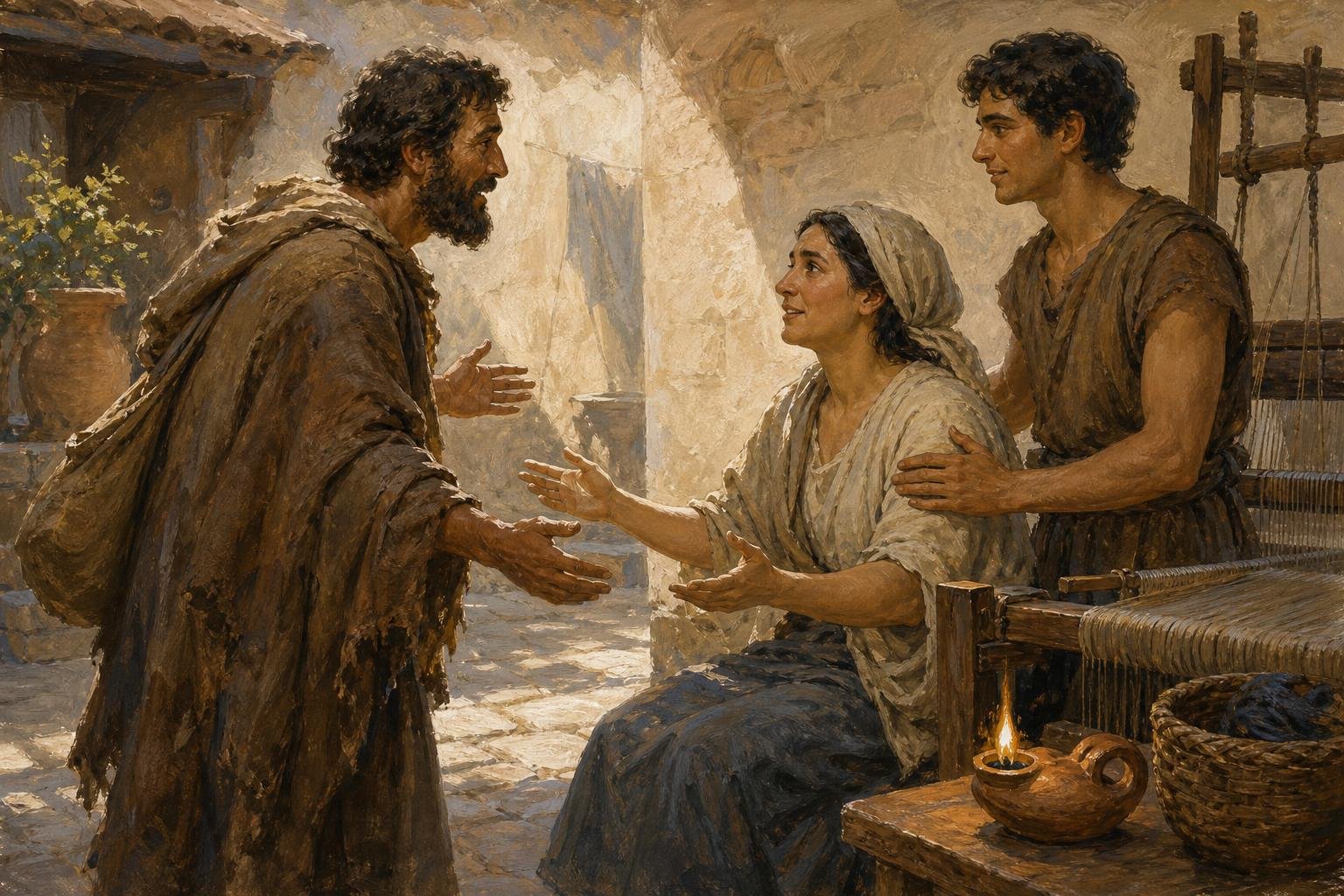

Homer's Odyssey has dozens of named figures, but nearly all of the Odyssey characters matter for the same reason: each helps or blocks Odysseus as he tries to get home to Ithaca after the Trojan War. His family waits for him and the gods split over him. Strangers at sea shelter him or try to destroy him, while a crowd of suitors eats through his house.
Sorting the Odyssey characters this way makes them far easier to keep straight. Each section below covers one group and asks the same two questions of every figure in it: whose side are they on, and what do they change about his homecoming?
Odysseus and His Family
Odysseus in the Odyssey is the king of Ithaca. He spends ten years fighting at Troy and ten more trying to return, so he is gone for twenty years in all. His defining trait is cunning: he lies, disguises himself, and tests people before he trusts them. That habit shapes almost every relationship in the poem.
Penelope, his wife, holds the household together without him. She stalls the suitors by weaving a burial shroud for Laertes and secretly unraveling it each night for three years. Later she sets the contest with Odysseus's great bow. Telemachus, their son, was an infant when his father left. Early in the poem he visits Nestor, king of Pylos, who recalls the Greek leaders' returns from Troy and directs him to Menelaus, king of Sparta. Menelaus reports that Odysseus is alive but held by Calypso. Helen, Menelaus's wife, recognizes Telemachus's resemblance to his father and recalls Odysseus entering Troy in disguise. Laertes, Odysseus's father, has withdrawn to a farm in grief and reunites with his son only in the final book.
The Gods on Each Side
Athena is Odysseus's strongest ally. She disguises herself as Mentor to guide Telemachus, pleads Odysseus's case before Zeus, and turns Odysseus into an old beggar so he can enter his own palace unrecognized.
Poseidon opposes him. Odysseus blinds the Cyclops Polyphemus, Poseidon's son, and then boasts his real name as he sails off. Polyphemus prays to his father for revenge, and Poseidon stretches the journey out for years.
Zeus stands above both sides. At Athena's urging, he sends Hermes to order Calypso to release Odysseus. Hermes also gives Odysseus the herb moly, which protects him from Circe's drugs. Zeus acts against the crew as well: Helios, the sun god, demands punishment when the men slaughter his cattle and threatens to shine among the dead if he is refused. Zeus answers by destroying their ship with a thunderbolt.
Odysseus's Crew
Odysseus and his crew leave Troy in twelve ships, and he is the only one who reaches Ithaca. Their losses have different causes: the Laestrygonian giants destroy eleven ships, and Scylla kills six men. The survivors later doom themselves by killing Helios's cattle. Other choices delay their return. Some eat the lotus and lose all wish to go home. Aeolus, keeper of the winds, gives Odysseus a bag containing the winds that would prevent his homecoming. The crew opens it while he sleeps, blowing the fleet back to Aeolus, who refuses further help.
Two members of Odysseus's crew stand out by name. Eurylochus refuses to enter Circe's hall, which saves him, but he later talks the starving men into killing Helios's cattle. Elpenor dies falling from Circe's roof. His shade asks Odysseus for a proper burial, and Odysseus gives him one.
Hosts and Monsters on the Voyage
Calypso, a nymph, keeps Odysseus on her island, Ogygia, for seven years and offers him immortality if he stays. He refuses because he wants Penelope and home. Circe, an enchantress on Aeaea, turns his scouts into pigs. Once Odysseus resists her with Hermes's moly, she restores them and hosts the crew for a year. She also sends him to the underworld and warns him about the dangers ahead.
Those dangers follow her warnings closely. The Sirens sing sailors to their deaths, so Odysseus plugs his men's ears with wax and has himself tied to the mast. Scylla, a six-headed monster, snatches six men from the ship. Charybdis, a whirlpool, later swallows the wreck, and Odysseus survives by clinging to a fig tree.
The Phaeacians answer how Odysseus finally gets home. Nausicaa, the princess, finds him shipwrecked on the shore and tells him to appeal to her mother, Queen Arete, whose favor matters most at court. King Alcinous hosts him, hears the story of his wanderings, and sends him to Ithaca loaded with gifts. Poseidon then turns their returning ship to stone.
Voices in the Underworld
Circe's instructions take Odysseus to the land of the dead, where he needs Tiresias, the blind Theban prophet. Tiresias warns him not to harm Helios's cattle, predicts trouble with the suitors, and tells him of a final journey inland.
Anticleia, his mother, appears too. She died while he was away, and her shade says that longing for him caused her death. She tells him that Penelope remains faithful, that Telemachus manages the estate, and that Laertes lives roughly on the farm. Three times Odysseus tries to embrace her, and three times she slips through his arms.
The dead heroes offer warnings of a different kind. Agamemnon, murdered on his return by Aegisthus with the involvement of his wife, Clytemnestra, tells Odysseus to be careful going home. Achilles says he would rather labor for a poor man on earth than rule the dead.
The Suitors in the Palace
Telemachus counts 108 suitors in Book 16: young men who crowd Penelope's house, eat its food, and plot to kill him. Two lead them.
Antinous is the most openly arrogant. He mocks Telemachus and hurls a footstool at the disguised Odysseus. He is the first to die, shot through the throat. Eurymachus is smoother and more deceptive. He speaks kindly to Penelope while plotting, and once the killing starts he blames Antinous and offers to repay the household. Odysseus refuses and kills him. Amphinomus, the most decent of the group, is warned to leave and still dies with the rest.
Loyal and Disloyal Members of the Household
Eumaeus, the swineherd, takes in the disguised Odysseus without knowing who he is. His hut is where Odysseus reveals himself to Telemachus. Philoetius, the cowherd, stays equally loyal, and both men fight beside father and son against the suitors. Argos, Odysseus's old dog, lies neglected on a dung heap. He recognizes his master after twenty years, wags his tail, and dies.
Eurycleia, Odysseus's old nurse, is the one who recognizes him by his scar. While washing his feet, she feels the mark a boar gave him on a boyhood hunt, and he silences her before she can speak. No character in the Odyssey shows disloyalty more plainly than Melanthius, the goatherd. He kicks the beggar and smuggles weapons to the suitors. Melantho, an enslaved maid, insults the disguised Odysseus. In Book 22, Telemachus hangs twelve enslaved women accused of disloyalty, but the poem does not explicitly identify Melantho among them.
Key Takeaways
- Odysseus's return connects the journey abroad with the struggle for his household.
- Penelope and Telemachus face the suitors while Odysseus remains absent.
- Athena supports Odysseus; Poseidon opposes him after Polyphemus's blinding.
- Loyalty separates household allies such as Eumaeus from figures such as Melanthius.
- Hosts, prophets, and dead heroes provide different kinds of help and warning.
Frequently Asked Questions
Is Travis Scott in The Odyssey?
Yes. Travis Scott plays the Bard in Christopher Nolan's film adaptation, released in US theaters on July 17, 2026, with Matt Damon as Odysseus. Scott is not a character in Homer's poem.
Who helps Odysseus on his journey?
Athena helps him most, and Hermes steps in at key moments. Among mortals, the Phaeacians carry him home, and Eumaeus, Philoetius, and Telemachus fight beside him once he is back.
Who was the main villain in The Odyssey?
Poseidon is the chief divine opponent because of Polyphemus's blinding. At home, Antinous is the worst of the suitors.
Who does Zendaya play in The Odyssey?
Zendaya plays Athena in Christopher Nolan's 2026 film adaptation. Athena is the goddess who supports Odysseus and guides Telemachus in Homer's poem.
Who are the female characters in The Odyssey?
The major ones are Penelope, Athena, Calypso, Circe, Nausicaa, Arete, Eurycleia, and Anticleia. Melantho is the most prominent disloyal maid.
How are Telemachus and Laertes related to Odysseus?
Telemachus is his son, and Laertes is his father. All three generations fight together in the final book.
Follow the Relationships Back to Ithaca
Penelope and Telemachus anchor the household he wants to recover, while Athena and Poseidon shape the obstacles around him. The suitors threaten his place in Ithaca, and the servants show where loyalty lies: Eumaeus shelters a beggar he doesn't recognize, and Melanthius kicks him. Away from home, Odysseus meets hosts, companions, monsters, and prophets, and each one speeds or slows his progress. Begin with these relationships instead of memorizing names one by one. Once you know whom each figure supports and what they do, the poem's many encounters fall into place.