
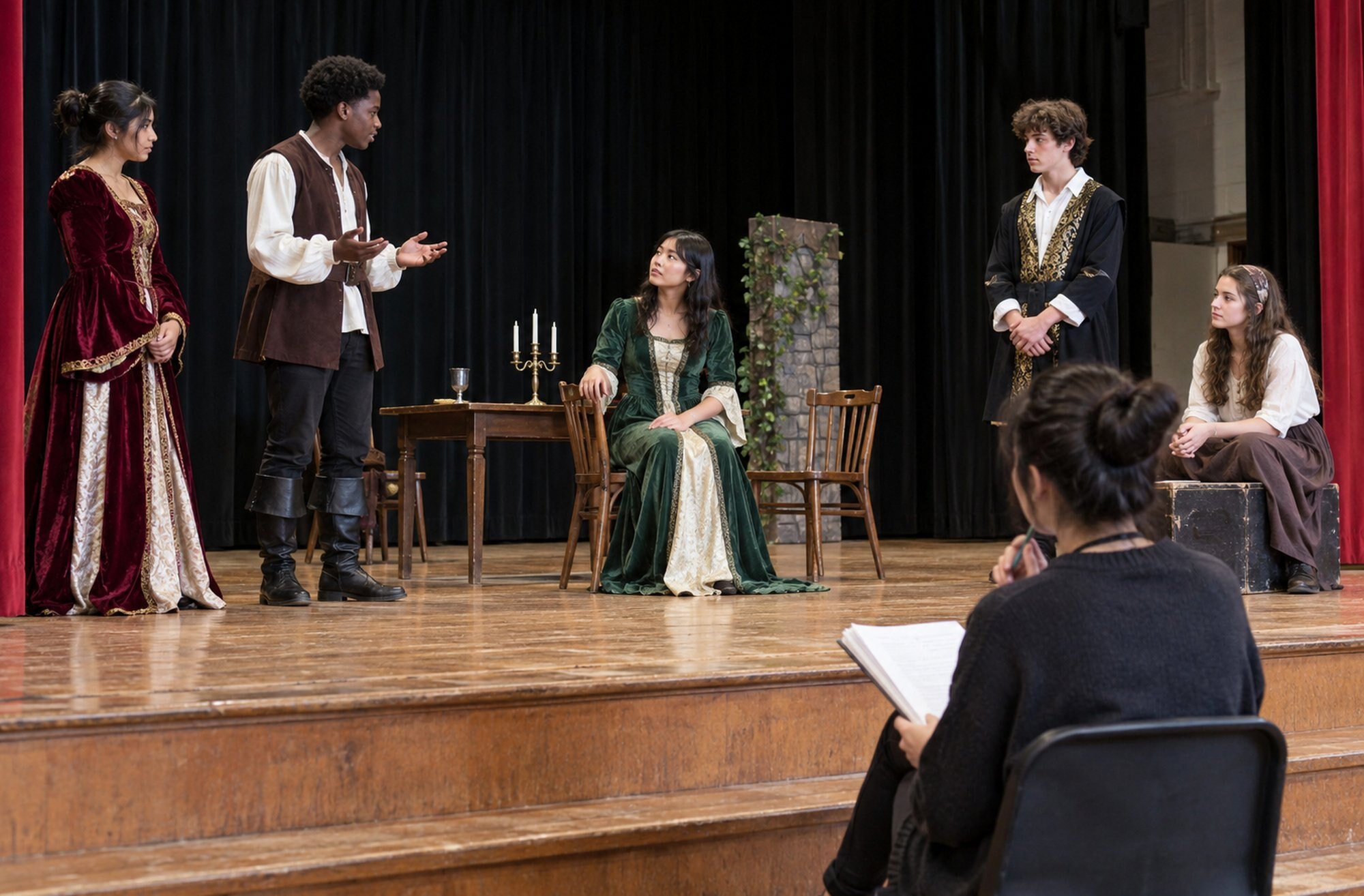

The Crucible is a play by Arthur Miller that dramatizes the Salem witch trials of 1692. It was first staged in Wilmington, Delaware, on January 15, 1953, before opening on Broadway on January 22. It follows John Proctor, a farmer whose past affair with Abigail Williams becomes a weapon once the town starts hunting witches. Its central question is what a person owes the truth when a lie would save his life. This guide covers what kind of work it is, the plot act by act, the main characters, where Miller departs from history, and the 1950s hearings behind it.
One distinction runs through every section: what happens on Miller's stage is not the same as what happened in 1692. Miller kept real names and the outline of the trials. He changed ages, merged officials, and invented the private motive that drives the story.
A Play, Not a Novel or a Musical
The Crucible is a spoken stage drama, not a musical or a novel, though Elizabeth sings offstage in Act Two. It is usually read as a paperback in English classes. Miller added long prose passages to the published text describing characters and the Puritan community, so the reading edition feels closer to a book than most scripts do.
This guide follows Viking Press’s four-act reading edition, published in 1953. Dramatists Play Service published a two-act acting edition in 1954, so its act divisions differ from those used here.
The original production opened at Broadway's Martin Beck Theatre on January 22, 1953, directed by Jed Harris, with Arthur Kennedy as John Proctor. The Crucible (1953) won the Tony Award for Best Play that year. Because it is a staple of American high school reading lists, many students meet it as assigned reading. It includes adultery, false accusations, executions, and onstage violence: Abigail strikes Betty in Act One. False accusations are dramatized onstage, including Mary Warren's accusation against Proctor in Act Three. The affair is only discussed, and the hangings take place offstage.
The Plot, Act by Act
In The Crucible, Salem is a Puritan village where land disputes and church quarrels already divide neighbors. The four acts move from rumor to courtroom to gallows.
Act One
Reverend Samuel Parris has caught his daughter Betty, his niece Abigail, and other girls dancing in the woods with Tituba, his enslaved servant from Barbados. When Betty will not wake, talk of witchcraft spreads. Reverend John Hale arrives as an expert on the devil. Under threat, Tituba confesses and names others, and the girls join in crying out names.
Act Two
At the Proctor farm, John and Elizabeth's marriage is still strained. Their servant Mary Warren, now an official of the court, brings home a poppet. Abigail then claims Elizabeth's spirit stabbed her with a needle, and a needle is found in the poppet. Elizabeth is arrested.
Act Three
Proctor brings Mary Warren before Deputy Governor Danforth to testify that the girls are pretending. When the girls turn on Mary, Proctor confesses the affair to expose Abigail's motive. Elizabeth, unaware of his confession, denies it to protect his name. Mary Warren accuses Proctor, and Hale quits the court in protest.
Act Four
By autumn, Abigail has fled with her uncle's money. Hale now begs the condemned to confess and live. Proctor signs a false confession but will not let it be posted on the church door. He tears it up and goes to hang.
The Affair Behind Abigail's Accusations
Abigail knows the Proctors because she once worked in their house. Before the play begins, John Proctor had an affair with her. Elizabeth found out and dismissed her. Abigail still wants Proctor, and her accusations aim to remove Elizabeth so she can take her place.
That private grievance drives the public panic. The needle in Act Two is a direct strike at Elizabeth. Proctor's confession in Act Three is meant to expose the grudge, and it fails. Admitting lechery destroys his reputation, while the court has already staked its authority on the girls.
The Main Characters
Many characters in The Crucible carry the names of real people from 1692. It is John Proctor whom The Crucible ultimately puts on trial, but accusers, accused, and officials all push the story forward. The table describes Miller’s fictionalized characters, not historical biographies: Abigail’s employment in the Proctor household, like the affair, is an invention.
The Crucible play: 10 characters driving the accusations and court
| Character | Role in Miller’s play | Main motive or pressure | Defining action in the play |
|---|---|---|---|
| John Proctor | Farmer; challenges the accusers and becomes accused | Expose the fraud without sacrificing his integrity | Refuses to authorize a false written confession (Act Four) |
| Elizabeth Proctor | John’s wife; accused of witchcraft | Protect John’s reputation and preserve her own honesty | Unknowingly undermines John’s testimony by denying his adultery (Act Three) |
| Abigail Williams | Former Proctor servant; leading accuser | Escape punishment and pursue John Proctor | Threatens the girls into concealing what happened in the forest (Act One) |
| Mary Warren | Proctors’ servant; participant in the court proceedings | Fear of Abigail and punishment by the court | Retracts her testimony against the girls and accuses John (Act Three) |
| Tituba | Enslaved woman in Reverend Parris’s household; early target | Escape threatened whipping and hanging | Confesses under pressure and names Sarah Good and Goody Osburn (Act One) |
| Rebecca Nurse | Respected church member; accused of witchcraft | Remain faithful rather than confess falsely | Rejects a false confession despite facing execution (Act Four) |
| Giles Corey | Farmer; challenges accusations against his wife and neighbors | Protect his source and resist the seizure of land | Refuses to name a witness supporting his charge against Thomas Putnam (Act Three) |
| Reverend Samuel Parris | Salem minister; Abigail’s uncle | Protect his ministry, reputation, and later his safety | Urges postponement of executions after Abigail flees (Act Four) |
| Reverend John Hale | Minister summoned to investigate witchcraft | Initially defend religious truth; later save the condemned | Denounces the proceedings and quits the court (Act Three) |
| Deputy Governor Danforth | Senior judge directing the witch trials | Uphold the court’s authority and earlier judgments | Rejects postponement because it would cast doubt on previous executions (Act Four) |
Ten characters in The Crucible shape the Salem trials through accusations, resistance, coerced testimony, and judicial decisions, with each character’s role, motive, and defining action compared.
Three of the accused show how the panic spreads. Tituba's coerced confession teaches the girls that naming others is the way to survive. Rebecca Nurse, respected across the village, is condemned anyway, which proves that standing offers no protection. Giles Corey refuses to plead and is pressed to death under stones.
For Elizabeth Proctor, The Crucible reserves the cruelest turn. A woman known for never lying tells one lie out of love, and it condemns her husband.
What Miller Changed From the Historical Record
The affair is Miller's invention. The historical Abigail Williams was about 11 in 1692, and John Proctor was about 60. Miller makes Abigail 17 and Proctor a man in his mid-thirties, which makes the affair possible on stage. In a note printed with the play, Miller says he raised Abigail's age, reduced the number of accusing girls, and combined several judges into fewer characters.
The frame is accurate. Tituba was among the first accused, and Rebecca Nurse, Proctor, and Corey all died in 1692, Corey by pressing. Nineteen people were hanged that year. The jealousy that motivates Abigail is a dramatic interpretation and does not appear in the record.
McCarthy, the Committee, and Why Miller Wrote It
Miller wrote the play during the Red Scare, when Senator Joseph McCarthy and the House Un-American Activities Committee were questioning Americans about Communist ties. Witnesses cleared themselves by naming others. Miller dramatized similar pressure to name others in Salem. In Act Four, Danforth presses Proctor to accuse others but agrees to accept his confession without those accusations. He still requires a signed confession for public display; Proctor signs it but refuses to surrender it and tears it up.
The play came first. In June 1956, three years after the premiere, Miller appeared before the committee and refused to name others. He was convicted of contempt of Congress in 1957, and the conviction was overturned in 1958. For Arthur Miller, The Crucible had already staged that refusal: in Act Four, Danforth presses Proctor to name others, and he will not.
Key Takeaways
- The Crucible is Arthur Miller's 1953 stage drama set during the Salem witch trials.
- Abigail's accusations turn private tensions into a public prosecution.
- John Proctor's final choice sets personal integrity against survival.
- The title presents the crisis as a severe test of character.
- Miller connects Salem's accusations with twentieth-century anti-Communist investigations.
Frequently Asked Questions
Is The Crucible a horror?
No. It is a historical tragedy. The play never shows real witchcraft, and its dread comes from courtroom pressure and false accusations.
Who is the true villain in The Crucible?
Abigail is the most obvious villain, since her lies start the deaths. Danforth bears equal blame because he refuses to admit error once people have hanged. Miller places the deeper fault in a system that rewards accusation.
What is the ending of The Crucible?
Proctor tears up his signed confession and walks to the gallows with Rebecca Nurse. Elizabeth refuses to beg him to change his mind.
What is the main idea of the play The Crucible?
It shows what happens when accusation outweighs evidence. It also asks whether a person can keep their integrity when a lie would save them.
Has The Crucible Been Challenged in Schools?
Yes. Robert P. Doyle’s report, Books Challenged or Banned in 1999–2000, records a challenge at West Middlesex High School in Pennsylvania in 1999. The play was retained in the sophomore curriculum. That case documents a challenge, not a ban; the report does not state the objection.
What is the last line of The Crucible?
Elizabeth speaks it after Proctor leaves to hang: "He have his goodness now. God forbid I take it from him!" She means that refusing to lie has restored his sense of himself.
Integrity Under the Pressure of Accusation
The Crucible turns the Salem witch trials into a drama about accusation overpowering evidence. Abigail's grudge, Danforth's certainty, and Proctor's guilt over the affair link private choices to public deaths. The decisive moment is small and concrete. Proctor signs the confession, then refuses to let it hang on the church door because it would brand him a liar and condemn the people who would not confess. Read beside 1953, when Miller watched witnesses name others to save themselves, The Crucible shows the cost of surviving by abandoning the truth. Proctor decides his name is worth more than his life, and Miller asks the reader to weigh that choice.