
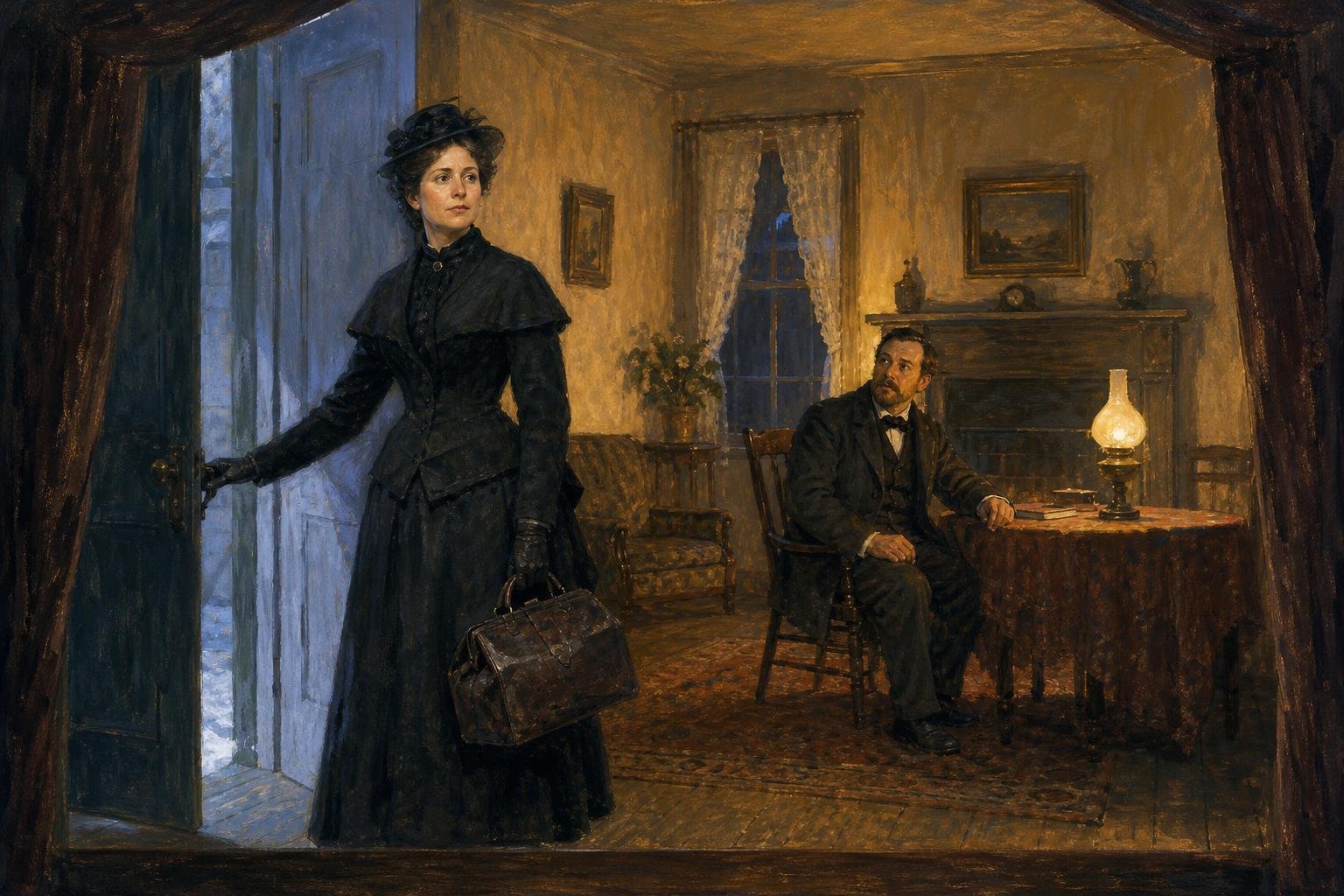

A Doll's House follows Nora Helmer, who secretly borrowed money on her father's forged signature to save her husband's life. When the forgery comes out, Torvald thinks first of his reputation, and Nora leaves him. Each act turns on that one secret: who knows about it, who controls it, and what it costs once it is out.
Who Wrote It and When
The version of A Doll's House Henrik Ibsen finished in 1879 is a realist play in three acts. It was published that year and first performed at Copenhagen's Royal Theatre on December 21. The dialogue is everyday prose and the setting is a family home, so ordinary middle-class life takes up the whole stage.
All of the action happens in the Helmers' living room over three days around Christmas. Some English translations call the play A Doll House, so a Doll House summary on a reading list is about the same text. The difference is the translator's choice, and it doesn't change the story.
Act One: Christmas Eve and the Secret Loan
Nora comes home with Christmas presents and hides macaroons from Torvald. He calls her his "little lark" and scolds her for spending. Money should soon be easier, though, because he has just been made manager of the bank.
Nora's widowed friend, Kristine Linde, comes to town seeking work. During her visit, she learns of Torvald's appointment, which offers her an employment opportunity. Nora wants to show she isn't the spoiled child Kristine takes her for, so she tells her a secret. Years earlier Torvald was seriously ill, and Nora paid for a year in Italy to restore his health. Torvald believes her father paid. In fact she borrowed the money, and she has been paying it back quietly out of the housekeeping and by doing copying work.
Her lender is Nils Krogstad, a clerk at Torvald's bank. He is about to be dismissed so that Kristine can take his job. He has a hold on Nora because her father's signature on the loan guarantee is dated three days after her father died. If Krogstad loses his post, he can show that date to anyone. He wants Nora to protect his job, and he makes clear what happens if she doesn't. The people around Nora are linked by debts, jobs and old loves, and the table shows how.
A Doll's House summary: characters and their connections
| Character | Role in the play | Key character connections | Relationship tension |
|---|---|---|---|
| Nora Helmer | Torvald's wife; mother of three | Kristine's friend; Krogstad's borrower; Anne-Marie's former charge | Conceals independent decisions within a marriage built on obedience |
| Torvald Helmer | Newly appointed bank manager | Nora's husband; Krogstad's superior; Dr Rank's friend | Treats Nora as dependent and places high value on respectability |
| Kristine Linde (Mrs Linde) | Widow seeking paid employment | Nora's old friend; Krogstad's former love | Previously chose a financially secure marriage over Krogstad |
| Nils Krogstad | Bank clerk and widowed father | Nora's creditor; Torvald's employee; Kristine's former love | Fears losing both his livelihood and his chance to restore his reputation |
| Dr Rank | Physician with a terminal illness | Close friend of the Helmers; secretly loves Nora | His feelings complicate Nora's reliance on his friendship |
| Anne-Marie | Nursemaid in the Helmer household | Raised Nora; now cares for Nora's children | Gave up raising her own daughter to take paid work as a nursemaid |
| Ivar, Bob and Emmy | Nora and Torvald's three children | Cared for by Nora and Anne-Marie | Their dependence on caregivers sharpens the play's questions about parental duty |
The character map identifies Nora and Torvald's family, Kristine and Krogstad's former romance, Dr Rank's attachment to Nora, and Anne-Marie's caregiving role.
Torvald knows nothing of what Nora did. That evening he condemns Krogstad's own earlier forgery and says dishonest parents poison their children. Nora hears it as a verdict on herself.
Act Two: Waiting for the Letter
On Christmas Day, Nora begs Torvald to keep Krogstad on, but he sends the dismissal notice. Nora then considers asking Dr. Rank for help. He tells her he is dying and confesses his love; she can no longer ask him for money.
Krogstad arrives and demands a better position at the bank. He drops a letter revealing the forgery into the locked mailbox; only Torvald has the key. After he leaves, Nora tells Kristine about the forgery and the letter. Kristine offers to appeal to Krogstad.
In the meantime Nora keeps Torvald away from the mailbox by rehearsing the tarantella she will dance at a costume party upstairs. She dances so wildly that he agrees to leave the post until the party is over. She privately hopes he will take the blame for the forgery when he reads the letter, and she means to kill herself before she lets him make that sacrifice.
Act Three: Kristine's Choice and Dr. Rank's Farewell
While the party goes on, Kristine meets Krogstad. They were lovers once, until she married a man who could support her mother and brothers. Now she proposes that they build a life together. Krogstad is moved, and he offers to take back his letter unread.
Kristine tells him to leave it. She thinks the Helmers need the truth out in the open, and that more hiding won't help them. Krogstad can stop the letter, and she is the one who decides he shouldn't.
The Helmers come back down, and Dr. Rank calls in. He jokes that at the next masquerade he will go as an invisible man. Later Torvald unlocks and empties the mailbox, then notices Rank's visiting cards, each marked with a black cross. Nora explains what they mean: Rank is saying goodbye and shutting himself away to die. Torvald then opens Krogstad's letter.
The Two Letters
The first letter sets out the loan and the forgery. Torvald calls Nora a hypocrite and a criminal, and his main fear is that Krogstad now has power over him. He tells her she can stay in the house for the sake of appearances, but she must not bring up their children. The sacrifice Nora had hoped for and dreaded doesn't happen.
The second letter comes from Krogstad after his talk with Kristine. It returns the forged bond and drops his threat. Torvald burns the papers, says "I am saved," and forgives Nora. He thinks the matter is over. Nora can't forget how he behaved while the danger was real.
Nora's Final Conversation With Torvald
Nora changes into her everyday clothes and asks Torvald to sit down. She says that in eight years of marriage they have never had a serious talk. She was her father's doll-child and then her husband's doll-wife, and now she has to leave and educate herself.
Torvald reminds her of her duties as a wife and mother. Nora says she has a duty to herself as well. She gives back her ring and leaves her keys. She tells him they could only have a real marriage if both of them changed completely. Then she goes, and the street door closes behind her. Nora plans to stay with Kristine that night and return to her old home the next day. The play leaves her eventual fate and any return to Torvald unresolved.
The German theatre manager Chéri Maurice and actress Hedwig Niemann-Raabe demanded a different ending; she refused to play a mother who leaves her children. Warned that an unauthorized adaptation might replace his text, Ibsen supplied an alternative in which Nora collapses at the children's bedroom door instead of leaving. In a letter dated February 17, 1880, he condemned the change and said its use was against his wishes.
Key Takeaways
- The trip to Italy saves Torvald and leaves a hidden debt inside the marriage.
- Krogstad uses Nora's forged signature to blackmail her; the impossible date exposes it, and she admits signing her father's name.
- Kristine stops Krogstad from taking back his letter, and that lets the truth come out.
- Torvald's response to the first letter ends Nora's belief that he would protect her.
- The plot of A Doll's House ends with Nora walking out, and her future is left unknown.
Frequently Asked Questions
What Is the Main Message of A Doll's House?
A marriage can't be real when one partner treats the other as a possession. Nora decides she has to understand herself before she can be anyone's equal partner.
Why Was the Ending of A Doll's House So Controversial?
Nora's decision to leave her husband and three children challenged expectations of a wife's and mother's duties. The German alternative ending described above arose from specific theatrical demands and the threat of an unauthorized adaptation, not simply from audience objections.
Why Is A Doll's House So Famous?
Nora's exit turned a domestic story about a debt into a public argument about marriage and personal freedom. Arguments over that slammed door helped make the play one of the most widely staged works in modern theater.
What Is Nora's Tragic Flaw in A Doll's House?
The term fits only loosely, because Nora isn't a classical tragic hero. Naivety is the usual answer: she doesn't understand how serious the forgery is in law, and she expects Torvald to behave like a hero.
Is A Doll's House a Tragedy or a Comedy?
It is a realist drama, often called a problem play, and can also be read as a modern tragedy. Its light domestic scenes give way to a serious marital conflict; realism does not rule out tragedy.
Why Does Nora Forge Her Father's Signature?
Her father was dying, and she didn't want to worry him or tell anyone how ill Torvald was. She believed that saving her husband's life justified signing the guarantee herself.
Nora Leaves the Doll's House
Nora's leaving comes down to her seeing that Torvald's love depended on things staying comfortable. When the first letter put his reputation at risk, he turned her out of their children's lives. When the second letter removed the risk, he forgave her. Nora's exit rests on that reversal. She was hoping for a sacrifice, and what she got was a husband who changed his mind once he was safe.