
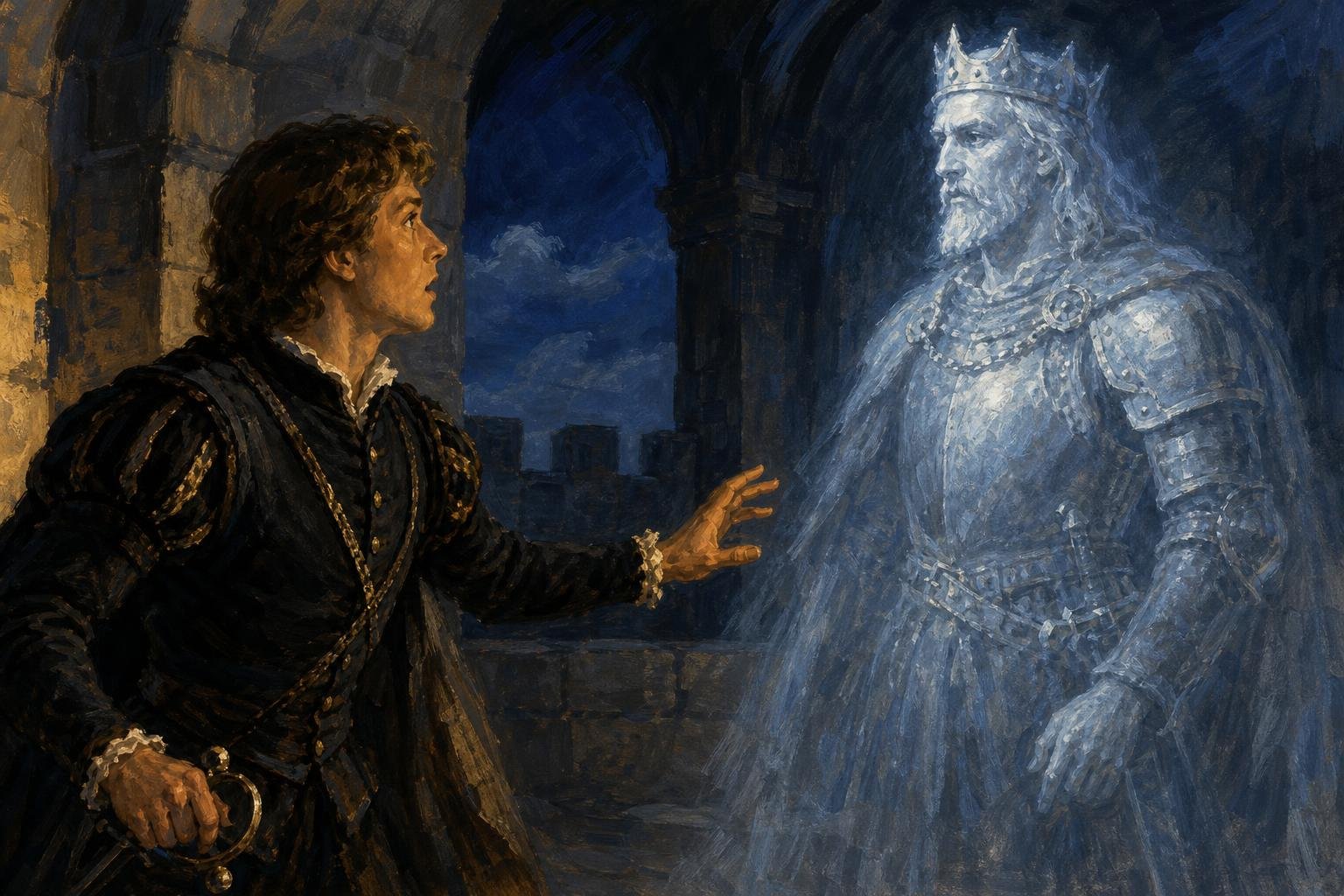

Hamlet is a Danish prince whose dead father appears as a ghost on the castle battlements and names his murderer: Claudius, the dead king's brother, who now holds the crown and has married the widow. Hamlet sets out to prove the charge and take revenge. By the last scene the king, the queen, the prince and the counselor's whole family are dead. This Hamlet summary takes the play act by act, following what Hamlet learns in each one and what that knowledge costs.
Who's Who at Elsinore
Hamlet comes home to a court that has gone from a funeral to a wedding inside a month. His mother, Gertrude, has married his uncle Claudius, and Hamlet's disgust pours out: "Frailty, thy name is woman."
Around that marriage stand the play’s principal characters. Polonius, the king's long-winded counselor, has a son, Laertes, who is leaving for France, and a daughter, Ophelia, whom Hamlet has been courting. Horatio, a friend from university at Wittenberg, is the only person Hamlet trusts. Norway's Prince Fortinbras is raising men to win back lands his father lost to Hamlet's father.
Act 1: A Ghost Accuses the King
At midnight the guards show Horatio a figure in armor that looks like the dead king. At court, Claudius scolds Hamlet for mourning too long and sends ambassadors to Norway to hold Fortinbras back. After the court departs, Horatio and the guards tell Hamlet about the ghost. Laertes and Polonius warn Ophelia that Hamlet's vows mean nothing. That night, Hamlet joins the watch.
Alone with Hamlet, the ghost tells how it died. Claudius crept into the orchard where the old king slept and poured a vial of "cursed hebona" into his ear. He died unconfessed.
The ghost wants revenge but forbids Hamlet to touch Gertrude. Hamlet swears his friends to secrecy and warns them that he may "put an antic disposition on": pretend to be mad.
Act 2: Spies and a Plan
Ophelia runs to her father in terror. Hamlet came into her room half-dressed, "pale as his shirt, his knees knocking each other." He gripped her wrist, stared at her, sighed, and backed out without a word.
Polonius is sure this is love driven mad, since he had ordered Ophelia to turn Hamlet away. Claudius is less sure. He sends for Rosencrantz and Guildenstern, two of Hamlet's school friends, to find out what is wrong, and Hamlet gets them to admit they were sent for.
Then a company of actors arrives. One weeps as he performs a speech about Hecuba, queen of fallen Troy. Alone afterward, Hamlet turns on himself ("O, what a rogue and peasant slave am I!") because an actor can cry over a story while he does nothing for a murdered father.
His shame turns into a plan. The players will act out a murder like the ghost's before the king. The ghost might be a devil, so Hamlet wants proof: "the play's the thing / Wherein I'll catch the conscience of the king."
Act 3: The Play Within the Play
Claudius and Polonius hide to watch Hamlet meet Ophelia. After "To be, or not to be," Hamlet tells her "I did love you once," then "I loved you not," and orders her to a nunnery. Claudius decides to send him to England.
That night, when the player-murderer pours poison into a sleeping king's ear, Claudius stands, calls for lights and leaves. Hamlet has his proof. Soon after, he finds Claudius kneeling alone: "O, my offence is rank, it smells to heaven." Hamlet draws his sword, then puts it away, because a man killed at prayer might go to heaven. Claudius gets up: "My words fly up, my thoughts remain below."
In Gertrude's room, Hamlet frightens his mother into crying for help. A voice behind the arras echoes her, and Hamlet stabs through the hanging, hoping it is the king. It is Polonius. The ghost appears again, and Gertrude, who cannot see it, takes this as proof that her son is mad.
Act 4: Exile, Madness, and a Second Avenger
Claudius ships Hamlet to England with Rosencrantz and Guildenstern, who carry sealed letters ordering his execution. On the road Hamlet passes Fortinbras's army marching to fight for a scrap of Poland, and he condemns his own delay once more.
A letter from Hamlet tells Horatio that pirates attacked his ship. Hamlet boarded theirs, became their prisoner and secured his return to Denmark in exchange for a favor. Rosencrantz and Guildenstern sail on to England. Only in Act 5, Scene 2 does Hamlet explain what happened before the attack: he opened his escorts' letters, discovered his death sentence and substituted an order to execute the bearers, sealing it with his father's signet ring.
At Elsinore, Polonius's death has broken Ophelia, who sings scraps of songs and hands out flowers. Laertes storms in with a mob, and Claudius points his anger at Hamlet. They agree on a fencing match. Laertes will fight with a sharp blade dipped in poison, and Claudius will keep a poisoned cup ready.
Gertrude brings the final news. Ophelia was hanging garlands on a willow when a branch broke and she fell into the brook. Her clothes, "heavy with their drink," pulled her down to "muddy death."
Act 5: The Graveyard and the Poisoned Duel
A gravedigger throws up a skull that belonged to Yorick, the jester who carried Hamlet on his back when he was a boy. "Alas, poor Yorick! I knew him, Horatio."
The grave is for Ophelia, who gets only shortened rites because her death may have been suicide. Laertes jumps into the grave, and Hamlet jumps in after him: "I loved Ophelia. Forty thousand brothers / Could not… make up my sum."
At the match, Gertrude drinks from the poisoned cup to toast her son. Laertes wounds Hamlet, the two swap blades in a scuffle, and Hamlet wounds Laertes with the poisoned one. Gertrude falls. As he dies, Laertes names the king.
Hamlet stabs Claudius and forces the last of the wine down his throat, and he and Laertes forgive each other. When Horatio reaches for the cup to die too, Hamlet takes it from him: someone has to tell the story. Hamlet dies predicting that Fortinbras will be elected king and giving him his support. Fortinbras arrives with English ambassadors, who report that Rosencrantz and Guildenstern are dead, and he claims the throne.
Why Hamlet Waits
The clearest delay in the play is the drawn sword over the kneeling king. Hamlet has his proof and Claudius is alone, but Hamlet waits so that his uncle will not go to heaven. Claudius's prayer was empty anyway, so the reason for waiting was wrong.
Hamlet voices reasons for particular delays, but not a settled explanation for all his inaction. In Act 4, Scene 4, he weighs forgetfulness against excessive deliberation and admits that he does not know why he has still not acted. In Act 2 he fears the ghost is a devil, so he sets a trap before striking. Both the actor's tears and Fortinbras's army shame him into scolding himself.
Still, he can act. Minutes after sparing Claudius, he stabs blindly through a curtain, and at sea he forges a death warrant in one night. Quick, impulsive violence comes easily to him. The planned, justified killing the ghost asked for is the one he keeps putting off.
Key Takeaways
- The ghost accuses Claudius of murder and demands revenge, but Hamlet first wants evidence that it is telling the truth.
- Hamlet announces that he may feign madness, while Claudius uses friends and courtiers to investigate him.
- The staged poisoning convinces Hamlet of Claudius's guilt, but he spares the king when he appears to be praying.
- Hamlet kills Polonius by mistake, setting off Ophelia's breakdown and Laertes' pursuit of revenge.
- Claudius and Laertes turn a fencing match into a murder plot; their poisoned blade and cup kill Gertrude, Laertes, Claudius and Hamlet.
- Hamlet asks Horatio to tell his story and supports Fortinbras, who arrives to claim the throne.
Frequently Asked Questions
Who is Hamlet in love with?
Ophelia is Hamlet's romantic attachment, but his contradictory words and behavior leave his feelings open to interpretation. In a single scene he tells her "I did love you once" and then "I loved you not," and later he kills her father. At her grave he declares that he loved her more than forty thousand brothers could.
Why did Ophelia go mad?
Ophelia goes mad after Hamlet kills her father. Before that, she had rejected Hamlet on Polonius's orders and been used as bait while the king spied on him. Claudius calls her madness "the poison of deep grief."
What is the overall message of Hamlet?
The Hamlet Shakespeare wrote has no single moral, but it shows revenge spreading far beyond its target. One poisoning in an orchard leads to eight more deaths. Waiting offers no guarantee of safety either: while Hamlet delays, Claudius plots against him.
What is Hamlet's most famous quote?
The most famous line is "To be, or not to be: that is the question," from Act 3, Scene 1. In that speech Hamlet weighs putting up with suffering against ending his life. What holds him back is fear of what comes after death.
What is the difference between Hamlet and Hamnet?
Hamlet is the fictional Danish prince, and Hamnet was Shakespeare's real son. Hamnet died in 1596 aged 11 and is the subject of Maggie O'Farrell's 2020 novel "Hamnet." The two names were interchangeable in Shakespeare's time.
What is Hamlet about?
Hamlet is about a son who learns that his father was murdered and finds he cannot simply strike back. The story of Hamlet is a contest between watchers. Claudius spies through Polonius, Ophelia and two school friends, and Hamlet spies through a play.
Revenge Leaves the Throne Empty
Hamlet comes down to this: revenge, once carried out, destroys what it was meant to restore. Hamlet kills Claudius after poison has killed Gertrude and mortally wounded both Laertes and himself. Denmark then passes to Fortinbras, whose father lost his lands to Hamlet's father. The ghost wanted justice for one murder, and the price was the end of its own royal line.