

Is the Odyssey a true story? No. Odysseus’s ten-year voyage home is myth, with no independent evidence that he lived. Real places lie beneath the story; archaeology and the poem’s language help separate its Bronze Age setting from its later composition.
What Is Real, Mythological or Unproven?
| Category | Examples | What the evidence supports |
|---|---|---|
| Places | Troy and Ithaca | Troy is identified with Hisarlık; modern Ithaca broadly fits parts of the poem’s description, but its identification remains disputed. |
| People | Odysseus and Penelope | They are characters in the epic, not independently established historical people. |
| Events | Destruction at Troy | Archaeology establishes destruction, not that Homer’s Trojan War happened as narrated. |
| Adventures | The Cyclops and Sirens | These belong to mythology, not verified accounts of a voyage. |
The Story Being Judged
The Odyssey follows Odysseus, king of Ithaca, home after the Trojan War. He blinds the Cyclops Polyphemus and survives the Sirens while suitors press his wife, Penelope, to remarry.
No record attests to these adventures. Some monsters resemble Mediterranean hazards: ancient writers placed Scylla and Charybdis in the Strait of Messina, where currents meet. Such dangers offered material for storytelling, not proof of the voyage.
A Poem Composed Long After Its Setting
Tradition places the Trojan War around the twelfth century BCE. The epic took shape much later, conventionally in the eighth century BCE, after Mycenaean palace society collapsed.
In Odyssey 9.391–394, Homer compares the hissing of the Cyclops’s injured eye to a smith quenching hot iron in water. The comparison describes metalworking, but does not by itself establish when the passage was composed.
What Archaeologists Found at Troy
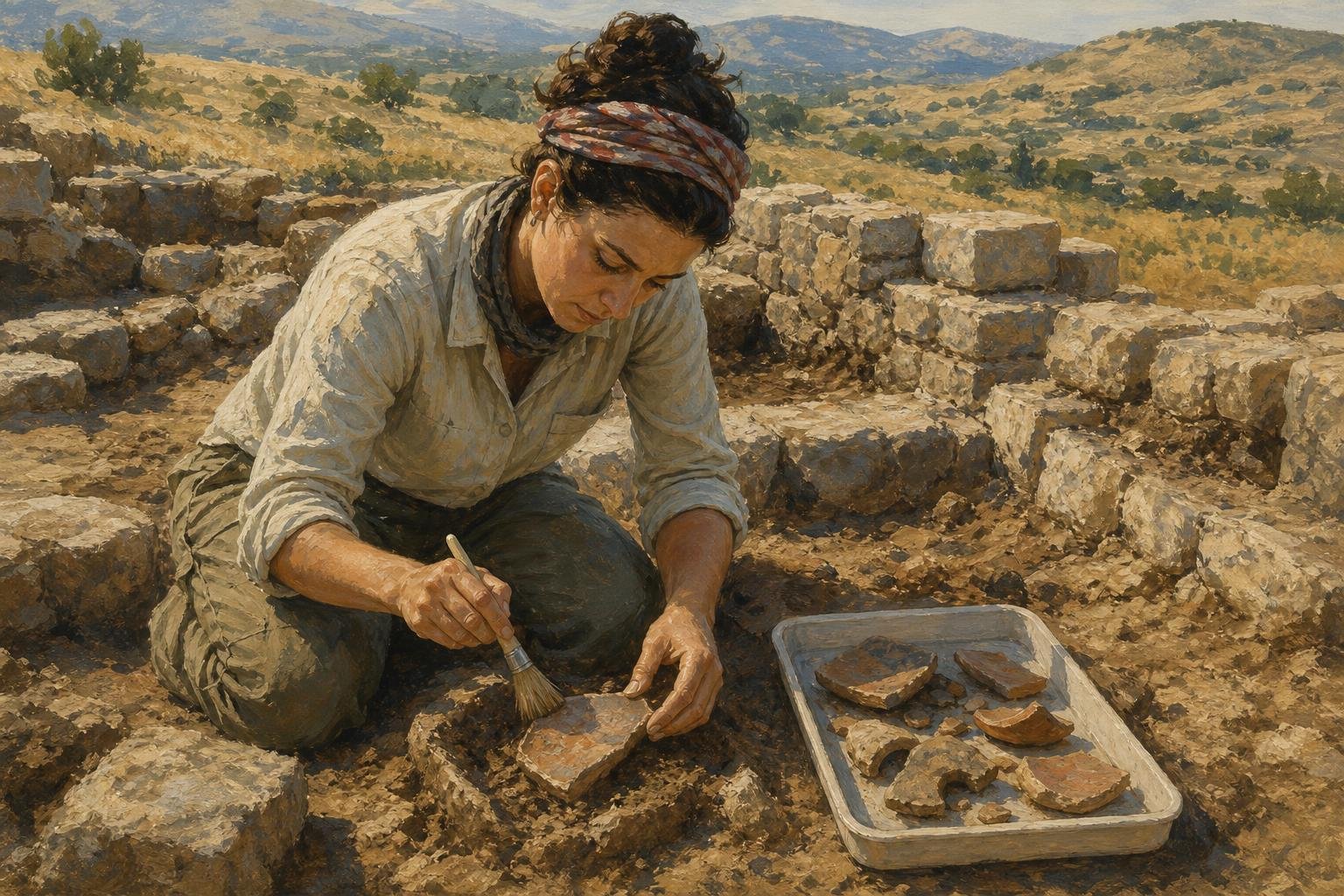
Archaeologists identify Troy with Hisarlık, near the Dardanelles, where Heinrich Schliemann excavated.
Troy VI suffered major damage around 1300 BCE, possibly from an earthquake. Its successor, Troy VIIa, burned around 1180 BCE. Tightly packed houses and storage jars sunk into floors suggest pressure on its inhabitants. These remains establish destruction, but cannot identify which disaster Greek tradition remembered.
Was There a Historical Trojan War?
Hittite texts add evidence beyond the destruction layers. A treaty fragment in the British Museum names Alaksandu, ruler of Wilusa, and the Hittite king Muwatalli II. Hittitologist J. D. Hawkins identifies Wilusa with Troy and discusses a Hittite letter recalling a dispute over Wilusa with the king of Ahhiyawa, widely associated with the Mycenaean Greeks.
Hawkins argues that the Trojan War tradition likely preserves memories of Late Bronze Age events. That provides a possible historical background, not confirmation of Homer’s particular war or Odysseus’s participation.
Ithaca and the Search for a Real Home
Homer’s Ithaca is rocky, suitable for goats but poor for horses. Modern Ithaca, in the Ionian Sea, broadly fits that description and has Bronze Age remains, none securely tied to Odysseus. Later finds attest to his worship: a Hellenistic mask bears a dedication to him. In June 2025, Greece’s Ministry of Culture announced that inscribed roof tiles and other finds identify the island’s “School of Homer” complex as the Odysseion, a shrine to the hero. These establish a later cult, not a Bronze Age king.
Its position fits less well: Homer places Ithaca farthest west, while the modern island lies east of Kefalonia. Resemblance does not settle the identification.
Mycenaean Ithaca: Ithaca or Kefalonia’s Paliki?
Modern Ithaca has Bronze Age remains, but these do not identify Odysseus’s kingdom. An alternative proposal places Homer’s Ithaca on Paliki, the western peninsula of Kefalonia, addressing the poem’s westward location.
In their July 4, 2026 account in Antigone, James Diggle and John Underhill report that geological investigations disproved the proposed Bronze Age sea channel separating Paliki from the rest of Kefalonia. They still argue for Paliki, now interpreting Homer’s Ithaca as a peninsula. This remains a proposed identification, not proof of a Mycenaean kingdom ruled by Odysseus.
Can Anyone Map Odysseus’s Route?
No reliable map fits. After storms carry the ships past Cape Malea, magical inhabitants and incompatible sailing times defeat geographical reconstruction.
Ancient readers recognized the problem. Strabo reports Eratosthenes joking that finding the route would require finding the cobbler who stitched the bag of winds.
Was There a Real Odysseus?
A real Aegean ruler could have contributed to the legend, but possibility is not evidence.
Linear B tablets from Pylos and Knossos preserve palace inventories and name officials, craftsmen and gods. None found so far names Odysseus, leaving no documented ruler to connect with Homer’s hero.
Key Takeaways
- Read the adventures as mythology, not testimony.
- Separate the poem’s setting from its composition.
- Treat archaeological destruction as evidence of destruction, not of every associated legend.
- Distinguish a plausible island description from proof of its king.
- Leave the route unmapped where fantasy replaces geography.
- Keep a possible historical inspiration separate from an identified person.
Frequently Asked Questions
Is the Odyssey fiction?
Yes: its narrative is a mythological epic shaped by oral tradition, though real places anchor parts of it.
Is Odysseus real?
His existence remains unproven. A ruler behind the legend is possible, but no independent record establishes his identity.
Is the Odyssey real?
As a text attributed to Homer, yes. That does not make its narrated events verified history.
Is the Trojan Horse story actually true?
No archaeological or written evidence establishes it as an event. In the Odyssey, Demodocus sings about the horse and Menelaus recalls it; these are episodes within the story, not independent testimony.
Did the fall of Troy actually happen?
The layers discussed above show repeated destruction, not necessarily repeated conquest: Troy VI’s damage is commonly attributed to an earthquake. Whether either destruction represents the war remembered by Greek tradition remains debated.
What is the Odyssey based on?
Generations of oral stories about Trojan War heroes, combined with folktale motifs such as the one-eyed giant and details from the poets’ own world.
Read the Myth, Recognize the History
The Odyssey records how later Greeks imagined an earlier age. Its historical value therefore extends beyond whether a king completed a voyage: the iron-forge comparison reveals something about the storytellers themselves. Read its real settings as anchors for imagination, not guarantees that the surrounding adventures happened.