

How old were Romeo and Juliet? Juliet is thirteen, a little more than two weeks short of her fourteenth birthday, and two characters say so outright. Romeo gets no number at all, so every age you see for him is someone's estimate.
That imbalance runs through the whole play. The women who raised Juliet count her age almost to the day, and her parents argue over what it means. Romeo's age stays a single word: youth.
Juliet's Age in Act 1, Scene 3
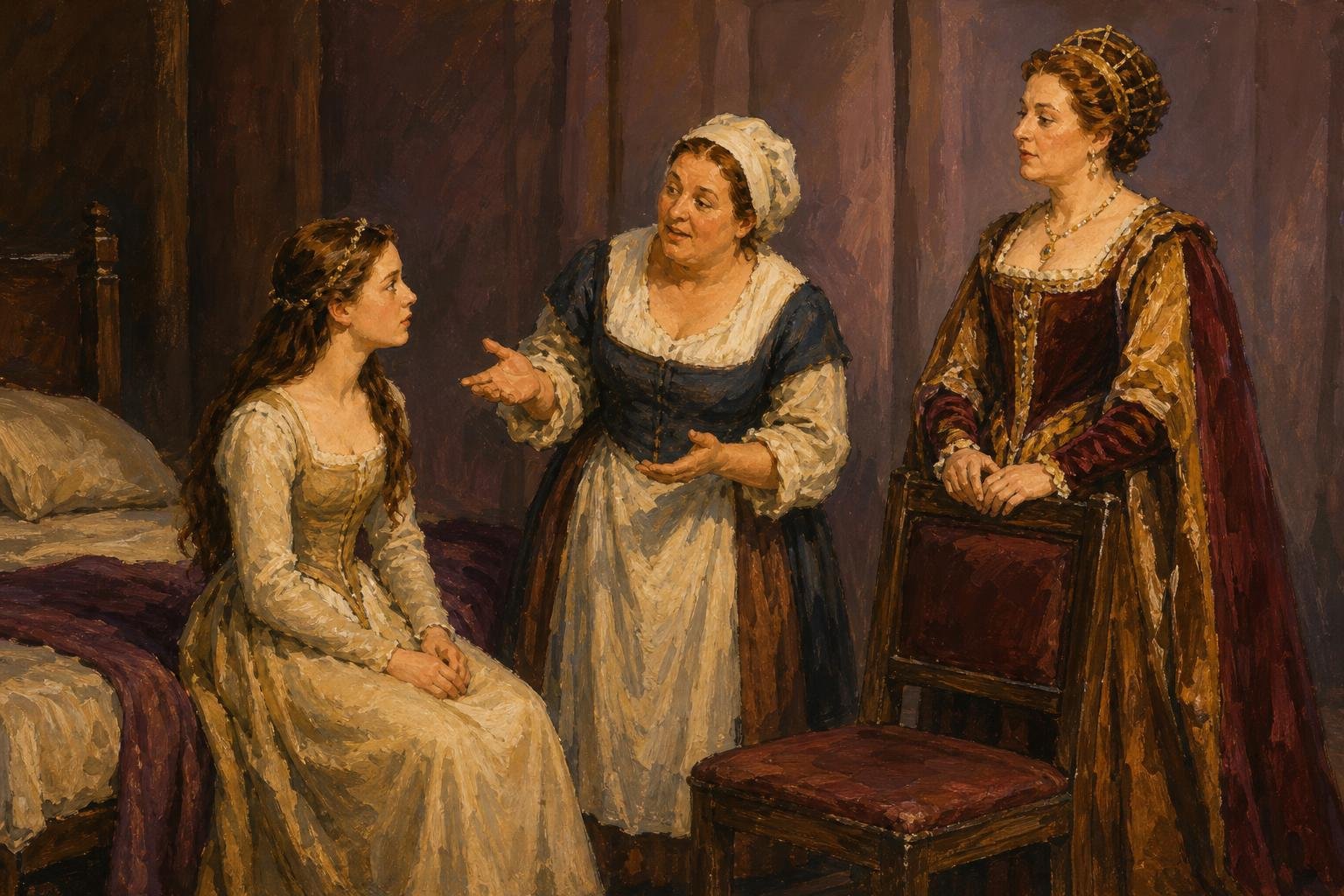
The clearest evidence comes when Lady Capulet calls for her daughter and the Nurse. Lady Capulet says, "Thou know'st my daughter's of a pretty age," and the Nurse answers that she can tell Juliet's age "unto an hour." Lady Capulet states it: "She's not fourteen." The Nurse agrees in her own rambling way: "I'll lay fourteen of my teeth, / And yet, to my teen be it spoken, I have but four, / She's not fourteen."
Then the Nurse keeps going. Her own daughter, Susan, was born at about the same time as Juliet ("Susan and she... were of an age"), and Susan is now dead. Juliet was weaned on the day of an earthquake, "now eleven years" ago, when the Nurse had put wormwood on her breast and sat in the sun under the dovehouse wall. She remembers the toddler falling and breaking her brow, and her late husband joking that Juliet would "fall backward when thou hast more wit."
Each memory pins the count to something the Nurse lived through. When Juliet is asked how she feels about marriage, she answers, "It is an honour that I dream not of." She is thirteen, and nobody in the scene is guessing.
Her Birthday Falls on Lammas Eve
The same scene gives Juliet's birthday. The Nurse asks, "How long is it now / To Lammas-tide?" Lady Capulet replies, "A fortnight and odd days." The Nurse then says, "Come Lammas Eve at night shall she be fourteen."
Lammas is August 1, so Lammas Eve is July 31. That date comes from the church calendar, not the play, but it is standard. The play's own timing matters more: two weeks and more stand between this conversation and the birthday.
The action, from the Capulet feast to the tomb, runs only a few days. Juliet dies at thirteen. A summary that says she "turns fourteen" during the play has no line behind it. The countdown the Nurse starts never reaches its end.
Her Parents Disagree About Marriage
Juliet's age matters to her family before she has met Romeo. In Act 1, Scene 2, Paris asks for her hand, and Lord Capulet stalls him: "My child is yet a stranger in the world; / She hath not seen the change of fourteen years. / Let two more summers wither in their pride / Ere we may think her ripe to be a bride."
Paris pushes back: "Younger than she are happy mothers made." Capulet's reply is sharp: "And too soon marr'd are those so early made." He also tells Paris that his consent is only part of the matter and that Juliet's choice counts.
Lady Capulet takes the other side in the next scene. "I was your mother much upon these years / That you are now a maid," she tells Juliet. She married and gave birth in her early teens, and she sees nothing strange in her daughter doing the same.
Capulet's caution does not last. After Tybalt's death, in Act 3, Scene 4, he sets the wedding to Paris for Thursday, only days away. The man who wanted two more summers now wants speed.
What the Play Says About Romeo
Romeo gets no "not fourteen," no birthday and no count of years. He gets descriptions. At the feast, Capulet stops Tybalt from attacking him by saying that "Verona brags of him / To be a virtuous and well-govern'd youth." Friar Laurence greets him as "young son." The Nurse speaks of "young Romeo."
Youth is the word that keeps coming back, and the play pairs it with a history Juliet does not have. When the play opens, Romeo is already lovesick over Rosaline, and Friar Laurence teases him for dropping her so fast. He has courted before, while Juliet has not even dreamed of marriage. These contrasts may suggest that Romeo is older than Juliet, but that remains an interpretation, not an age established by the dialogue.
His actions do not settle his age either. He roams Verona at night with Mercutio and Benvolio and slips into the Capulet feast in a mask. Later he buys poison from an apothecary in Mantua and kills Paris at the tomb. In Act 3, Scene 1, the Prince banishes him for killing Tybalt without declaring him an adult. Tybalt calls him a "wretched boy" in the same scene; neither the insult nor the punishment supplies an age.
Why the Age Gap Cannot Be Calculated
Juliet's thirteen comes from Act 1, Scene 3. Romeo has no number, so a sentence such as "Romeo was three years older than Juliet" starts from a figure the writer chose. That figure may be sensible. It is still the writer's.
What the text does support is a gap in freedom. Romeo moves through the city as he likes, fights in the street and rides to Mantua alone. Juliet needs a reason to leave her father's house at all. She sends the Nurse to find Romeo and reaches Friar Laurence's cell by saying she is going to confession. The play measures the distance between them in what each is allowed to do, and it never turns that distance into years.
Juliet Is Around Sixteen in Brooke
Shakespeare did not invent the Romeo and Juliet story. One of his main sources was Arthur Brooke's 1562 narrative poem, The Tragical History of Romeus and Juliet, which itself drew on earlier Italian and French prose versions.
In Brooke, Juliet's father says, "Scarce saw she yet full sixteen years" (line 1860), placing her around sixteen rather than giving an unqualified age. Shakespeare's younger heroine can be read as sharpening the plot's haste and danger, especially when her father cuts "two more summers" down to a few days. That remains an interpretation.
The change is plain on the page: Shakespeare made Juliet younger than Brooke's heroine and squeezed Brooke's months of story into a few days. Brooke's qualified wording does not support an exact three-year subtraction.
Casting and Retellings Are Not Evidence
In Shakespeare's own theater, women's roles were played by boy actors, so the first Juliet was a boy. The line "She's not fourteen" was spoken about a character, with no girl of that age anywhere on the stage.
Nearly four centuries later, Franco Zeffirelli's 1968 film cast teenage leads: Olivia Hussey, who was fifteen, and Leonard Whiting, who was seventeen. Hussey was close to Juliet's stated age; Romeo has no stated age to compare with Whiting's. Casting adults in either role does not, by itself, make the characters older.
Each of these choices tells you about its own production. None of them alters what Lady Capulet and the Nurse say.
Key Takeaways
- Juliet is thirteen and approaching her fourteenth birthday.
- Shakespeare never states Romeo's exact age.
- A precise age gap cannot be calculated from the play.
- Juliet's family does not initially agree about her readiness for marriage.
- Different versions and unsupported estimates should not override Shakespeare's dialogue.
Frequently Asked Questions
Why was Juliet only 13?
Shakespeare gives no explicit reason. He made her younger than Brooke's heroine, described as around sixteen, and her father initially thinks she is too young to marry. Reading her youth as heightening the tragedy's haste is an interpretation.
How old was Romeo when he died?
The play does not say. Descriptions such as "youth" and "young Romeo" give no numerical age, at his death or earlier.
Does Juliet reach her fourteenth birthday before the play ends?
No, she dies at thirteen. Her birthday on Lammas Eve is "a fortnight and odd days" away when it is mentioned, and the action ends a few days later.
Does Shakespeare establish a precise age gap between the lovers?
No. Only Juliet's age is given; a numerical gap requires an assumed age for Romeo.
Is a performer's age evidence of the character's age?
No, because casting reflects a production's choices. Boy actors played Juliet in Shakespeare's theater, and many later productions cast adults. The character's age comes from the dialogue.
Does Capulet initially want Juliet to marry immediately?
No. In Act 1, Scene 2 he asks Paris to wait "two more summers." He reverses only after Tybalt's death, when he sets the wedding for Thursday.
Trust the Dialogue, Not the Estimates
Juliet's father, mother and Nurse discuss her age in Act 1, Scenes 2–3; Juliet herself first appears in Scene 3. Their disagreement makes her readiness for marriage a conflict within the play, not merely a question for modern readers. Romeo's freedom offers a contrast, but not a birth date.