
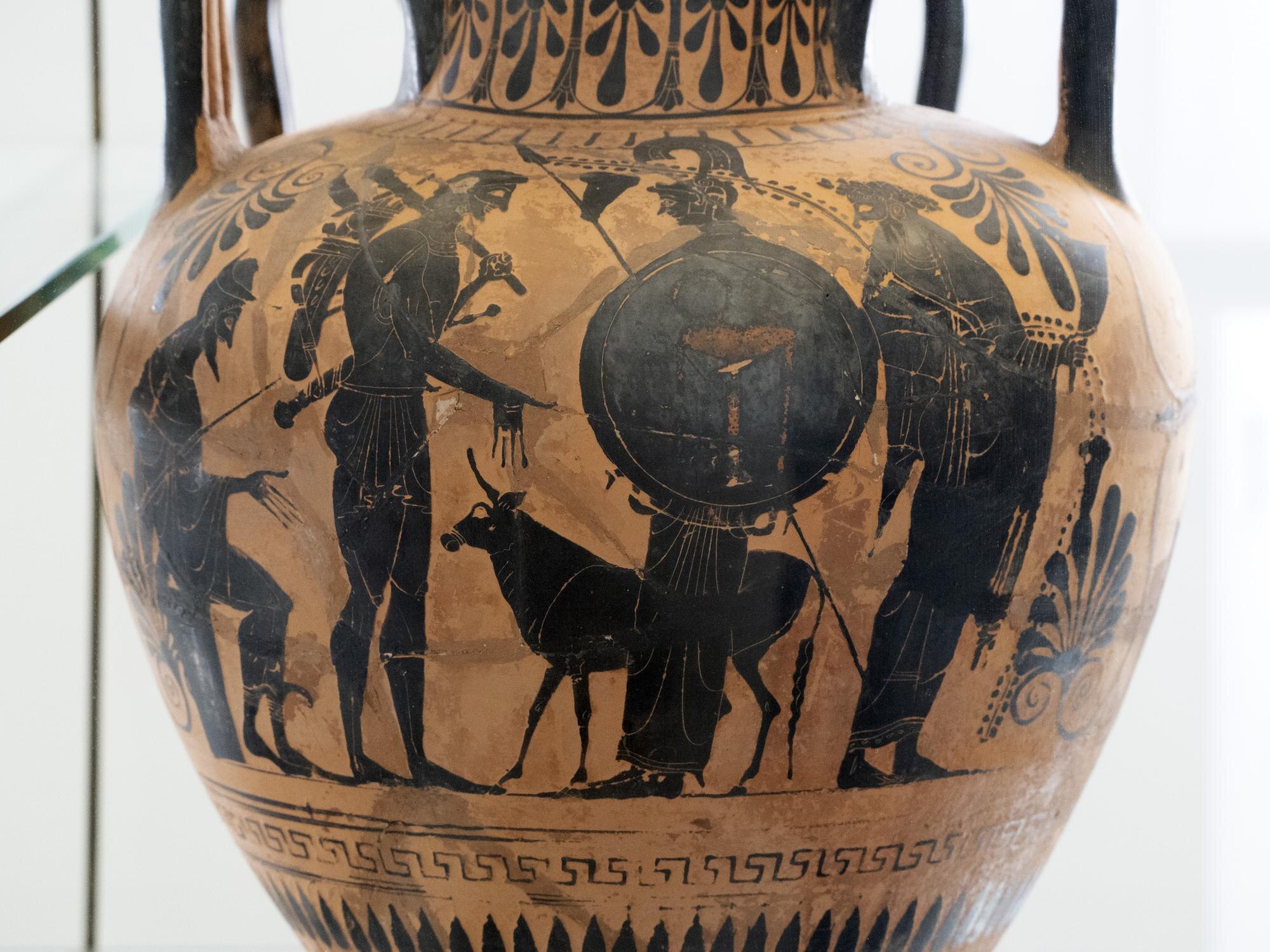

The Iliad and the Odyssey are two separate Greek epics set in the same legendary world, and the Odyssey works in many ways as a sequel. The Iliad covers a few weeks late in the war at Troy, centered on the anger of Achilles. The Odyssey follows Odysseus home from that war and through his fight to win back his household.
Neither poem tells the whole war. The space between them holds some of its most famous events: the death of Achilles, the wooden horse, the burning of Troy. You will not find any of them in the Iliad's action, and the Odyssey gives them only as memories. So the clearest way to see how the poems connect is to ask the same question of each: what falls inside its story, and what does it leave outside?
The War Both Poems Grow From
The Trojan War begins with an abduction, or an elopement, depending on who tells it. Paris, a prince of Troy, carries off Helen, the wife of Menelaus, king of Sparta. Menelaus's brother Agamemnon gathers a Greek army to bring her back, and the siege of Troy drags on for ten years.
That beginning lies outside both poems. Each assumes its audience already knows why the Greeks are camped on the Trojan shore.
The ending lies outside the Iliad too. The wooden horse, the Greeks hidden inside it and the fall of the city surface only later, told and sung in the Odyssey. Homer's audience held the full war in memory. The poems pick their moments from it.
What the Iliad Covers, and Where It Stops
The Iliad opens in the tenth year of the siege. Agamemnon takes Briseis, a captive woman awarded to Achilles, and Achilles withdraws from the fighting in fury. Without their best warrior, the Greeks are driven back toward their ships.
The withdrawal costs Achilles the person he loves most. His closest companion, Patroclus, goes into battle wearing Achilles' armor and is killed by Hector, Troy's greatest defender. Grief turns Achilles' anger away from Agamemnon and onto Hector. He returns to battle, kills Hector and drags the body behind his chariot.
Then the poem goes quiet. Priam, Hector's aged father, enters Achilles' tent at night to ransom his son's body, and Achilles relents. The last book closes with Hector's funeral.
What stays outside is just as telling. Achilles' own death is foretold several times but never shown. Troy is still standing when the poem stops.
What the Odyssey Covers After Troy
The Odyssey picks up ten years after Troy's fall, with Odysseus gone from Ithaca for twenty. In his palace, a crowd of suitors eats through his wealth while pressing his wife, Penelope, to remarry; she stalls them with patience and tricks. Their son, Telemachus, now grown, sails off for news of his father.
Odysseus himself is stuck on the island of the nymph Calypso, who wants to keep him. Released at last, he reaches the court of the Phaeacians and tells the story of his wanderings there. He blinded the Cyclops Polyphemus after giving his name as "Nobody," which won him the hatred of Polyphemus's father, Poseidon. The witch Circe turned his men into pigs. To hear the Sirens and survive, he had himself tied to the mast while his crew plugged their ears with wax.
Those adventures reach us in Odysseus's own voice, which means the Odyssey's most famous episodes are, like Troy, told after the fact. The present-tense story is the homecoming. In the second half, Odysseus returns to Ithaca, where Athena disguises him as a beggar. He tests who has stayed loyal and wins the contest of stringing his own bow. With Telemachus beside him, he kills the suitors and is reunited with Penelope. In the final book, he also reunites with his father, Laertes. The suitors' relatives seek revenge, but Athena halts the fighting and establishes peace. The poem ends not just with a household reclaimed, but with the wider conflict brought to a stop.
How the Two Poems Point to Each Other
The Odyssey keeps looking back at Troy, and the gap the Iliad left open gets filled from inside it. In Sparta, Menelaus tells Telemachus how Odysseus kept the Greeks silent inside the wooden horse. At the Phaeacian court, the singer Demodocus performs the story of the horse, and Odysseus weeps as he listens.
The sharpest link comes in the underworld. Odysseus meets the shade of Achilles, who says he would rather work as a hired laborer on earth than rule over all the dead. In the Iliad, Achilles knew he had a choice between a long, obscure life and a short, glorious one, and he chose glory. His speech questions what glory is worth to the dead. Yet he later leaves pleased at the news of his son's prowess: heroic achievement still matters to him. The Odyssey can be read here as answering the Iliad, but not simply reversing its values.
Agamemnon's shade appears too. He tells how Aegisthus killed him with the help of his wife, Clytemnestra, a betrayal the Odyssey sets against Penelope's faithfulness. Lined up together, the heroes of the two poems pull in different directions:
The Iliad and the Odyssey: battlefield glory versus homecoming
| Hero and epic | Heroic priority | Defining strength | Cost or vulnerability | Defining scene |
|---|---|---|---|---|
| Achilles — Iliad | Win lasting glory; avenge Patroclus | Unmatched fighting power | Anger overrides restraint; victory cannot restore Patroclus | Book 22: kills Hector and drags his body behind his chariot |
| Hector — Iliad | Defend Troy and preserve family honor | Courage rooted in public duty | Facing Achilles leaves Andromache widowed and his son fatherless | Book 6: returns to battle after meeting Andromache and their son |
| Odysseus — Odyssey | Return to Ithaca and reclaim his household | Cunning, disguise, and endurance | Pride endangers his return when he reveals his name to the Cyclops | Book 13: accepts Athena’s beggar disguise rather than returning openly |
| Penelope — Odyssey | Preserve her household and verify her husband’s return | Strategic delay and careful testing | Must resist pressure from suitors without knowing whether Odysseus lives | Book 23: tests Odysseus with the secret of their immovable marriage bed |
Homer, Oral Tradition, and Poetic Form
Ancient Greeks credited both poems to Homer, but almost nothing about him is certain. Scholars still debate whether one poet composed both, whether two poets did, or whether each poem took shape over generations of performance.
Both poems are in dactylic hexameter, the standard line of Greek epic, and each is divided into 24 books, a division likely added by later scholars. The meter matters because it explains the repetitions every reader notices: "swift-footed Achilles," "rosy-fingered Dawn." In the 1920s and 1930s, Milman Parry showed that these stock phrases are built to fit the hexameter line, ready-made pieces a poet could drop in wherever a name or a sunrise was needed.
Parry then went looking for living proof. He and his student Albert Lord recorded South Slavic singers who could still perform long heroic poems with no written text, composing as they sang. Lord set out the findings in The Singer of Tales in 1960. The Homeric epics most likely took shape the same way.
Which to Read First, and in Which Translation
You can read the Odyssey without the Iliad. It tells you what you need about Troy through Menelaus, Demodocus and Odysseus himself, and its adventures carry newcomers easily. Reading the Iliad first pays off in particular scenes, though: the underworld meeting with Achilles lands harder once you have watched him choose glory and mourn Patroclus.
Homer's Iliad and Odyssey have been translated many times, and the first line of the Odyssey shows how much a translator changes. Homer calls Odysseus "polytropos," a man of many turns.
- Richmond Lattimore stays close to the Greek, line for line, and keeps spellings like "Achilleus." His opening: "Tell me, Muse, of the man of many ways."
- Robert Fitzgerald writes flowing, literary verse that reads well aloud: "Sing in me, Muse, and through me tell the story / of that man skilled in all ways of contending."
- Robert Fagles uses energetic, dramatic modern English and remains common in classrooms: "Sing to me of the man, Muse, the man of twists and turns."
- Emily Wilson published her Odyssey in 2017 and her Iliad in 2023, both in plain contemporary English with a steady meter, and her Odyssey matches the Greek line count. She opens with "Tell me about a complicated man."
Read Wilson's Odyssey first and Fagles's Iliad second. Save Lattimore for when you want the Greek showing through the English.
Key Takeaways
- These are two separate Greek epic poems, not two titles for one work.
- Both are traditionally attributed to Homer and grew from oral storytelling.
- The Iliad follows Achilles during a limited period of the Trojan War.
- The Odyssey follows Odysseus’ return and the recovery of his household.
- Reading the Iliad first supplies context, but either poem can stand alone.
Frequently Asked Questions
What's the difference between the Iliad and the Odyssey?
The Iliad is a war poem about anger, honor and grief that ends with a funeral, while the Odyssey is a homecoming poem about cunning and endurance that ends with a household restored.
What is the famous line from the Iliad?
The most famous line is the first, usually rendered as something like "Sing, goddess, the rage of Achilles, son of Peleus." The Greek opens with the word "menin," meaning wrath or rage. Each translator words it differently, but the anger it names drives the whole poem.
Who finally kills Achilles?
Paris kills Achilles with an arrow guided by the god Apollo, according to later Greek tradition. In the Iliad, the dying Hector predicts that Paris and Apollo will kill Achilles at Troy's Scaean gate, without specifying how. In the Odyssey's final book, Agamemnon's shade describes Achilles' funeral.
Are the Iliad and the Odyssey related?
Yes, they share a war and a cast. Odysseus, Agamemnon, Menelaus, Helen and the old king Nestor appear in both. As the section on how the poems point to each other shows, the Odyssey picks up threads the Iliad leaves loose.
Are the Iliad and the Odyssey the same thing?
No, they are two complete poems, each with its own hero and its own 24 books.
When were the Iliad and the Odyssey written?
Most scholars place their composition in the 8th or 7th century BCE, and many think the Odyssey came somewhat later than the Iliad. When and how they were first written down is still debated.
Two Epics, Different Human Struggles
Reading the poems together brings their competing values into focus. The Iliad pursues glory through anger and grief, but Achilles' meeting with Priam also makes room for compassion. The Odyssey gives the dead Achilles a speech that values life above power among the dead, without erasing his pride in his son's achievements. Neither poem offers a simple choice between glory and survival. Their connection lies in the questions they share: what achievement costs, what the dead retain, and what the living owe one another.