
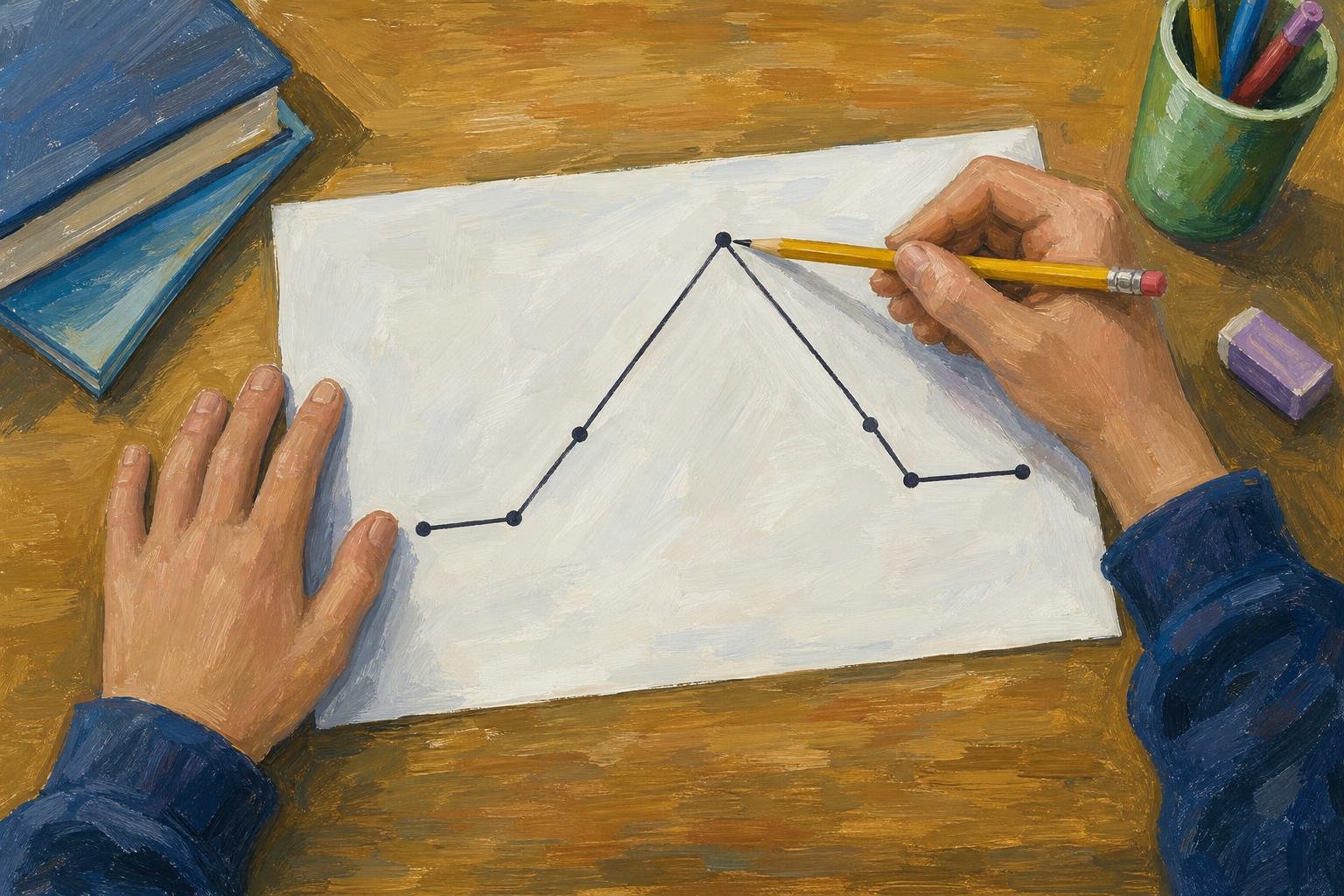

A plot diagram maps a story’s major events by showing how they develop and resolve its central conflict. Read it from left to right, looking for what each event changes. A Cinderella chart can include the ball, the midnight escape, and the wedding yet still fail to explain the story if it leaves out the slipper fitting that connects the escape to the ending.
That missing connection matters more than a perfectly drawn triangle. The examples below show how to find it and build a chart around it.
What the Diagram Shows
A story plot diagram turns a sequence into an explanation. “Cinderella dances, runs away, and loses a slipper” records actions. “Cinderella flees before revealing her identity, leaving the slipper as a way to identify her” connects those actions to a consequence.
That consequence gives the next event a reason to happen. Without the lost slipper, this account has not explained how the prince can find the unknown guest. A useful event label therefore does two jobs: it names what happens and shows what becomes possible, necessary, or impossible afterward. Keep the connection. Cut the decorative detail.
Read the Stages From Left to Right
The parts of a plot diagram mark changes in the conflict. Exposition establishes the opening situation; the inciting incident disrupts it. Rising action develops the struggle until the climax determines its direction. Falling action follows that turn, and resolution shows the resulting situation, also called the dénouement.
Read the stages in order, following how each one changes the central conflict.
| Order | Stage | What to look for |
|---|---|---|
| 1 | Exposition | The opening situation, characters, and stakes. |
| 2 | Inciting incident | The disruption that sets the main action in motion. |
| 3 | Rising action | Attempts, obstacles, and consequences that develop the struggle. |
| 4 | Climax | The decisive turn that determines the conflict’s direction. |
| 5 | Falling action | The immediate consequences of that turn. |
| 6 | Resolution (dénouement) | The resulting situation and what has changed. |
Charles Dickens’s A Christmas Carol makes those connections visible. Scrooge’s encounters with the spirits matter because they confront him with reasons to change; a chart that merely lists each visitor misses that pressure.
| Plot diagram part | Question it answers | Connection to the next part | Example: A Christmas Carol |
|---|---|---|---|
| Exposition | Who wants what, and what could be lost? | Establishes the situation the inciting incident disrupts. | Scrooge lives as a miser and rejects Christmas generosity. |
| Inciting incident | What makes action necessary now? | Gives rising action a specific goal and stakes. | Marley’s ghost warns Scrooge that three spirits will visit him. |
| Rising action | What attempts and obstacles lead to the decisive moment? | Builds the case and pressure that converge at the climax. | The spirits confront Scrooge with his past, the present, and a possible future. |
| Climax | What decides the central conflict’s direction? | Produces the outcome whose immediate effects become falling action. | Facing his own grave, Scrooge promises to change his life. |
| Falling action | What changes immediately because of that decision? | Connects the decisive outcome to the settled situation. | Scrooge wakes on Christmas morning and sends a turkey to the Cratchits. |
| Resolution (dénouement) | What is the resulting situation? | Completes the arc by showing what changed from the opening. | Scrooge becomes generous and helps Tiny Tim. |
A plot structure diagram makes that mounting pressure visible through its rising slope. Tension is pressure for something to change.
Find the Turning Point Before Filling Every Space
Locate the turning point before distributing events across the chart. Write the central conflict as a question, then compare the strongest candidates against it. For Cinderella, “Will she attend the ball?” and “Will she escape her mistreatment and be recognized?” produce different charts because they ask different questions.
Against the second question, compare the midnight escape with the slipper fitting. The escape threatens Cinderella’s connection with the prince and leaves her identity unknown. The fitting settles that uncertainty. One scene creates the problem that the other resolves.
The escape may feel more dramatic: the deadline arrives, Cinderella runs, and the slipper falls behind. Yet drama alone does not make it the climax. Choose the fitting for a chart centered on recognition; choose a different turning point only if you can explain the different conflict your chart follows.
Map The Three Little Pigs’ Key Events
This plot diagram example follows “The Story of the Three Little Pigs” in English Fairy Tales, collected by Joseph Jacobs and available through Project Gutenberg. In this version, the wolf eats the first two pigs; they do not escape to their brother’s house. The chart focuses on whether the third pig can survive the wolf’s attacks.
With that focus settled, group the failed attack on the brick house and the wolf’s further tricks as rising action. The house provides protection, but the wolf remains a threat. Here, the climax combines his fall into the pot with the pig’s immediate replacement of its lid. The chart separates that decisive capture from its consequences. These stage assignments interpret the events through the stated conflict.
| Plot diagram stage | The Three Little Pigs event | Role in the plot |
|---|---|---|
| Exposition | A sow has three little pigs but cannot support them. | Establishes why the pigs must leave their mother’s care. |
| Inciting incident | She sends them out to seek their fortune. | Sets their independent lives and encounters with the wolf in motion. |
| Rising action | The wolf destroys the first two pigs’ houses and eats them. He cannot blow down the third pig’s brick house. The third pig outwits him over turnips, apples, and a trip to the fair. | Establishes the danger and shows that protection and temporary escapes have not ended it. |
| Climax | The wolf comes down the chimney, falls into the waiting pot, and is trapped when the pig replaces the lid. | Reverses their positions: the hunter becomes the captive. |
| Falling action | The pig boils the wolf and eats him for supper. | Carries the capture through to the wolf’s destruction. |
| Resolution | The third pig lives happily afterward. | Confirms his survival and the end of the wolf’s threat. |
These final events occur close together, but their functions differ: the capture turns the conflict, the wolf’s destruction follows from it, and the ending confirms the pig’s changed situation. Preserve that sequence rather than inventing another adventure to fill the falling-action space.
Support Event Labels With Textual Evidence
“Cinderella goes to the ball and eventually marries the prince” is a weak summary because “eventually” hides the explanation. It skips the evidence that connects the mysterious guest to the person the prince marries. A chart can contain accurate events and still have a hole in its reasoning.
Repair that hole with a precise paraphrase or brief quotation from the fitting scene. Add a page, paragraph, or line reference from the edition you are using so another reader can locate it; page numbers differ between editions. Then explain the consequence: the fitting establishes her identity. The reference locates the evidence. Your explanation shows why it belongs at the peak.
Choose a Format That Fits the Story
A beginning-middle-end organizer suits a reader who can follow Cinderella’s broad change but cannot yet separate the fitting from its aftermath. A six-part chart suits a closer argument about those adjacent moments. More boxes help only when the distinctions explain something.
Some endings refuse the closure those boxes appear to promise. Frank R. Stockton’s “The Lady, or the Tiger?” ends without revealing whether the opened door releases a woman or a tiger. Its final situation is uncertainty, not a settled rescue or death. Put that uncertainty in the resolution space; do not supply an outcome the story withholds.
Plot elements also need different treatment when the telling moves backward in time. For Scrooge’s remembered childhood, a timeline can show when the events happened, while a pyramid can show when those memories begin changing him. The format should preserve the distinction your argument needs.
Key Takeaways
- Connect an event to its consequence; a list of scenes leaves the reader to supply the logic.
- State the conflict before choosing between competing turning points.
- Use the climax label for the decisive change, even when another scene feels more dramatic.
- Support disputed labels with a passage and an explanation of what it changes.
- Let an unresolved ending remain unresolved on the chart.
Frequently Asked Questions
These questions use Scrooge’s encounters with his past to show how one story can require different mapping choices.
What is a plot diagram?
A plot diagram is a visual explanation of how important events develop a story’s conflict. In Scrooge’s case, it connects the spirits’ visits to his change of conduct instead of treating the visits as an itinerary.
Can more than one event belong in a single stage?
Yes, a stage can contain several events that perform the same structural job. Scrooge’s visits to the past and present can share the rising-action slope because both prepare his confrontation with the future.
What should students do when two events both seem like the climax?
Students should compare which candidate most decisively answers their stated conflict. For “Will Scrooge change?”, weigh his promise at the grave against his generous actions after waking. The first establishes his commitment; the later actions demonstrate that he keeps it.
Does every stage need the same amount of space?
No, space should follow the amount of explanation each stage needs. Scrooge’s encounters may need several labels, while his promise at the grave needs one. Equal-sized worksheet boxes do not require equal numbers of events.
Should a flashback be placed where it appears or when it happened?
Place a flashback where readers encounter it when mapping the telling, and where it happened when mapping chronology. Scrooge’s childhood belongs early on a life timeline but within the spirits’ visits on a diagram of his transformation. Label the approach so a remembered event does not look like a new present-day action.
Can two different charts of the same story both be defensible?
Yes, two charts can be defensible when they state their focus and support their choices. A chronology of Scrooge’s life and a diagram of his Christmas transformation serve different purposes. Neither should silently switch between those purposes midway through.
Start With the Story’s Turning Point
Put A Christmas Carol to the test without copying the table. Draw two small charts: one with Scrooge’s promise at the grave at the peak, another with his first generous action after waking there. Write the same conflict question above both. Then explain what each choice makes you classify as falling action.
The stronger chart is the one whose consequences follow clearly from its peak, with fewer strained labels. If neither works, revise the question before adding more events. Use a timeline beside the pyramid if the remembered childhood keeps confusing the order.