
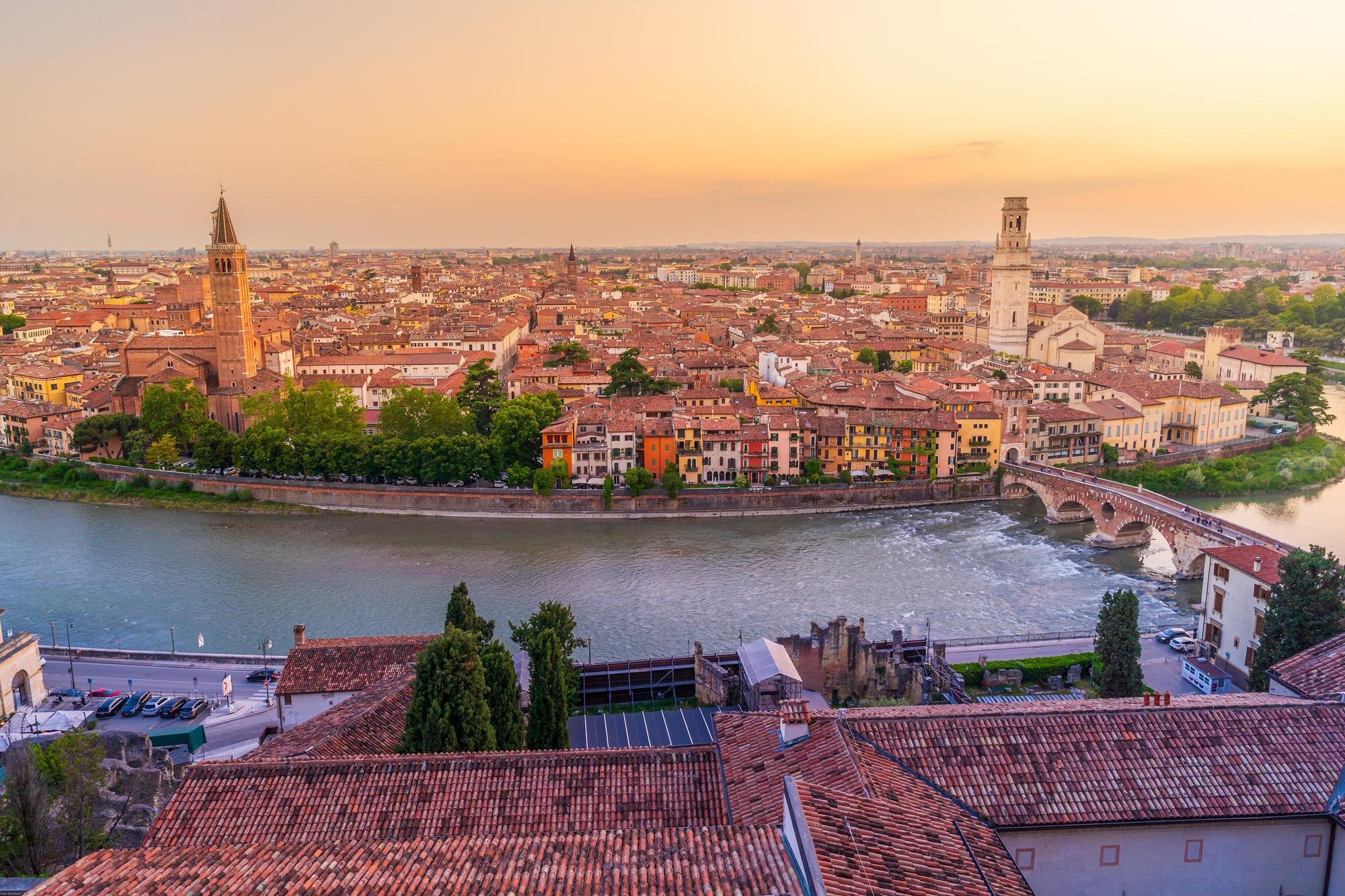

Where does Romeo and Juliet take place? Mostly in Verona, a city on the Adige River in northeastern Italy, with a single scene in Mantua, a smaller city to the south where Romeo goes into exile. There is no record that William Shakespeare ever saw either city. He wrote the play in the mid-1590s and built his Verona out of books, for a story his sources set roughly three centuries earlier.
That leaves three Veronas that readers tend to mix up. One is the city on Shakespeare's page. One is the real city that now sells tickets to it. The third is Verona Beach, the invented city in Baz Luhrmann's 1996 film.
What the Prologue Tells You
The Chorus names the place before anyone else speaks: "Two households, both alike in dignity, / In fair Verona, where we lay our scene." Those households are the Montagues and the Capulets. Most characters belong to one house or the other.
Within a hundred lines the feud is in the streets. Two Capulet servants, Sampson and Gregory, pick a fight by biting a thumb at the Montague men. Benvolio draws to part them, Tybalt draws to kill him, and townspeople pour in shouting "Clubs, bills, and partisans!"
Prince Escalus stops it. Three civil brawls "bred of an airy word," he says, have "thrice disturb'd the quiet of our streets." Whoever starts the next one will pay with his life.
That threat comes back to Romeo. After he kills Tybalt, the Prince spares his life and banishes him instead. In Friar Lawrence's cell, Romeo hears the sentence as worse than death: "There is no world without Verona walls, / But purgatory, torture, hell itself." The Friar tells him to leave before the watch is set or in disguise at daybreak. He leaves at dawn, after one night with Juliet.
Where the Scenes Happen Inside Verona
In the city's open spaces the feud is lethal. Act 3, Scene 1 begins with Benvolio warning that "The day is hot, the Capulets abroad." By the end of the scene Mercutio and Tybalt are dead in a public place.
The love story survives only indoors or out of sight. Romeo meets Juliet at the Capulet feast, inside her father's house. The scene people call the balcony scene is set in the Capulet orchard, with Juliet at a window above. Shakespeare's text never uses the word "balcony." Friar Lawrence's cell is the one neutral room in Verona. Both lovers go there for advice, and they marry there.
The last private room is underground. Juliet dreads the Capulet vault before she drinks the Friar's potion, picturing "bloody Tybalt, yet but green in earth," lying "festering in his shroud." Romeo forces the tomb open with a mattock and a wrenching iron. He kills Paris at its mouth and drinks his poison beside her. Juliet wakes, finds him dead, and stabs herself with his dagger.
Mantua and Romeo's Exile
Banishment sends Romeo to Mantua, a city in Lombardy about 25 miles south of Verona. Only Act 5, Scene 1 is set there. His servant Balthasar arrives with the false news that Juliet is dead, and Romeo buys poison from a poor apothecary.
The Friar's plan rests on two things. One is a potion that will hold Juliet in a deathlike sleep for "two and forty hours," or 42 hours. The other is a letter reaching Romeo before she wakes. The letter never leaves Verona: Friar John, the messenger, is shut inside a house suspected of plague. Balthasar's news gets to Mantua, and the Friar's explanation never does.
The failed message, not the distance itself, makes the exile fatal. In Act 5, Scene 2, Friar John explains that the authorities sealed the doors and prevented him from leaving. Romeo returns from Mantua believing Juliet is dead, without knowing that her apparent death is part of the Friar's plan.
A Fourteenth-Century Story in a 1590s Play
Mercutio's mockery of Tybalt reflects Elizabethan fencing fashions, not an exact date for the story. He calls him "the very butcher of a silk button," then parodies his moves: "the immortal passado! the punto reverso! the hai!" Those Italian fencing terms were fashionable in Elizabethan London, where Vincentio Saviolo published his fencing manual in 1595.
London shows through because Shakespeare wrote the play around 1595, and it was first printed in 1597. He worked mainly from Arthur Brooke's 1562 English poem The Tragicall Historye of Romeus and Juliet.
The older date comes from the Italian sources. Luigi da Porto published an early version around 1530 and set it under Bartolomeo della Scala, who ruled Verona in the early 1300s. Prince Escalus's name echoes that ruling family. Even earlier, Dante's Purgatorio VI names the Montecchi and Cappelletti. As Treccani explains, later storytellers interpreted them as rival Veronese families; Dante's pairing does not establish the lovers' family feud.
The play never states a year. The action unfolds over several days, apparently in mid-July: in Act 1, Scene 3, Lady Capulet says Lammastide is "a fortnight and odd days" away, and the Nurse says Juliet will turn fourteen on Lammas Eve, July 31.
Visiting Verona Today
The prologue's city is real. Verona lies in the Veneto region, and its historic center has been a UNESCO World Heritage Site since 2000. Its most famous Shakespeare site is a balcony the play never mentions.
Juliet's House (Casa di Giulietta) on Via Cappello is a medieval house linked to the Dal Cappello family. Their name sounds like Capulet, and that resemblance is the whole connection. According to Verona's municipal museum history, the stone balcony over the courtyard was added during the house's 1939–1940 restoration to help turn it into a setting for the literary legend. Below it is a bronze statue of Juliet, and visitors rub its right breast for luck.
Verona Beach in Luhrmann's Film
Baz Luhrmann's Romeo + Juliet (1996) keeps Shakespeare's dialogue and changes almost everything around it. Verona Beach is an invented modern city. The rival houses become armed gangs whose handguns carry brand names like "Sword," so the lines about drawing swords still fit. Prince Escalus becomes police Captain Prince.
Verona Beach combines Mexican filming locations with visual effects. The production shot mostly in Mexico City and around Veracruz on the Gulf coast. Hammerhead, the visual-effects company, created the skyline's towering Christ statue using a 24-inch fiberglass model, rather than a full-size landmark built in Mexico.
Key Takeaways
The prologue sets the play in "fair Verona," in northeastern Italy.
Mantua gets one scene, Act 5, Scene 1, and the tragedy turns on a letter that never reaches it.
The feud kills in Verona's streets, while the lovers meet in a house, an orchard, a cell and a tomb.
Juliet's balcony in Verona is a twentieth-century addition.
Verona Beach belongs to Luhrmann's film, not Shakespeare's text.
Frequently Asked Questions
Where is Romeo and Juliet set?
It is set mainly in Verona, Italy, which the prologue names in its second line. One scene takes place in Mantua, where Romeo lives in exile.
Does Verona still exist?
Yes, Verona is a living city in the Veneto region of northeastern Italy. Its historic center is a UNESCO World Heritage Site.
Is Juliet's balcony in Verona real?
The house is real. The balcony was added in 1939–1940. Shakespeare's text never mentions a balcony: Juliet speaks from a window above the Capulet orchard.
Does Shakespeare specify an exact year for the action?
No, the play never names a year. The fourteenth-century date comes from his Italian sources. The dialogue suggests several days in mid-July, shortly before Juliet's fourteenth birthday on Lammas Eve.
Is Verona Beach the same place as Verona in Italy?
No, Verona Beach is the fictional city in Luhrmann's 1996 film. It was shot largely in Mexico. Shakespeare's play is set in the real Verona.
Keep Verona and Verona Beach Separate
The confusion usually comes from mixing up sources. Shakespeare's setting is whatever his text names: Verona in the prologue's second line and Mantua for one scene. A year, a balcony or a beach comes from outside the play, as the sections above show. Inside the text, exile separates Romeo from Juliet, and quarantine prevents Friar John from delivering the letter explaining her apparent death.