
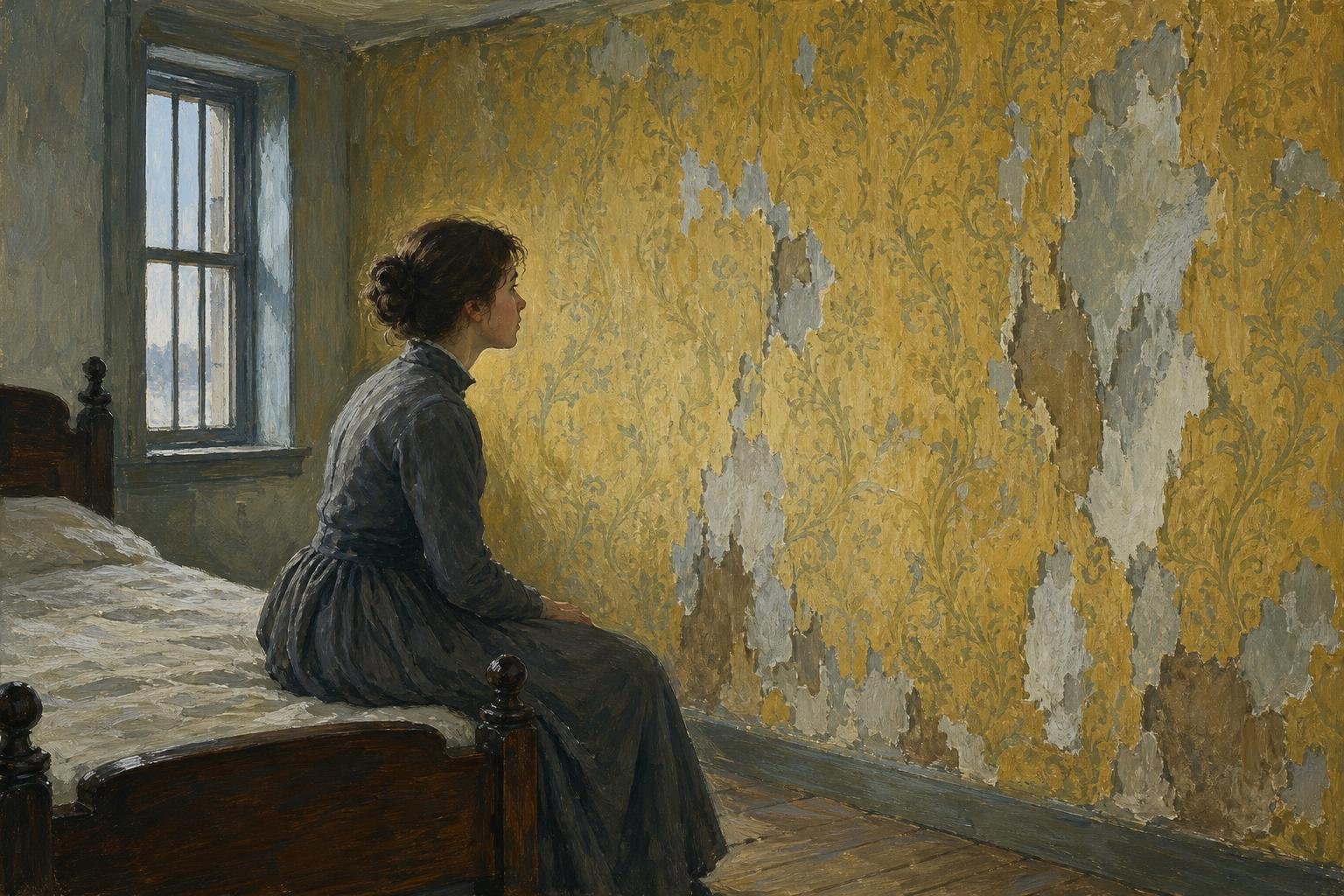

The Yellow Wallpaper by Charlotte Perkins Gilman is about a young mother whose husband, a physician, prescribes rest, forbids her work and writing, and insists they use an upstairs room she dislikes. Alone with the room's torn yellow paper, she comes to believe a woman is trapped behind its pattern. Through her secret journal you watch isolation break her down, until the final scene finds her creeping around the walls while her husband lies fainted on the floor.
This article covers the plot, the people in the house, why John bans her writing, what the journal form hides, the question of her name, what the wallpaper means, and how much of Gilman's own life went into the story. Every section comes back to one question: who in that house gets to decide what is real?
What Happens, From Arrival to the Final Scene
Arriving at the Colonial Mansion
The narrator and her husband, John, rent a large colonial estate for three summer months. She has recently had a baby. John diagnoses "temporary nervous depression—a slight hysterical tendency," and her brother, also a physician, agrees. The treatment is rest: tonics, air, no work, and no writing. She wants a downstairs room that opens onto the garden. John overrules her and installs them at the top of the house, in a room she takes for an old nursery. The windows are barred, there are rings in the walls, the bed is nailed to the floor, and the yellow paper has been stripped away in large patches.
The Pattern Takes Over
At first those torn patches only disgust her. She calls the color "repellant, almost revolting," and she hates how the lines wander and break off at strange angles. Over the weeks she tires easily, cries often, and hides her journal whenever John or his sister Jennie comes near. John warns that he may send her to Weir Mitchell in the fall. As she begins to see a woman behind the pattern, she asks John to take her away. He refuses. Later, the outer design becomes bars to her, with a woman behind them. She now wants to stay until she solves the pattern. She describes a smell that follows her through the house and a long worn streak, a "smooch," near the bottom of the wall.
The Last Day
During the final night upstairs, she tears off yards of wallpaper, believing she is helping the woman escape. The next day, before their planned departure, she locks the door and throws the key outside. She strips off more paper, as far as she can reach from the floor. By now she speaks as the woman who has escaped the wall. John retrieves the key and opens the door. She tells him, "I've got out at last," and he faints. The story ends with her creeping her usual path around the room and stepping over him on every circuit.
Who's Who in the House
The cast is small, and each person decides something about the narrator. Her name is uncertain; the final reference to Jane is ambiguous. She is educated, observant, and often funny, and her early entries argue with her husband's treatment even while she obeys it. Her sense of herself is the thing the story tracks most closely.
John decides almost everything else. He is affectionate in his words and calls her "blessed little goose," but he dismisses each request she makes. He laughs at her fears, chooses her room, and treats her description of her own symptoms as part of the illness. Because he is both her doctor and her husband, she cannot tell where his medical advice ends and his ordinary authority begins.
Jennie, John's sister, keeps the house and watches the narrator, who hides her writing from her because Jennie "thinks it is the writing which made me sick." Mary looks after the baby. The narrator appreciates her care but says being with the child makes her nervous. This shows her distress around motherhood without establishing that anyone deliberately excludes her from it. The brother appears only as a second medical voice confirming John's diagnosis. The woman in the paper finishes the cast, and by the end the narrator cannot be separated from her.
Why John Forbids Her to Write
John's reasoning follows the medicine of his day. Writing counts as intellectual effort, and the rest cure held that effort drained a woman's limited nervous energy. To John, keeping her away from the page is part of the prescription, in the same way the tonics are.
The narrator disagrees, and she says so only to the page: "Personally, I believe that congenial work, with excitement and change, would do me good." This is the deeper reason the ban matters. Writing is the one place where she can disagree with him. In speech she gives way, because he is her husband and a doctor, and "one expects that in marriage." On paper she can say that his treatment might be the reason she isn't getting better.
The ban also wears her out in a way John never sees. She has to write in secret, listen for footsteps, and pretend to rest. She admits that hiding the writing tires her more than the writing itself. So the prohibition produces the exhaustion it claims to prevent. Each entry becomes an act of defiance, and that gives the reader the story's first clue about how it will end.
What the Journal Lets You See and What It Hides
Because every entry is defiance, the whole story comes to you as first-person journal entries written in a voice that is losing its hold. You never get an outside view. You learn what John says only through her report. You cannot tell whether Jennie really has been studying the paper or whether the narrator only fears it. When she says the woman creeps through the garden by daylight, nothing on the page confirms or denies it.
That limit is deliberate. You read from inside the experience John refuses to take seriously, so you feel the gap between her perceptions and his verdicts from her side. The early entries are lucid and wry, and later ones grow fragmented, so the change in her prose becomes evidence too.
The form also leaves gaps. Entries break off when someone approaches, and days pass with nothing written. What happens between entries you have to infer. The final scene stretches the journal convention: how could she record these actions as they happen? That is a question about the form, not evidence that someone else takes over the narration.
Is the Narrator Named Jane?
The only clue sits in her last speech to John: "I've got out at last, in spite of you and Jane!" No character named Jane has appeared before this.
One reading makes Jane the narrator herself. If so, she now speaks as the woman from the wallpaper and talks about her former self, the obedient wife, as someone she has escaped. A second reading treats "Jane" as a slip or a misprint for Jennie, the sister-in-law who has watched her all summer. The text cannot settle it.
So you can't say for certain that her name is Jane: the narrator is not unambiguously named. That uncertainty fits a story in which her identity is repeatedly defined by others. Her diagnosis, room, and daily routine are chosen for her, while her own account is dismissed.
What the Wallpaper Stands For
The paper works on several levels at once, and that layering is what keeps Gilman's story open to argument. At the plainest level it is part of the room. Barred windows, rings in the walls, and a bed nailed down suggest a place built to hold someone, and the narrator lives inside it.
The pattern adds the social layer. A woman trapped behind bars and shaking them, visible only in certain light, matches the narrator's own position in her marriage and her household. Many readers also see the many creeping women she later imagines as a picture of women generally, held behind the patterns of respectable domestic life. The paper becomes the place where her private distress and that public arrangement meet.
The ending pulls the two together and refuses to resolve them. Tearing the paper is a revolt, and John fainting reverses their roles, since fainting was the stock reaction of the fragile wife. Yet the woman who "got out" is still crawling around the room. Freedom and breakdown happen in the same act. The ending is neither a straightforward triumph nor a defeat without resistance.
How Much of Gilman's Own Life Is in It
That double ending has roots in Gilman's life. In 1887, after a long depression that followed the birth of her daughter, Gilman went to S. Weir Mitchell, the Philadelphia neurologist best known for the rest cure. In her 1913 essay "Why I Wrote The Yellow Wallpaper," she recalled his parting orders: live as domestically as possible, limit intellectual activity to two hours a day, and never again use a pen, brush, or pencil. She wrote that following these orders brought her close to losing her mind, and that she recovered only after she went back to work.
She wrote the story a few years later. The New England Magazine published it in January 1892, under the name Charlotte Perkins Stetson. In the same 1913 essay she said she had sent Mitchell a copy, and that the story "was not intended to drive people crazy, but to save people from being driven crazy."
So the story is fiction built on lived experience. Gilman did not personally see a woman in the wallpaper. She invented that figure to show where the treatment she received could lead.
Key Takeaways
- The narrator's prescribed rest becomes isolation rather than recovery.
- John's medical authority reinforces his control as her husband.
- Secret journal entries reveal both resistance and changing perceptions.
- The wallpaper connects domestic confinement with the narrator's psychological distress.
- The ending combines resistance with collapse, not uncomplicated liberation.
Frequently Asked Questions
What Is the Main Idea of the Short Story "The Yellow Wallpaper"?
The story shows how denying a woman any say over her own mind and work can deepen the illness it claims to treat. The narrator's rest cure forbids writing and restricts her choices and the stimulating companionship she wants. John refuses to invite Cousin Henry and Julia while she is ill, although he encourages a week-long visit from her mother, Nellie, and the children. Her decline follows the loss of her voice as much as any original illness.
What Grade Level Is The Yellow Wallpaper?
It is usually taught in high school. The vocabulary is manageable, but the unreliable narration and the subject of mental distress suit older students. Some teachers prepare students for the ending before they assign it.
Is The Yellow Wallpaper a Horror Story?
It is often read as Gothic or psychological horror, with its old mansion, locked room, and figure in the wall. The fear comes from what is happening to the narrator's mind under confinement, and nothing supernatural is confirmed. Gilman's own stated aim, quoted in the section on her life, was to warn readers rather than frighten them.
How Does The Yellow Wallpaper End?
On the last day in the house, the narrator locks herself in and tears off the paper. She tells John she has escaped, and he faints. She keeps creeping around the room, stepping over his body, which is both a reversal of his control and the depth of her breakdown.
What Is a Famous Quote From The Yellow Wallpaper?
In her last speech to John, the narrator says: "I've got out at last, in spite of you and Jane!" Another often cited line is "John laughs at me, of course, but one expects that in marriage," which sums up the marriage in a single dry sentence.
What Mental Illness Did the Woman in The Yellow Wallpaper Have?
The story names only John's diagnosis of nervous depression with a hysterical tendency, terms from 1890s medicine. Because she has just had a baby, many modern readers see signs of postpartum depression that worsens into psychosis under isolation. The text never gives a definitive diagnosis, and that uncertainty is part of its point.
Confinement Behind the Wallpaper
When writing about the story, distinguish John's prescribed restrictions from the narrator's decision to lock the door near the end. Then trace how her attitude toward the wallpaper changes from disgust to fascination and identification. Those shifts provide evidence for an argument about confinement without reducing the ending to either liberation or defeat.