
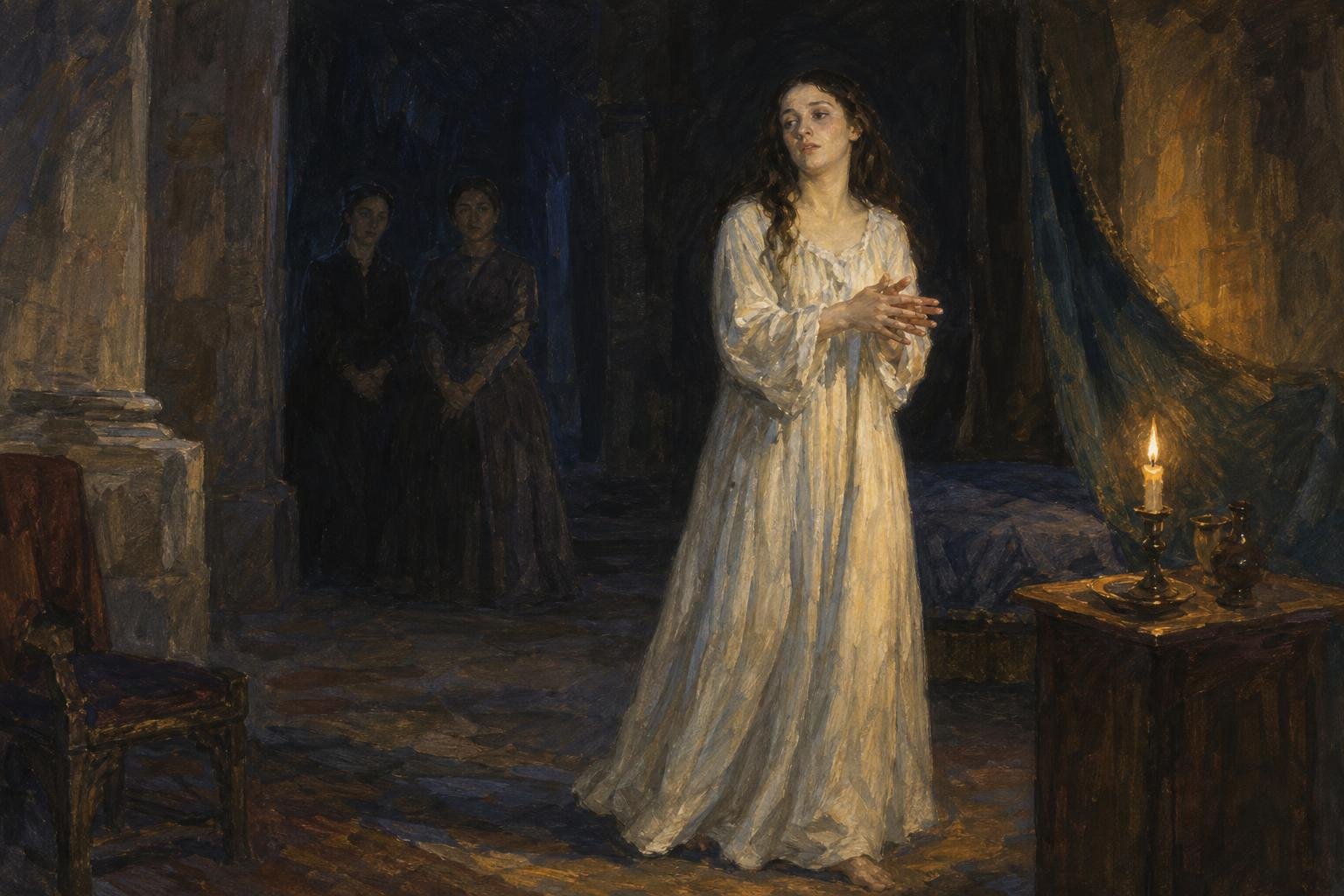

How does Lady Macbeth die? Shakespeare never shows it. She dies offstage: a cry of women goes up while Macbeth prepares for battle in Act 5, Scene 5, and Seyton tells him, "The queen, my lord, is dead." In the final scene Malcolm adds that she is thought to have killed herself, and the play never names a method.
What the play does give you is a trail of clues. There is the report itself, an accusation from her enemy, a sleepwalking scene full of blood and candlelight, and a decline that begins long before Act 5. Each section below follows one of these clues and asks what it shows about how her life ends.
Key Takeaways
- Lady Macbeth dies offstage; Seyton reports her death in Act 5, Scene 5.
- Malcolm's later account strongly suggests suicide but includes a qualification.
- Shakespeare specifies no method of death.
- Her sleepwalking and blood imagery support a reading centered on guilt.
- Her last spoken words occur before, not during, her death.
The Moment Her Death Is Reported
The report takes only a few lines. Macbeth is preparing for Malcolm's army in Act 5, Scene 5, when a cry sounds offstage. He asks what it was, and Seyton, his attendant, answers, "It is the cry of women, my good lord." Seyton leaves to find out more.
While he is gone, Macbeth says he has "almost forgot the taste of fears." He used to shudder at a shriek in the night. Now a scream inside his own castle barely touches him. Then Seyton comes back: "The queen, my lord, is dead."
The cry of women precedes the report, but the text does not identify the women or say who found her body. Seyton gives no cause. Macbeth asks for none.
He answers with the speech that begins, "She should have died hereafter; / There would have been a time for such a word." From there he moves to "To-morrow, and to-morrow, and to-morrow" and to life as "a tale / Told by an idiot, full of sound and fury, / Signifying nothing." His wife's death is the trigger for the bleakest lines he speaks.
Then a messenger runs in to say that Birnam Wood appears to be moving. Macbeth arms himself and goes out to fight, and the play does not mention her again until he is dead.
What Malcolm Says in the Final Scene
The only line in the play that names a possible cause comes after Macbeth's head has been brought onstage. In the closing speech (Act 5, Scene 8 in most modern editions), Malcolm reports that Lady Macbeth is thought to have killed herself: "this dead butcher and his fiend-like queen, / Who, as 'tis thought, by self and violent hands / Took off her life."
"By self and violent hands" means she killed herself, violently and by her own hand. Malcolm’s statement is the play’s only explicit report of suicide, qualified by "as 'tis thought"; the Doctor’s earlier warning to remove potential means of harm provides supporting context.
The words around it matter, though. "As 'tis thought" reports what people believe, not what Malcolm saw. And Malcolm is speaking as a winner. He has just defeated Macbeth, he is about to be crowned at Scone, and the same sentence labels the couple a butcher and a fiend. A new king gains a great deal from a story in which the old queen died by her own guilty hand. It closes the case on the previous reign with a verdict the dead woman seems to have passed on herself.
"Fiend-like" also sits oddly against what the audience has just watched. The last time anyone saw Lady Macbeth, she was not a fiend. She was a woman who walked in her sleep, could not stand the dark, and could not get her hands clean. Malcolm's epitaph fits the woman of Act 1. The audience saw a different woman in Act 5.
The Sleepwalking Scene and Her Last Words
Lady Macbeth's final appearance comes in Act 5, Scene 1, well before her death is reported. A Doctor and a Gentlewoman watch her walk in her sleep, carrying a light. The Gentlewoman explains that she keeps a light by her continually, on her own command. In Act 1 this same woman called on "thick night" to hide the murder. Now she cannot bear to be without a candle.
She rubs her hands as if washing them: "Out, damned spot! out, I say!" She replays the night of Duncan's murder: "Yet who would have thought the old man to have had so much blood in him?" Then she moves to crimes she had no part in: "The Thane of Fife had a wife: where is she now?" That is the murder of Macduff's wife and children, which Macbeth ordered without her. His guilt has become hers as well. Then: "Here's the smell of the blood still: all the perfumes of Arabia will not sweeten this little hand."
Her final speech in the play ends: "What's done cannot be undone. To bed, to bed, to bed!" She then exits, and the Doctor and Gentlewoman continue speaking. These are her last words supplied by the text, not words spoken in a death scene.
The Doctor sees where this is heading. He says she needs "the divine" more than "the physician," and he tells the Gentlewoman to "Remove from her the means of all annoyance, / And still keep eyes upon her." "Means of all annoyance" points to anything she could use to hurt herself. He is watching for the danger of self-harm; in the final scene, Malcolm reports that Lady Macbeth is thought to have killed herself.
Signs of Decline Before Act 5
The sleepwalking scene works so well because nearly every line in it answers something she said earlier.
In Act 2, Scene 2, just after the murder, she tells her husband, "A little water clears us of this deed." In Act 5, Scene 1, she scrubs at a spot no water removes. In Act 1, Scene 5, she asked to be filled "from the crown to the toe top-full / Of direst cruelty." By the end she cannot stop reliving the cruelty she asked for.
The cracks show well before Act 5. In Act 3, Scene 2, soon after becoming queen, her first words alone are bleak: "Nought's had, all's spent, / Where our desire is got without content." She has the crown and gets no pleasure from it. Macbeth's secrecy also begins before the banquet: in this scene he hints at a coming deed but withholds his plan to murder Banquo. At the banquet in Act 3, Scene 4, she still takes charge, covering for Macbeth when he sees Banquo's ghost and sending the guests away before he says too much. That is her last act of control. She does not appear again until she is sleepwalking.
In Act 5, Scene 3, Macbeth asks the Doctor about her. The Doctor says she is "troubled with thick-coming fancies, / That keep her from her rest." Macbeth asks whether he can "minister to a mind diseased" and "Raze out the written troubles of the brain." The Doctor's answer shuts the door: "Therein the patient / Must minister to himself."
Why Shakespeare Keeps Her Death Offstage
Shakespeare leaves no note explaining the choice, but the shape of Act 5 points to some reasons.
By the last act, the play has narrowed to Macbeth and the army closing in on Dunsinane. A full death scene for Lady Macbeth would pull focus from the battle and from his final collapse. Placing the news in the middle of his preparations puts the weight on how he takes it, and the "To-morrow" speech is the result. Her death matters in the play mainly through what it does to him.
The offstage death also completes her arc. She drives the early acts, plotting, goading and taking charge. After the banquet she fades, and by Act 5 she exists mostly in other people's talk: the Doctor's diagnosis, the Gentlewoman's report, Seyton's single line, Malcolm's epitaph. A woman who once ran the action ends up as something reported by servants and enemies.
Leaving the moment unstaged also leaves her final state of mind open. The text already calls for an offstage cry of women before Seyton reports her death; that sound is not a director's invention. A director may choose to show her body or depict her death, but those choices go beyond the text. Shakespeare supplies the cry and the report, not a staged death scene.
Common Claims the Text Does Not Support
The play names no method. Versions in which she jumps from the battlements, takes poison or uses a knife come from productions, films and retellings. "Violent hands" suggests force and nothing more specific.
The precise timing is also unspecified. Her death is reported during Macbeth's preparations for battle, but the play does not establish exactly when she died or whether she was alone. The cry of women does not identify the Gentlewoman or confirm that anyone was keeping watch. The Doctor's earlier instruction establishes concern for her safety, not the circumstances of her death.
A third claim is that Macbeth clearly does not care. "She should have died hereafter" leads into a bleak speech about time and meaning, but it does not settle his feelings toward his wife. You can hear grief, numbness or apparent indifference in it. Her death prompts the speech; whether his response reveals sorrow or emotional exhaustion remains open to interpretation.
Frequently Asked Questions
What happened to Lady Macbeth before she died?
She fell into a decline marked by sleeplessness and guilt-ridden sleepwalking. After the banquet in Act 3, Scene 4, she drops out of the action and next appears in Act 5, Scene 1, washing imagined blood from her hands while a Doctor and a Gentlewoman watch. The Doctor tells Macbeth she suffers from "thick-coming fancies" that keep her from rest.
What does Lady Macbeth say before she dies?
Her final speech ends with "What's done cannot be undone. To bed, to bed, to bed!" in the sleepwalking scene. She then exits, leaving the Doctor and Gentlewoman onstage. The play supplies no words spoken at the moment of her offstage death.
Did Lady Macbeth regret her role in Duncan's murder?
Macbeth kills Duncan; Lady Macbeth helps plan and conceal the murder. In Act 2, Scene 2, Macbeth says, "I have done the deed," while she explains that Duncan's resemblance to her father stopped her from killing him herself. She never directly expresses regret for her role, but the sleepwalking scene shows her tormented by the murder. She relives that night, is horrified by how much blood Duncan had, and cannot clean her hands. The lines read most naturally as guilt she could not live with.
Does Lady Macbeth kill herself?
Most likely yes, according to Malcolm, who says she took her own life "by self and violent hands." His qualification, "as 'tis thought," presents suicide as a reported belief rather than an unqualified fact. He does not identify his source or establish whether anyone witnessed her death.
Who tells Macbeth that his wife has died?
Seyton, his attendant, tells him in Act 5, Scene 5. His line is "The queen, my lord, is dead," and he gives no cause or details.
Does Lady Macbeth leave a suicide note in the play?
No, the text mentions no note, letter or message connected to her death. In the sleepwalking scene the Gentlewoman says she has seen her rise in her sleep, take out paper, write on it, read it and seal it. The play never says what she wrote or links it to how she dies.
What the Text Lets Us Conclude
Her decline supports a guilt-centered reading: the woman who said "A little water clears us of this deed" ends up scrubbing a spot that will not come out, and her final speech admits that what is done cannot be undone. Those scenes suggest a connection between her guilt and her reported suicide, but they do not establish her exact final motives.