
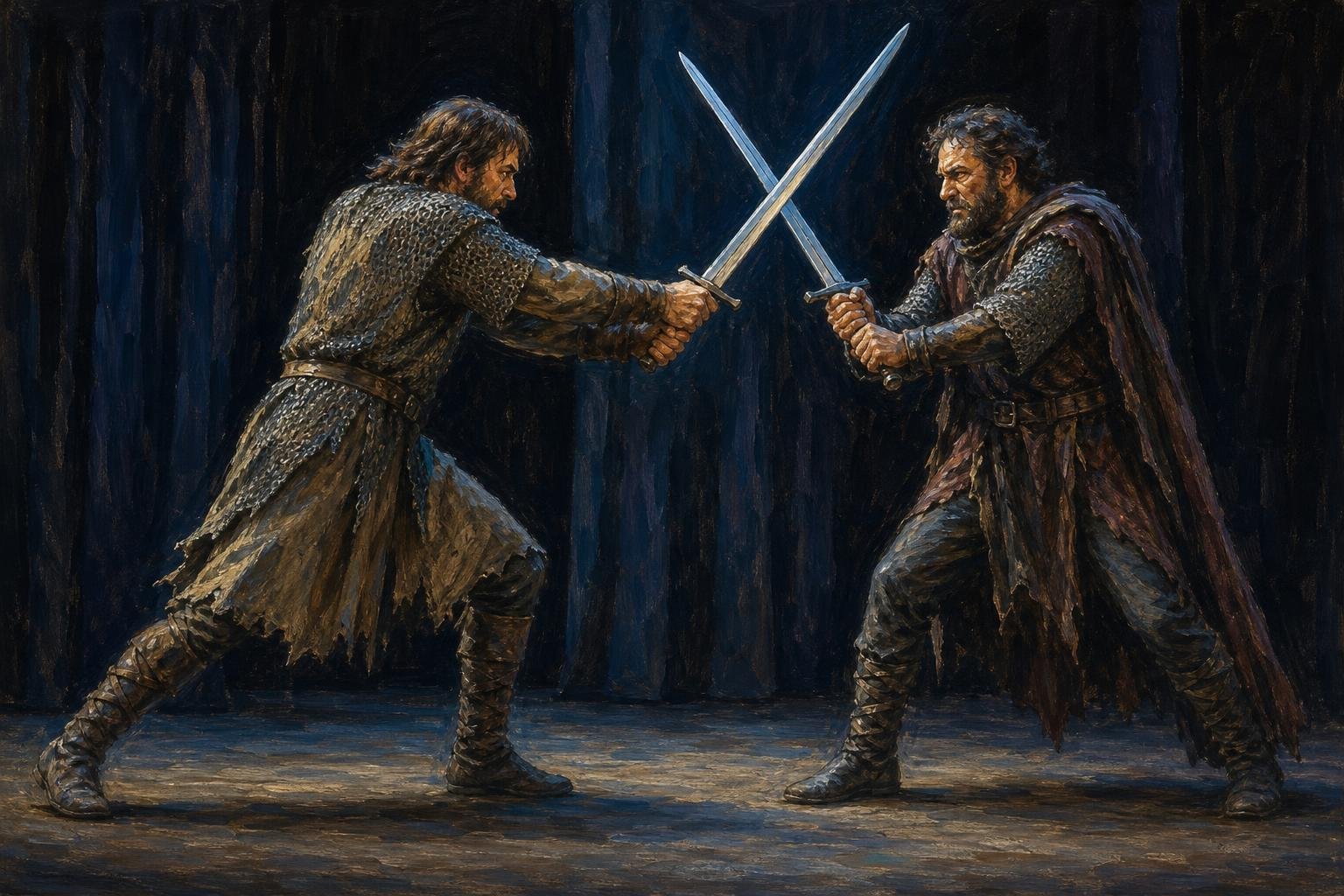

Who kills Macbeth? Macduff does, in the final battle of Act 5, after Macbeth learns that the witches' promise of safety does not protect him against Macduff. The two men leave the stage fighting, and Macduff later returns carrying Macbeth's head.
Where the Final Fight Takes Place
The battle is at Dunsinane; in the Folger edition, the battlefield action spans Act 5, Scenes 7–8, with Macbeth's final duel in 5.8. Malcolm's army has already advanced behind branches cut from Birnam Wood, and Macbeth's castle has given up without much of a fight. Macbeth is trapped. He fights on anyway.
Earlier, in 5.7, Macbeth meets young Siward, son of the English general Siward, and kills him. Then he sneers that swords are harmless when held by any "man that's of a woman born." It is the brag of a man who still thinks he cannot die.
Elsewhere on the field, Macduff is after one man only. He refuses to waste his sword on "wretched kerns, whose arms / Are hired to bear their staves." "Tyrant, show thy face!" he shouts. If anyone else gets to Macbeth first, "My wife and children's ghosts will haunt me still."
Why Macduff Wants Macbeth Dead
Those ghosts come from Act 4. In 4.1 an apparition warns Macbeth to "beware Macduff." When Macbeth then learns that Macduff has fled to England, he sends murderers to Macduff's castle. In 4.2 they kill Lady Macduff's son onstage. Lady Macduff flees, pursued by the murderers, and is killed offstage. Ross later reports the full toll: "Wife, children, servants, all / That could be found."
The news reaches Macduff in 4.3, and at first he can barely take it in. "All my pretty ones? / Did you say all?" Malcolm urges him to "dispute it like a man." Macduff answers, "I shall do so; / But I must also feel it as a man."
He feels it, and then the grief hardens. "Front to front / Bring thou this fiend of Scotland and myself," he says. "Within my sword's length set him; if he scape, / Heaven forgive him too!" Of all the thanes who defect, it is Macduff Macbeth fears most. Now Macduff has said what he will do when he finds him.
The Witches' Promise and Macduff's Birth
Macbeth's confidence comes from the same visit to the Weird Sisters in 4.1. A bloody child tells him that "none of woman born / Shall harm Macbeth." He takes it to mean that no soldier alive can kill him.
So when the two men finally meet in 5.8, Macbeth tries to warn Macduff off. "I bear a charmed life, which must not yield / To one of woman born."
Macduff tells him to give up on the charm. Then he says it:
"Macduff was from his mother's womb / Untimely ripped."
He means that he was cut from his mother's womb, a Caesarean birth, rather than delivered vaginally. In the prophecy's wordplay, this makes him the exception to the protection Macbeth thought "woman born" guaranteed.
Macbeth's Last Choice
Macbeth understands at once. "Accursed be that tongue that tells me so," he says, and he turns on the witches: "And be these juggling fiends no more believed, / That palter with us in a double sense." Then comes the line nobody expects from him. "I'll not fight with thee."
Macduff offers him something worse than death: "Then yield thee, coward, / And live to be the show and gaze o' th' time." If he surrendered, Macbeth would be exhibited as a public spectacle, with his likeness displayed on a pole.
That threat turns him around. "I will not yield, / To kiss the ground before young Malcolm's feet." Birnam Wood has come to Dunsinane, and the man facing him is "of no woman born." He will "try the last" anyway.
"Lay on, Macduff, / And damned be him that first cries 'Hold, enough!'"
What the Stage Directions Show
That battle cry is Macbeth's last line. The stage directions take over from there, and they give very little away.
In the 1623 First Folio, the men exit fighting. A further direction then has them re-enter fighting, with Macbeth slain. That is why some productions show his death onstage and others keep it out of sight. Neither version names a blow or describes a wound. The next firm evidence is the direction "Enter Macduff, with Macbeth's head."
Young Siward's death gets more attention. His father asks, "Had he his hurts before?" He is satisfied when Ross answers, "Ay, on the front." Nobody inspects the tyrant's wounds.
Why Malcolm, Not Macduff, Takes the Crown
Macduff holds up the head. "Behold where stands / Th' usurper's cursed head. The time is free." He ends the speech with "Hail, King of Scotland!" He says it to Malcolm.
The order matters. Malcolm is the eldest son of the same King Duncan Macbeth stabbed in his sleep in Act 2, and Duncan named him Prince of Cumberland, his heir, in 1.4. The murder that made Macbeth king of Scotland is undone by putting the broken line back on the throne.
Malcolm rewards his thanes by making them earls, "the first that ever Scotland / In such an honor named." For the man who held the crown before him he has one phrase, and he gives Lady Macbeth one too: "this dead butcher and his fiend-like queen."
Key Takeaways
- Macduff kills Macbeth in their final confrontation in Act 5, Scene 8.
- Macbeth's murder of Macduff's family makes the fight personal.
- Macduff's unusual birth exposes the loophole in the witches' assurance.
- Macduff returns with Macbeth's head, and the text never describes the fatal wound.
- Malcolm becomes king of Scotland, and Macduff is the one who hails him.
Frequently Asked Questions
What happens in Act 5 Scene 8 of Macbeth?
Macduff finds Macbeth and reveals that he was "untimely ripped" from his mother's womb. Macbeth refuses to surrender, and the two fight. Macduff then returns with Macbeth's head and hails Malcolm as king.
What were Macbeth's final words?
His last spoken line is "Lay on, Macduff, / And damned be him that first cries 'Hold, enough!'" He has no dying speech. The stage directions carry him from that challenge to his death.
Who becomes king after Macbeth?
Malcolm, Duncan's eldest son and named heir, becomes king. In the play's final speech he invites everyone to see him crowned at Scone.
Who is the real hero in Macbeth?
It depends on what "hero" means. Macduff can be read as an avenging hero who helps free Scotland from tyranny. Macbeth is the tragic protagonist: the central character whose ambition leads to his downfall. These are different roles, not a ranking of who suffers most.
Who killed Macbeth in the play?
Macduff, the Thane of Fife, killed him. He is the one man the witches' prophecy did not protect Macbeth against, and he kills him at Dunsinane.
How did Macbeth die?
He died fighting Macduff after refusing to yield. The text never describes the fatal wound. A stage direction has the men re-enter fighting and Macbeth slain, before Macduff enters with Macbeth's head.
Macduff Ends Macbeth's Reign
Macduff's opposition to Macbeth begins before he learns of his family's murder: in Act 4, Scene 3, he is already urging Malcolm to defend Scotland. Personal revenge joins that political purpose. The apparitions do name Macduff, warning Macbeth to beware him; what Macbeth misunderstands is the assurance about being "of woman born." Macduff's victory therefore brings together the play's public struggle against tyranny and his private grief.